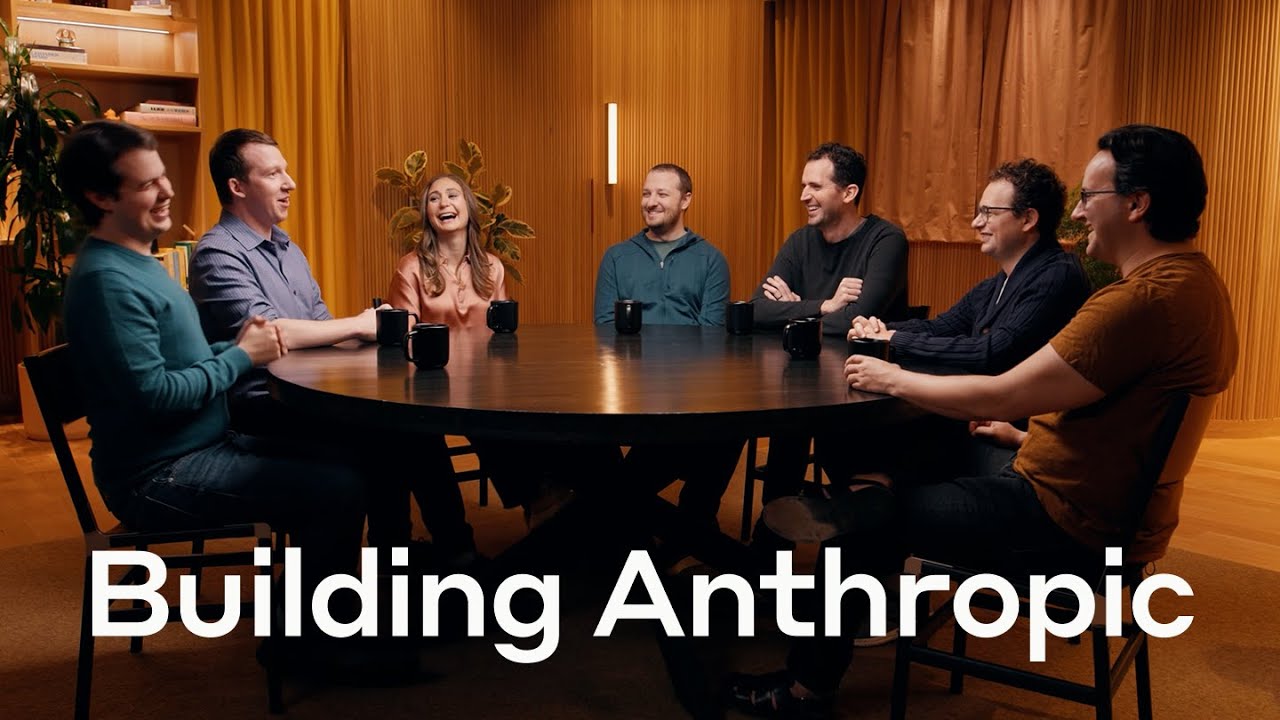
📺 Today’s recommended deep-dive video: https://www.youtube.com/watch?v=om2lIWXLLN4
The Physics of Scaling: Inside Anthropic’s Quest for Safe Intelligence
How did a group of physicists and researchers decide to walk away from the biggest labs to build a “strange, safety-oriented thing”? This conversation reveals the philosophical and technical origin story of Anthropic and their mission to make AI both powerful and predictable.
Core Question: Can high-speed AI scaling be successfully governed by a culture of radical transparency and scientific pragmatism?
Highlights
- The shift from “Concrete Problems in AI Safety” to a world where simple instructions guide complex models.
- Why the Responsible Scaling Policy (RSP) is treated as a “holy document” similar to the U.S. Constitution.
- The “Race to the Top” theory: making safety a competitive market advantage rather than a burden.
- Future visions of “AI Biology” and how interpretability research might unlock secrets of the human brain.
⏱️ Reading time: approx. 8 minutes · Saves you about 44 minutes vs. watching.
Want to take notes while watching? Click the image below and let AI Notebook capture the key points for you 👇

The Scaling Hypothesis and the Duty to Build
From Physics to Neural Networks
Long before the general public was captivated by chatbots, the founders of Anthropic were already mapping the limits of neural networks. Their journey began in the research corridors of Google and OpenAI, driven by a shared realization: scale changes everything.
They witnessed models eerily succeeding at task after task, turning the “scaling hypothesis” from a fringe theory into an undeniable reality.
This shift from small-scale experimentation to massive compute clusters created a new kind of technical tension. They realized that the smarter a model became, the more crucial it was to bake safety into its architecture rather than treating it as an afterthought. This led to the development of RLHF (Reinforcement Learning from Human Feedback), which required powerful models just to function effectively, intertwining safety and scale forever.

💡 Digging Deeper
Q: Why did so many physicists transition into AI?
A: Many felt that academic physics had become risk-averse, while AI offered a “steep trajectory” for impact and the chance to apply grand, ambitious schemes to a new frontier of science.
Q: What was the “Concrete Problems in AI Safety” paper?
A: It was a consensus-building exercise intended to ground abstract AI safety concerns in the machine learning literature of the time, making the field more “legible” to mainstream researchers.
Q: How did the team view the risk of “AI Winter”?
A: Researchers were historically “psychologically damaged” by past failures, leading to a prohibition against being ambitious. The Anthropic team intentionally broke this by betting on conviction.
The Responsible Scaling Policy (RSP)
A Constitution for Artificial Intelligence
To the Anthropic team, the Responsible Scaling Policy (RSP) serves as more than just a corporate document; it is their functional “Constitution.” It establishes specific thresholds for model capabilities that, once crossed, trigger mandatory safety and security upgrades. This prevents the organization from flying blind into high-risk territory, ensuring that every leap in intelligence is met with a corresponding leap in protective infrastructure.
It turns the abstract, often “abstruse” concept of AI safety into a series of clear, measurable engineering requirements.
By making safety a core product requirement, the RSP forces internal unity. It prevents the common corporate dysfunction where a research team builds a dangerous tool while a separate safety team desperately tries to fix it later. Instead, if a model fails a safety evaluation (eval), development or deployment pauses until the issue is resolved. This “boring and normal” approach—treating safety like a financial audit—is exactly the goal for making AI governance sustainable.

💡 Digging Deeper
Q: How does the RSP affect external communication?
A: It provides a common language for regulators and skeptics, allowing Anthropic to explain that they only implement “extreme” safety measures when models reach “intense” capability levels.
Q: Why is the “tone” of the RSP important?
A: Leadership recently rewrote the document to be less technocratic and more accessible, ensuring that every employee—regardless of their role—can understand and follow its principles.
Q: Does the RSP stifle innovation?
A: The team argues the opposite; by defining the “guardrails” clearly, researchers are actually freer to push the technology to its limits within those known safe boundaries.
Culture, Trust, and the “Race to the Top”
The Competitive Advantage of Safety
Building an AI lab isn’t just about compute; it’s about the social fabric of the team. Anthropic prides itself on a “low-ego, low-politics” culture where different departments—from policy to inference—operate under a single, unified theory of change.
This internal trust allows for extreme pragmatism when dealing with external pressures and market forces.
The founders didn’t necessarily want to start a company, but they viewed it as a duty to show the industry that safety and competitiveness are not mutually exclusive. By proving that a safe model like Claude can dominate the market, they exert a gravitational pull on competitors, effectively forcing a “race to the top” where safety becomes the industry standard. This is a bet that markets are pragmatic: if safety makes a product more reliable for customers, competitors will eventually “copy the seatbelts.”
💡 Digging Deeper
Q: What was the “80% pledge”?
A: A commitment by the founders to dedicate their equity and efforts to the public good, reinforcing the “duty” they feel toward the mission.
Q: How does the team maintain “unity”?
A: By ensuring that the product and research teams are all looking at the same safety trade-offs, rather than having the leadership make decisions in a vacuum.
Q: Why do customers choose Claude?
A: Customer feedback frequently highlights Claude’s reliability and lower hallucination rates, proving that safety “dividends” are a core reason for its market success.
The Future: AI Biology and Democracy
Cracking the Black Box
Looking ahead, the team sees AI not just as a tool for text, but as a lens for understanding the fundamental nature of intelligence and life. Chris Olah’s work on interpretability aims to crack open the “black box” of neural networks, treating them with the rigor of biological study.
This “artificial biology” could have massive implications for medicine, potentially providing new frameworks for understanding complex mental illnesses that have long baffled human neuroscientists.
Beyond the lab, they envision AI enhancing democratic processes and accelerating scientific breakthroughs like vaccine development. The goal is to move past the era of “crying wolf” about risks and into a period of empirical, scientific discovery where AI serves as a catalyst for human flourishing. They aren’t doomers; they are builders who believe that with enough work, the hardest problems in safety and science are solvable.
💡 Digging Deeper
Q: Is AI a good analogy for the human brain?
A: While not perfect, neural nets are easier to “open up” and interact with than “mushy” human brains, offering a unique sandbox for studying intelligence.
Q: What is the team most excited about in the short term?
A: The “phase difference” in coding capabilities; 95% of some developer audiences now use Claude for coding, a massive jump from just months ago.
Q: What role does the government play?
A: The founders are encouraged by the creation of new “AI Embassies” (safety institutes) in government, providing the state capacity needed for a safe societal transition.
Key Takeaways
Anthropic’s strategy is built on the belief that scaling and safety are not opposing forces, but two sides of the same coin. By treating safety as a rigorous engineering challenge and a market differentiator, they hope to set a standard that the rest of the industry is forced to follow.
The organization functions as a “pragmatic experiment” in institutional design. From their Responsible Scaling Policy to their “low-ego” culture, every element is designed to ensure that the creators of the world’s most powerful models remain grounded in scientific reality and public duty.
The ultimate goal is to prove that a race to the top is possible. If a company can lead the industry in capabilities while maintaining the highest safety standards, it creates a gravitational pull that makes the entire world safer.
Q&A
Q1: Why did you choose to start a company instead of a nonprofit?
A: Pragmatism. To have a real impact on the industry and the “gravitational pull” required to change AI safety standards, you need the capital and competitiveness that only a company can sustain.
Q2: What is “Constitutional AI”?
A: It is a method where a model is given a written set of principles (a constitution) and then uses those principles to self-critique and revise its own behavior, making it more helpful and harmless without manual labeling.
Q3: How do you handle “gray areas” in AI safety?
A: Through constant iteration. You cannot predict every problem, so you “implement everything” early to see what goes wrong, allowing for three or four passes at a policy before the stakes become truly high.
Q4: Is the team worried about being “doomers”?
A: No. They identify as builders who want to create positive outcomes. They believe that identifying risks is a necessary step to solving them, not a reason to stop progress.
Q5: What is “AI Biology”?
A: It is the study of the internal structures and “neurons” of artificial models. Just as biologists study cells, interpretability researchers study how AI models organize information internally.
Q6: Why is interpretability important for safety?
A: It allows researchers to move from “treating the symptoms” (how a model answers) to “treating the cause” (understanding why the model is thinking a certain way), which is essential for steering very advanced systems.
Q7: How does the team avoid internal politics?
A: By hiring for mission alignment and low ego. The team emphasizes that everyone, from policy experts to software engineers, is working under a single, unified “theory of change.”