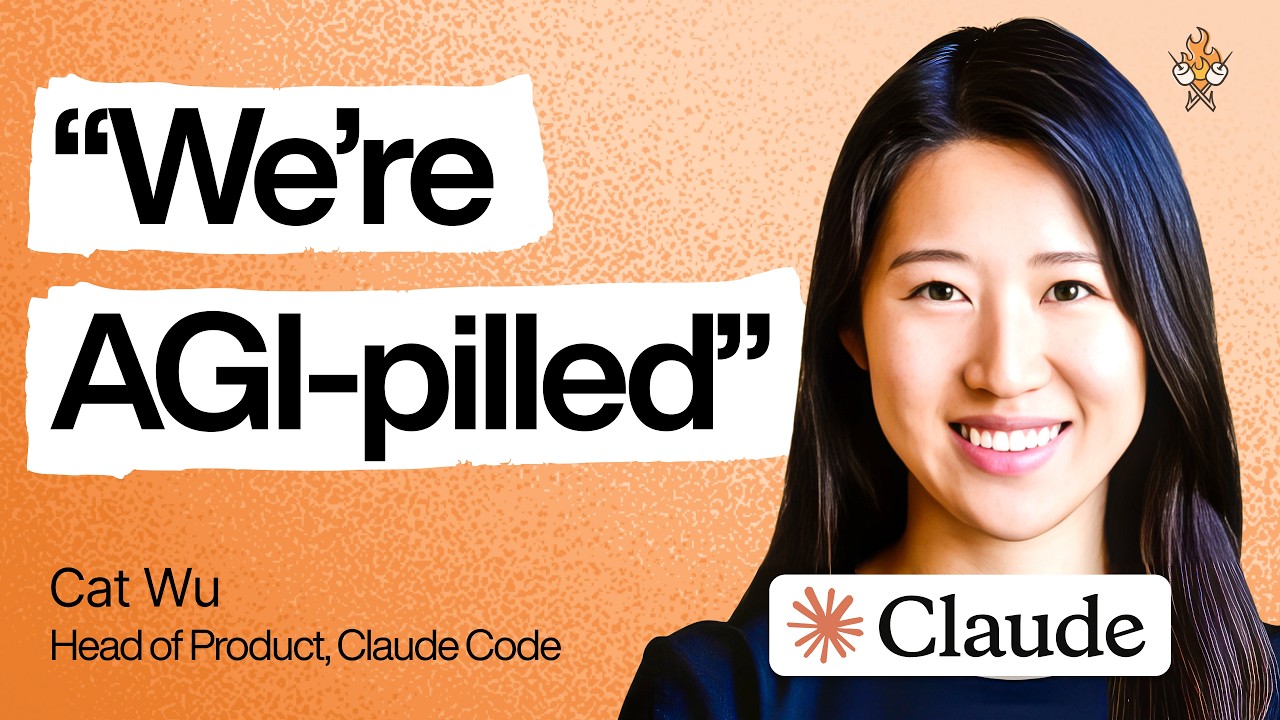
📺 Today’s recommended deep-dive video: https://www.youtube.com/watch?v=PplmzlgE0kg
The New Velocity: How Anthropic Reinvents Product Management for the AGI Era
In a world where model capabilities shift weekly, traditional product management roadmaps are obsolete. Kat Wu, Head of Product for Claude Coding at Anthropic, reveals the internal mechanics of a team shipping at light speed and explains why “product taste” has become the ultimate differentiator.
Core Question: How does the role of the Product Manager evolve when code becomes cheap, shipping cycles shrink from months to days, and models begin to eat their own harnesses?
Highlights
- The transition from a 6-month roadmap to a 1-day shipping cycle via “Research Previews.”
- Why “product taste” is now more valuable than technical coordination or infrastructure knowledge.
- The strategic blurring of roles where engineers, designers, and PMs operate with total agency.
- How Anthropic uses its own frontier models to automate the tedious parts of the PM workflow.
⏱️ Reading time: approx. 7 minutes · Saves you about 79 minutes vs. watching.
Want to take notes while watching? Click the image below and let AI Notebook capture the key points for you 👇

The Collapse of the Roadmap
Shipping at the Speed of Thought
In the high-stakes environment of frontier AI development, speed isn’t just a metric; it is the entire strategy for survival.
Traditional technology shifts occurred slowly enough to allow for 12-month planning cycles and heavy cross-functional coordination. However, with AI accelerating engineering, the time required to move from a concept to a live feature has collapsed from months to a single week, or sometimes, a single day. At Anthropic, this is achieved by removing every possible barrier to shipping, prioritizing immediate user feedback over long-term polished certainty.
To sustain this pace, the team utilizes an “Evergreen Launch Room” where engineers post dogfooded features for immediate review by marketing and documentation leads. This tight loop allows the company to bypass the friction of quarterly planning, ensuring that if an idea is viable on Monday, it is in the hands of users by Friday.

💡 Digging Deeper
Q: How do you handle the risk of shipping buggy features at such a high speed?
A: We embrace “Research Previews” to signal to users that a feature is experimental. This lowers the commitment and allows us to iterate based on real-world usage rather than guessing in a vacuum.
Q: What has happened to the traditional PRD (Product Requirement Document)?
A: They still exist for massive infrastructure projects, but for most features, we’ve replaced them with team principles and clear metrics readouts so everyone can make independent decisions.
The Rise of “Product Taste”
Why Choice is More Expensive Than Code
As LLMs make the act of writing code significantly cheaper, the scarcity shifts from production to direction.
The most valuable skill for a modern PM is no longer managing a JIRA board, but rather possessing the “taste” to decide what is actually worth building. When a team receives thousands of GitHub issues, a PM must have the conviction to filter the noise and identify the “golden path” for the user. This requires a deep, intuitive understanding of how to elicit maximum capability from a current model while patching its known weaknesses.
Because the roles of PM, Engineer, and Designer are merging, Anthropic prioritizes hiring engineers with great product taste. This creates a high-leverage environment where an individual can identify a problem on Twitter in the morning and have a fix merged by the evening without waiting for a PM’s permission.

💡 Digging Deeper
Q: Does an AI PM still need a technical engineering background?
A: It is helpful for understanding the “difficulty” of a task, which aids prioritization, but “taste”—the ability to define a delightful UX—is the more durable skill.
Q: How do you define “Product Taste” in an AI context?
A: It’s the ability to sense where users are abusing the limits of a product and figuring out how to guide them toward the model’s strengths while avoiding its hallucinations.
The Agentic Workflow
From Chatting to Doing
The shift from 2024 to 2025 marks the transition from chat-based assistants to action-oriented agents.
Claude Code and Co-work represent a new paradigm where the model doesn’t just suggest a solution but executes it. For a PM, this means moving away from “prompt engineering” toward building “harnesses”—structures that help the model verify its own work and manage complex, multi-step tasks. Interestingly, as models get smarter, they begin to “eat” these harnesses, requiring fewer prompting crutches to achieve the same result.
The long-term vision involves a transition from local execution to massive, remote multi-agent systems. Instead of running one task, an engineer might eventually manage 50 or 100 “Claudes” simultaneously, necessitating new interfaces for human oversight and verification.

💡 Digging Deeper
Q: What is the biggest “aha” moment for new users of these tools?
A: It is when they realize the agent can actually perform the action—like filling out a form or refactoring a codebase—rather than just talking about it.
Q: How should PMs use AI to increase their own leverage?
A: Connect your communication tools (Slack, Gmail) to a tool like Co-work to automate dossier creation and deck building, freeing up 20% of your time for “pet projects.”
Key Takeaways
The role of the human in the AGI era is shifting toward being a high-level curator and decision-maker. While AI can synthesize massive amounts of data and generate hundreds of slides, the human PM provides the “common sense” and emotional intelligence required to manage stakeholders and define the final narrative. Success in this environment requires a “bias towards action” and the willingness to lean into chaos rather than resisting it.
Ultimately, the best way to survive the AI transition is to become an active builder. By automating the repetitive, tedious parts of your own job to 100% accuracy, you gain the bandwidth to tackle the ambitious, “hairy” problems that AI isn’t yet ready to solve. At Anthropic, the motto is simple: just do things. Don’t wait for permission to operate across team boundaries; if you see a gap, fill it.
Q&A
Q1: How does Anthropic stay focused despite the massive pressure to compete?
A1: We have a unifying mission of bringing safe AGI to humanity. We are willing to sacrifice individual product goals or KRs if they don’t serve the broader Anthropic mission, which makes decision-making much faster.
Q2: What happened when the Claude Code source code leaked?
A2: It was a result of human error during a PR process involving two layers of review. We treated it as a process failure rather than an individual one and have since hardened our safeguards.
Q3: Why did Anthropic restrict “Open Claude” subscriptions for third-party use?
A3: We saw massive demand and needed to prioritize our first-party products and API infrastructure. We want to ensure our first-party products are sustainable and profitable rather than just subsidizing unlimited compute for others.
Q4: How do you use “Evals” in your daily work?
A4: Evals are the future of PM work. I build small sets of “golden” evals—even just 10—to quantify success and identify where a prompt or harness needs to be adjusted to fix specific failure modes.
Q5: What is the “to-do list” feature in Claude Code and why is it changing?
A5: It was originally a “crutch” to help earlier models remember to finish complex refactors. As models like Sonnet 3.5 and Opus 4 arrived, they naturally started finishing tasks without needing the list, allowing us to de-emphasize the feature.
Q6: What is your advice for someone feeling overwhelmed by the pace of AI?
A6: Lean into the tools. Find the repetitive, manual tasks you hate—like summarizing customer meetings or building decks—and put in the “elbow grease” to automate them to 100% success. That last 5% of accuracy is where the true leverage lies.
Q7: How do you maintain energy in such a high-intensity environment?
A7: We look for people who “lean into the chaos” and can face challenges with a smile. It’s about being “AGI-pilled” enough to see the future, but grounded enough to solve today’s model limitations.