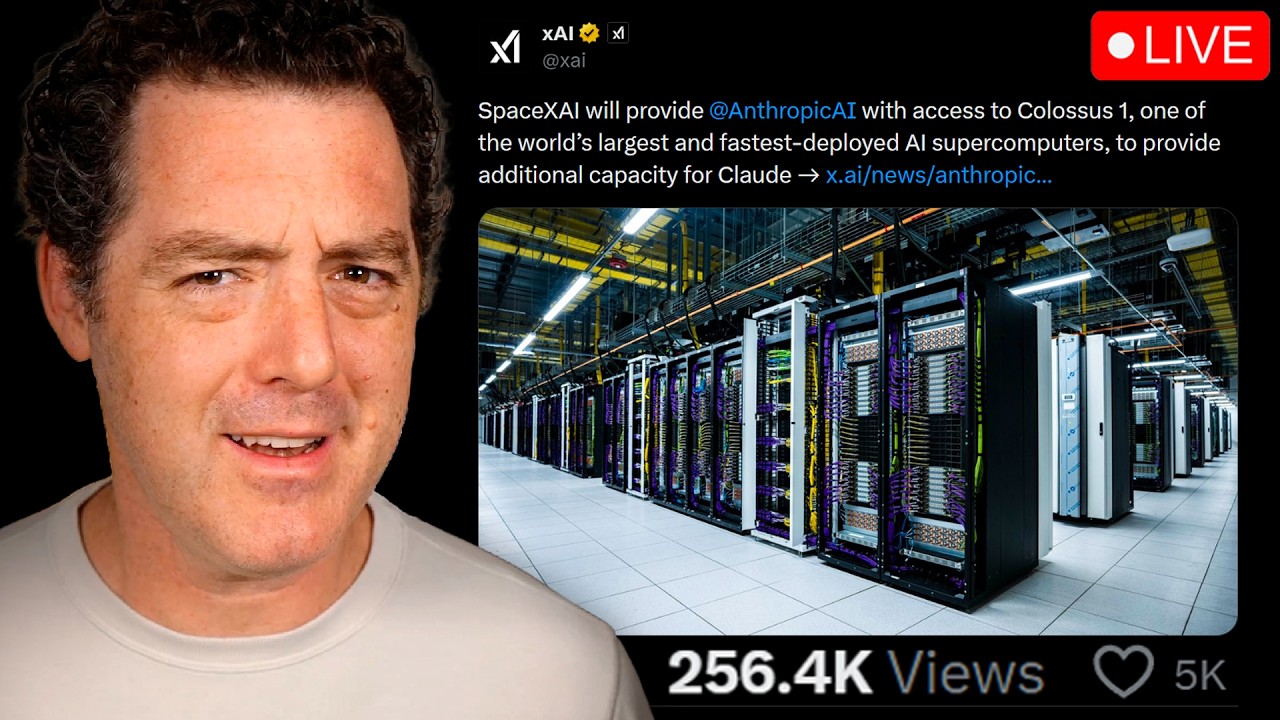
📺 Today’s recommended deep-dive video: https://www.youtube.com/watch?v=fa3mUy9DHcs
Anthropic’s Unlikely Savior: Why Elon Musk is Leasing Compute to His Rivals
Anthropic was suffocating under a self-imposed compute drought until a shocking partnership with SpaceX and xAI unlocked the Colossus supercomputer. This strategic shift doubles developer quotas and signals a major realignment in the AI infrastructure war as the industry moves toward agentic “dreaming” and orbital compute.
Core Question: How does Anthropic’s massive new compute deal with SpaceX change the competitive landscape for developers and the broader AI arms race?
Highlights
- Anthropic secures 300MW of capacity and 220,000 GPUs through SpaceX’s Colossus 1 data center.
- Immediate doubling of Claude Code rate limits and massive spikes in API quotas for Opus models.
- The irony of Elon Musk’s “misanthropic” criticism turning into a multi-billion dollar compute lease to spite OpenAI.
- Launch of new agentic features including “Dreaming” for memory refinement and “Outcomes” for rubric-driven task success.
⏱️ Reading time: approx. 7 minutes · Saves you about 75 minutes vs. watching.
Want to take notes while watching? Click the image below and let AI Notebook capture the key points for you 👇

The Compute Crunch and the Colossus Unlock
Breaking the Self-Imposed Drought
Anthropic finally blinked in the face of an unprecedented compute shortage that threatened to stall their momentum against OpenAI and Google. For months, developers felt the squeeze of reduced quotas and a frustrating lack of transparency regarding API limits. This new deal with SpaceX gives Anthropic access to the Colossus 1 data center, instantly providing 300 megawatts of capacity and over 220,000 Nvidia GPUs to power their most demanding Claude models.
The strategic error dates back several years when Dario Amodei chose a conservative capital expenditure path, fearing that AI demand might not scale at a predictable rate. While OpenAI leveraged every dollar to acquire GPUs, Anthropic played it safe and eventually found themselves unable to meet the exploding needs of their Enterprise and API users until this sudden infusion of SpaceX hardware.
Effective immediately, Anthropic is doubling Claude Code’s five-hour rate limits for Pro, Max, and Team plans while removing peak-hour restrictions. They are also aggressively raising API rate limits for Opus models, with some tiers seeing increases from 2 million to 10 million max input tokens per minute. This is an immediate unlock for power users who were previously forced to wait for off-peak hours to run complex agentic workflows.

💡 Digging Deeper
Q: Why did Anthropic need SpaceX if they have deals with Amazon and Google?
A: Amazon and Google deals involve long-term infrastructure (like 5GW capacity) that won’t be fully online for months or years, whereas Colossus 1 is active now.
Q: Is this a permanent solution for Anthropic’s capacity issues?
A: It is a massive stopgap, but Anthropic is still diversifying across AWS Trainium, Google TPUs, and Nvidia GPUs to avoid being beholden to any single provider.
The Enemy of My Enemy: Elon vs. Anthropic
The Irony of “Misanthropic” Partnerships
Elon Musk has spent the last year publicly trashing Anthropic, labeling them as “hypocritical” and claiming they were “misanthropic” in their approach to Western civilization. Yet, today he finds himself as their primary landlord, leasing out the massive compute surplus generated while xAI retools its own internal models.
The calculus here is likely purely motivated by Musk’s intense rivalry with Sam Altman, choosing to empower his second-tier rival to spite his primary nemesis at OpenAI.
Musk claims he spent time with the Anthropic team and found no signs of his “evil detector” going off, a sharp pivot from his previous accusations of data theft and regulatory capture. By leasing Colossus 1 to Anthropic, xAI generates immediate revenue from idle hardware while SpaceX AI continues to focus on training its next-generation models on the newer Colossus 2 infrastructure. This creates a strange paradox where the models Musk once called dangerous are now being trained and served on his own hardware.
💡 Digging Deeper
Q: What happened to xAI’s own training needs?
A: Musk admitted xAI is rebuilding its models from the ground up after realizing their initial architecture wasn’t optimal, leaving Colossus 1 temporarily underutilized.
Q: Does this affect the Cursor deal?
A: It’s complicated; SpaceX AI recently partnered with the Cursor team, but with Anthropic taking “all” of Colossus 1, Cursor will likely be moved to Colossus 2.
Claude Code Day: Agents that Dream
Sleep-Time Compute and Rubric Outcomes
Beyond the hardware news, Anthropic announced “Dreaming,” a sophisticated memory system that allows agents to review past sessions asynchronously to find patterns and improve their performance. This “sleep-time compute” strategy leverages GPUs during off-peak hours to restructure memory, ensuring that long-running agentic tasks remain high-signal and don’t succumb to the context-window drift that plagues traditional LLM implementations.
This move signals a shift toward agentic efficiency where models act as planners rather than just simple chat interfaces.
Along with Dreaming, the new “Outcomes” feature introduces rubric-based grading, where a separate model instance evaluates output against specific success criteria. Internal benchmarks show a 10% increase in success for complex tasks like PowerPoint generation, effectively removing the subjective guesswork from automated agent workflows. The system uses a separate context window for the grader so that the agent’s internal reasoning doesn’t bias the final evaluation of the work.

💡 Digging Deeper
Q: How does “Dreaming” actually save money?
A: By processing memory patterns during off-peak hours when electricity and compute demand are lower, Anthropic can optimize the agent’s efficiency during expensive peak times.
Q: What is the “Outcomes” feature similar to in the market?
A: It mirrors “Missions” in Factory AI or “Goals” in OpenAI, focusing on defining a terminal state of success rather than just a step-by-step prompt.
Key Takeaways
The partnership between Anthropic and SpaceX is a marriage of necessity that highlights the current state of the AI arms race: compute is the ultimate currency. Anthropic’s conservative past has forced them into the arms of a vocal critic, but the result is a massive win for developers who have been struggling with Claude’s restrictive quotas. By doubling rate limits and unlocking the Opus API, Anthropic is positioning itself to stay relevant as OpenAI prepares its next major release.
We are also seeing the birth of more sophisticated agentic architectures. Features like “Dreaming” and “Outcomes” suggest that the future of AI isn’t just about faster inference, but about smarter background processing and self-correction. As compute becomes commoditized across different chip architectures—from TPUs to Trainium—the real competitive moat will likely shift toward how effectively these companies can manage memory and goal-oriented reasoning at scale.
Q&A
Q1: What exactly are the rate limit increases for Claude Code?
A1: Effective immediately, five-hour rate limits are doubled for Pro, Max, Team, and Enterprise plans, and peak-hour reductions have been completely removed.
Q2: Why did Elon Musk change his mind about Anthropic?
A2: While he framed it as being “impressed” by their team, it is strategically beneficial for him to lease idle compute to an OpenAI competitor while xAI retools its own models.
Q3: What is “Colossus” in this context?
A3: Colossus is xAI’s massive supercomputer cluster in Memphis, Tennessee; Colossus 1 houses over 220,000 Nvidia GPUs and has 300MW of power capacity.
Q4: How does the “Dreaming” feature work?
4: It is an asynchronous memory refinement process where the model reviews past interactions during low-usage periods to identify recurring mistakes and optimize its internal workflows.
Q5: Does Anthropic still use Google and Amazon chips?
A5: Yes, they are actively using AWS Trainium and Google TPUs, and have long-term deals to bring gigawatts of new capacity online through 2027.
Q6: What is the “Outcomes” feature?
A6: It allows users to set a specific success rubric that a separate “grader” model uses to evaluate the agent’s work, ensuring higher quality in subjective tasks like brand voice or design.
Q7: Is orbital compute a real possibility?
A7: SpaceX and Anthropic have expressed interest in developing orbital AI compute, though figures like Sam Altman have dismissed the idea as unnecessary in the near term.