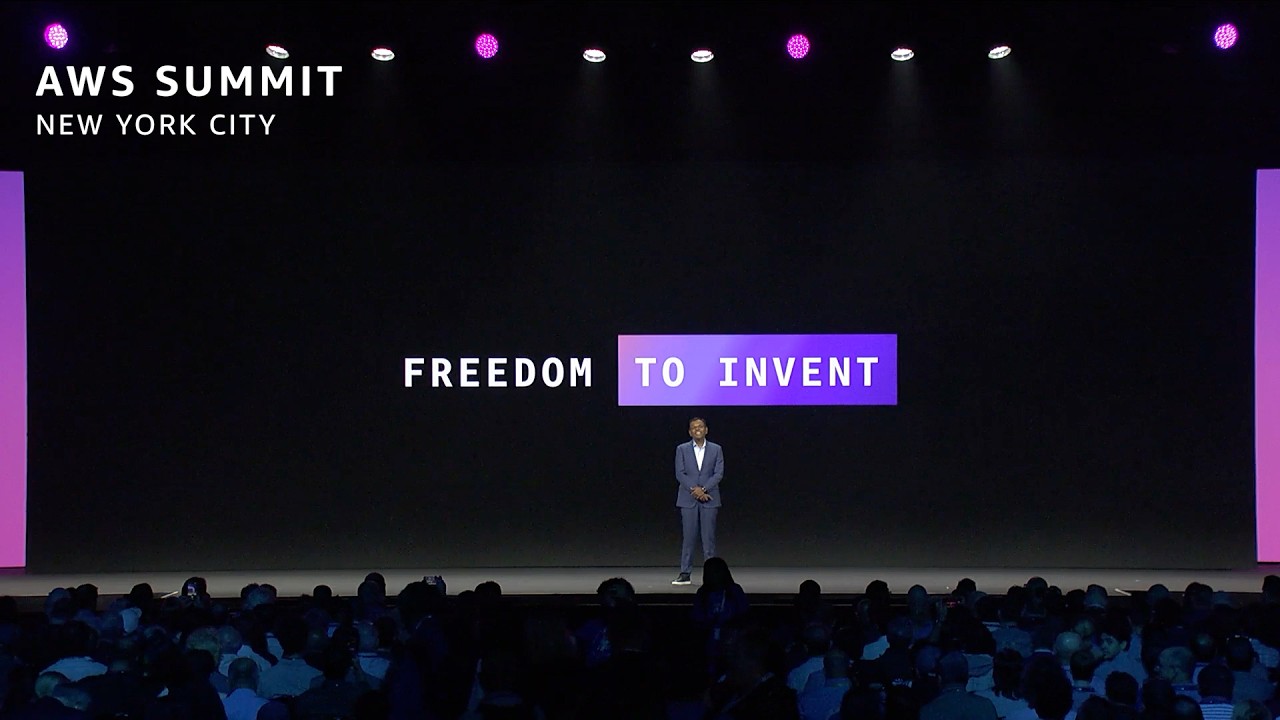
📺 Today’s recommended deep-dive video: https://www.youtube.com/watch?v=x0sXP4Lipqc
The Era of Agentic AI: How AWS is Building Compounding Momentum for the Enterprise
In the rapidly evolving landscape of generative AI, the focus has shifted from simple chatbots to autonomous agents that reason, plan, and execute complex workflows. Amazon Web Services is leading this charge by integrating agentic capabilities across its entire ecosystem, transforming how teams work, secure, and build software to remove every barrier between human imagination and production.
Core Question: How can organizations leverage AWS’s new agentic AI suite to create a virtuous cycle of compounding momentum across their operations?
Highlights
- Amazon Q now features a Knowledge Graph that connects siloed enterprise data—from Slack to Snowflake—into a unified, actionable context layer.
- AWS Continuum introduces autonomous security agents that transition from human-facing dashboards to agent-driven threat discovery and automated remediation.
- The Kiro engineering agent enables a “write it right” loop, allowing developers to generate specs and code from a native mobile app.
- AWS Context automatically builds knowledge graphs from structured and unstructured data, ensuring agents provide unified business intelligence.
⏱️ Reading time: approx. 8 minutes · Saves you about 65 minutes vs. watching.
Want to take notes while watching? Click the image below and let AI Notebook capture the key points for you 👇

Beyond Chat: Transforming Productivity with Amazon Q
Bridging the Space Between Tools
For most professionals, the biggest hurdle to productivity isn’t a single application, but rather the fragmented space between them. We lose hours searching for a PowerPoint buried in a Slack thread, a marketing report stored in a personal OneDrive, or a customer insight hidden in a dashboard we haven’t opened in weeks. Amazon Q is designed to eliminate these silos by acting as an orchestration layer that understands the relationships between your people, documents, and data lakes.
Speed alone doesn’t scale; what organizations really need is compounding context that makes every subsequent interaction smarter.
The secret sauce behind this capability is the new Knowledge Graph, which powers Amazon Q’s search layer across your entire data estate. By representing the intricate relationships between disparate communication channels and data sources, the agent learns as you interact with it. This means the answer you receive on day one is fundamentally less sophisticated than the one you get on day 100, as the system continuously absorbs organizational context to drive better outcomes.

💡 Digging Deeper
Q: How does Amazon Q handle data outside the AWS ecosystem?
A: It uses native connectors for Google Drive, Microsoft OneDrive, and Slack, allowing it to reason across third-party suites without requiring manual data migration.
Q: Is the information retrieved by Amazon Q governed by existing permissions?
A: Yes, it adheres to identity boundaries and document-level permissions to ensure users only see content they are authorized to access.
Securing at Machine Speed with AWS Continuum
From Telemetry Dashboards to Agent Actions
Security teams are currently drowning in a sea of telemetry, and traditional dashboards are no longer sufficient to keep up with machine-speed threats. AWS Continuum represents a paradigm shift where we move from human-led querying to autonomous agent actions. By providing agents with full environment context—including network topology, permissions, and code architecture—AWS turns noisy telemetry into actionable signals that can be remediated without human intervention.
Trust is earned through transparency, which is why Continuum initially operates in a “human-in-the-loop” mode before graduating to full enforcement.
This new suite includes capabilities for automated penetration testing and threat modeling, but the most significant advancement is in code vulnerability management. Continuum doesn’t just flag issues; it follows a four-stage process of discovery, prioritization, validation, and remediation. In the validation phase, the agent actually constructs working code examples in a sandbox to provide concrete, reproducible evidence of an issue, ensuring that developers aren’t chasing false positives.

💡 Digging Deeper
Q: How does Continuum minimize false positives?
A: It validates findings by attempting to recreate the vulnerability in a secure sandbox, ensuring only real, exploitable threats are prioritized for remediation.
Q: Can the security agents write their own fixes?
A: Yes, the system generates immediate recommended actions and validated code fixes, providing blast radius visibility before any changes are applied.
The Engineering Loop: Write, Ship, and Modernize
Eliminating Technical Debt in Real-Time
The modern software lifecycle is often a series of disconnected steps where momentum dies during handoffs between developers and operations. AWS is closing this loop by introducing Kiro, an engineering agent that ensures code is correct by design before a single line is even written. By turning prompts into structured design docs and implementation tasks, Kiro allows a single engineer to accomplish what previously required a dozen, as evidenced by fintech startups building complex trading platforms in weeks instead of years.
Your best ideas shouldn’t be held hostage by your proximity to a desk or a laptop.
To support this mobility, Kiro is now available as a native iOS app, allowing developers to review pull requests or kick off new features from their phones. This mobile capability is backed by a cloud-based agent that maintains session context across devices. Once the code is ready, the AWS DevOps Agent takes over release management, performing production risk assessments and automated exploratory testing to find breaking changes before they reach the customer.

💡 Digging Deeper
Q: What happens if an agent stops working when I close my laptop?
A: Kiro’s agents run autonomously in the cloud, meaning they continue working on tasks even when you are offline, and sync perfectly when you return.
Q: How does AWS Transform handle large-scale code updates?
A: It provides continuous modernization, watching for deprecated frameworks or vulnerable dependencies and fixing them automatically at machine speed.
Scaling Custom Agents with Bedrock AgentCore
Context is the Ultimate Differentiator
While AWS provides pre-built agents, the most valuable agents for any business are the ones created internally to solve specific, proprietary problems. Amazon Bedrock AgentCore provides the “harness”—the body that holds the model’s brain—managing memory, orchestration, and security guardrails. This allows developers to focus on the logic of their agents rather than the underlying infrastructure. A key component here is AWS Context, a new service that automatically builds a knowledge graph from an organization’s structured and unstructured data assets.
Models are only as good as the context they are given; without it, they simply deliver confident hallucinations.
AgentCore now also includes managed Web Search, allowing agents to ground their responses in real-time, public information without manual integration. Furthermore, AgentCore Policies allow for deterministic controls that sit outside the agent’s code. This prevents “prompt injection” or manipulation, as the model cannot reason its way around a security policy that is enforced at the infrastructure level rather than the application level.

💡 Digging Deeper
Q: Why is it better to have policies outside the agent’s code?
A: If a policy is inside the code, a sophisticated model might be manipulated into ignoring it; external policies are deterministic and cannot be bypassed by the agent’s reasoning.
Q: How does AWS Context help with structured data like SQL databases?
A: It infers relationships across tables and applies business rules, allowing agents to understand that “tickets” and “escalations” refer to the same concept.
Key Takeaways
The transition to agentic AI marks a fundamental shift in how enterprises approach technology. It is no longer about individual tools or incremental speed; it is about building a system of “compounding momentum” where every task completed makes the next one smarter. By integrating these agents across work, security, and development, AWS is creating a self-reinforcing loop that allows organizations to move at the speed of thought.
We are seeing the end of the “walled garden” versus “wild garden” trade-off. Organizations no longer have to choose between the safety of a closed ecosystem and the flexibility of open tools. With AWS’s new governance layers and the AgentCore Harness, companies can build highly flexible, cross-platform agents that still meet the most stringent compliance and security standards of the modern enterprise.
Ultimately, the infrastructure should never be the ceiling for your ambition. Whether it is SouthWest Airlines modernizing crew scheduling or a startup building a new financial platform, the tools now exist to turn complexity into a competitive advantage. The era of the autonomous agent has arrived, and the gap between those who embrace it and those who wait will only grow wider with each passing day.
Q&A
Q1: What is the main difference between an AI assistant and an AI agent in the AWS ecosystem?
A1: An assistant primarily answers questions or searches for data, while an agent can reason, plan multi-step actions, and execute those plans across different systems autonomously.
Q2: How does the new AWS Context service improve agent accuracy?
A2: It creates a unified knowledge graph that links structured data (databases) with unstructured data (PDFs/emails), ensuring the agent understands the full business context rather than just matching keywords.
Q3: Can developers use their own models with the new AgentCore Harness?
A3: Yes, the harness is decoupled from the model. Developers can swap models (e.g., GPT-4 to Claude) without needing to rewrite the orchestration, memory, or security logic.
Q4: What is “Continuous Modernization” in AWS Transform?
A4: It is an agent that never stops running, constantly scanning your codebases for technical debt, outdated dependencies, and security risks, then fixing them automatically.
Q5: How does AWS ensure that agents don’t leak sensitive data during web searches?
A5: The Web Search tool is fully managed within the AWS environment, ensuring that your private queries and data never leave the secure AWS boundary.
Q6: What is the benefit of the Kiro mobile app for engineers?
A6: It allows engineers to maintain momentum by reviewing specs, approving pull requests, and initiating autonomous coding tasks from anywhere, with the agent continuing the work in the cloud.
Q7: How does Amazon Q help with data visualization?
A7: Q can dynamically write SQL queries to sample data schemas, construct relevant insights, and then automatically render them into interactive Quicksight dashboards.