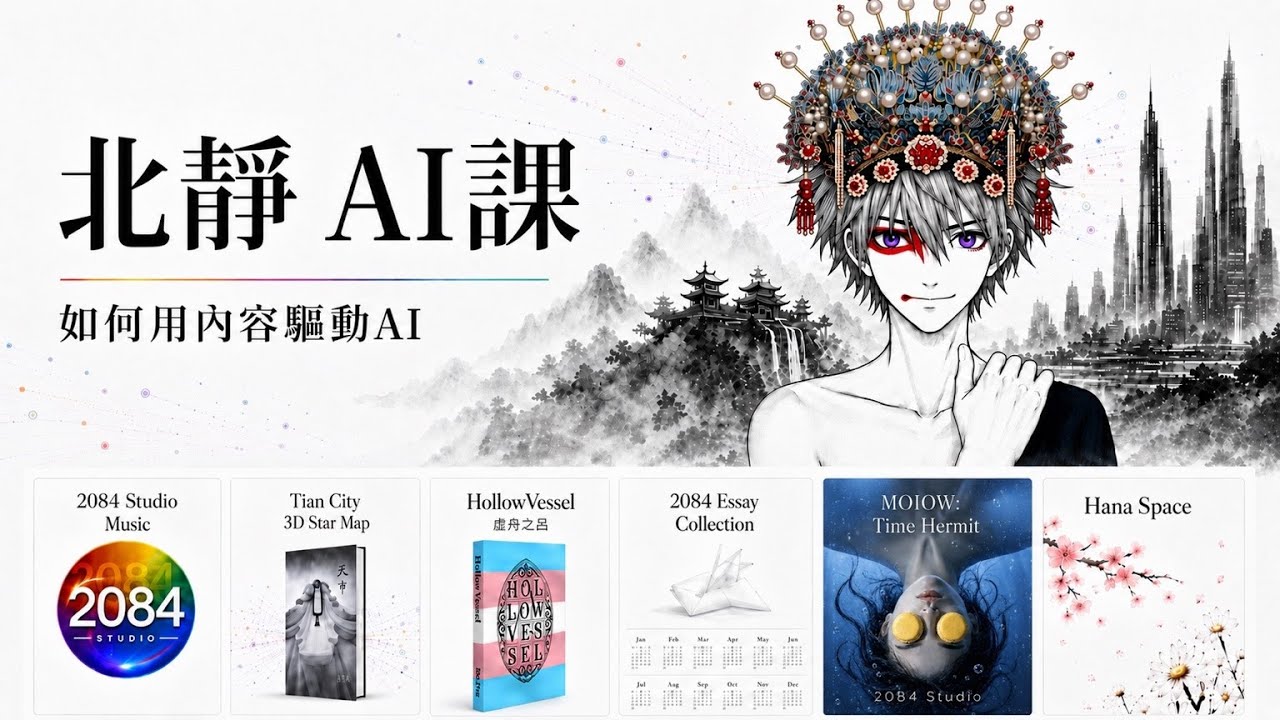
📺 Today’s recommended deep-dive video: https://www.youtube.com/watch?v=Q7Q8Disdci0
The 35-Day AI Revolution: Driving Creation Through Content
Building a multi-platform digital empire no longer requires a massive team or years of technical training. By treating artificial intelligence as a creative partner rather than a mere tool, one creator transformed a decade of writing into interactive maps, six music albums, and cinematic demos in just over a month.
Core Question: How can solo creators leverage their existing intellectual property to command AI across music, web development, and film production?
Highlights
- The shift from rigid “prompt engineering” to natural, conversational AI interaction.
- How to produce six professional-quality music albums in 35 days using Suno.
- Building interactive 3D narrative star maps to visualize complex character networks.
- A “Content-First” philosophy that prioritizes human IP over fleeting technical tricks.
⏱️ Reading time: approx. 8 minutes · Saves you about 72 minutes vs. watching.
Want to take notes while watching? Click the image below and let AI Notebook capture the key points for you 👇

The Philosophy of Content-Driven AI
Beyond Prompt Engineering
AI tools have evolved past the era of rigid prompt formatting into a phase where natural language is the ultimate interface.
Many beginners obsess over finding the “perfect” prompt word, but these technical details change almost monthly as models update, making specialized prompt-engineering knowledge obsolete very quickly. It is much more effective to treat the AI as a friend or a specialized assistant, communicating your creative vision through standard conversation—whether in Chinese or English—to achieve organic results that align with your specific aesthetic goals and personal taste.
By focusing on the underlying content rather than technical trickery, you ensure your work remains unique in a crowded digital landscape. AI is an incredibly powerful worker, but it requires the human “spark” of original ideas to produce anything of lasting value beyond mere digital noise.

💡 Digging Deeper
Q: Why use traditional Chinese instead of simplified Chinese when talking to AI?
A: Simplified Chinese data on the internet is often “polluted” by low-quality content or censorship; traditional Chinese or English often yields higher-quality, more diverse reasoning from the models.
Q: Is AI “eating up” human culture by running out of data?
A: No, because AI still struggles to process the deep emotional nuance and visual detail of movies and human experience; we are still the primary drivers of new content.
Q: Should I wait for better models before starting my project?
A: Start now with your content. Models upgrade every month, but your core stories and ideas are timeless and can be re-fed into newer systems as they arrive.
Multi-Media Expansion: Music and Video
From Novel Scripts to Auditory Experiences
In just 35 days, the studio produced six music albums using Suno, effectively transforming years of novel writing into a diverse auditory landscape.
By feeding specific plot points and emotional beats from existing books into the AI, we generated compositions ranging from electronic “opera cake” styles to classical erhu and violin fusions that represent the concept of quantum entanglement. This rapid prototyping proves that AI acts as a bridge between disparate creative mediums, allowing a writer to become a composer almost overnight without losing the soul of the original story.
The results are often surprising, providing “gifts” of unexpected melody that a human might never have initially conceived.
Video production followed a similar logic: we generated keyframes in ChatGPT, animated them via C-Dance, and stitched the final product together in professional editing software. This hybrid workflow allows a solo creator to produce high-quality music videos (MVs) that feel cinematic, bypassing the need for a traditional production crew or an expensive physical set.

Interactive Archives and 3D Visualization
Mapping the Narrative Universe
Interactive 3D star maps for the “Angels” IP were created to track hundreds of characters and events across a complex 150-year timeline.
Using Claude and Codex, we transformed static database entries into a navigable web interface that allows readers to explore the narrative’s complexity visually, clicking through nodes that represent character memories and historical events. This makes the “unreadable” or dense parts of a story accessible and engaging for a modern digital audience that craves interactivity.
These archives serve a dual purpose: they are promotional tools for the audience and structural aids for the author during the creative process.
By having the AI analyze a movie script’s 53 scenes, it becomes possible to generate split-shot visualizations and character dossiers that maintain narrative consistency across a massive project. This level of organization would typically take a production office months of manual labor, but it can now be achieved by a single person in a few afternoon sessions.

The Future of Solo Film Production
The Roadmap to the AI Feature Film
The ultimate goal is to move beyond demos and music videos to produce a full-length, 90-minute AI-generated feature film.
While current limitations—such as character consistency and the high cost of data tokens—present real hurdles, the rapid pace of development suggests these barriers will vanish within the next six to twelve months. By preparing the scripts, character designs, and soundtracks today, creators are positioning themselves to hit the “render” button the moment the technology reaches full maturity.
This shift empowers the “one-person studio” to compete with traditional industry gatekeepers who often control funding and distribution.
When traditional investment routes are blocked or external factors intervene, the creator can bypass the system and deliver their vision directly to the public. The era of the solo auteur, supported by a tireless AI staff, is no longer a science fiction fantasy but a near-term reality for those who have the courage to experiment with these tools right now.

Key Takeaways
The core message of this 35-day experiment is that content is the engine, and AI is the fuel. Without a decade of accumulated novels, scripts, and photography, the AI would have nothing of substance to process. Therefore, the most important work a creator can do is not learning new software, but refining their own internal world and “intellectual property” so that they have high-quality material to feed the machine.
Don’t get discouraged by the temporary imperfections of current AI models, such as glitches in character faces or inconsistent clothing. These are transient technical issues that will be solved by the next version of the software. Focus instead on the “surprises” the AI gives you—the accidental melodies and unique visual textures—and use them to enhance your original vision rather than fighting against them.
Q&A
Q1: How much does this AI setup cost per month?
A1: A basic professional setup (ChatGPT Plus and Claude Pro) costs about $40 USD per month; higher-tier packages for heavy data processing can go up to $130 USD, but are not always necessary.
Q2: Can AI truly replace a professional video editor or composer?
A2: Not yet for high-end professional needs, but for a solo creator, it provides 80% of the result at 1% of the cost and time.
Q3: What is the biggest challenge in AI video generation?
A3: Maintaining character consistency—ensuring a character looks the same and wears the same clothes across different shots is currently very difficult but improving.
Q4: How do I start if I have no coding or music experience?
A4: Use Notion for your base, Suno for music, and ChatGPT’s Codex for simple web elements; just talk to them in plain language and ask them to guide you.
Q5: Does the AI own the content it helps create?
A5: Currently, the legal landscape is evolving, but since the content is driven by your original scripts and inputs, you retain the creative direction and IP.
Q6: Why build a personal website instead of just using social media?
A6: Social media is ephemeral and controlled by algorithms; a personal site (like the 2084 Studio) acts as a permanent, organized archive for your creative legacy.
Q7: What is the “Moyal” project mentioned in the video?
A7: It is a central IP that bridges the creator’s novels and games, acting as a general outline for an entire interconnected digital universe.