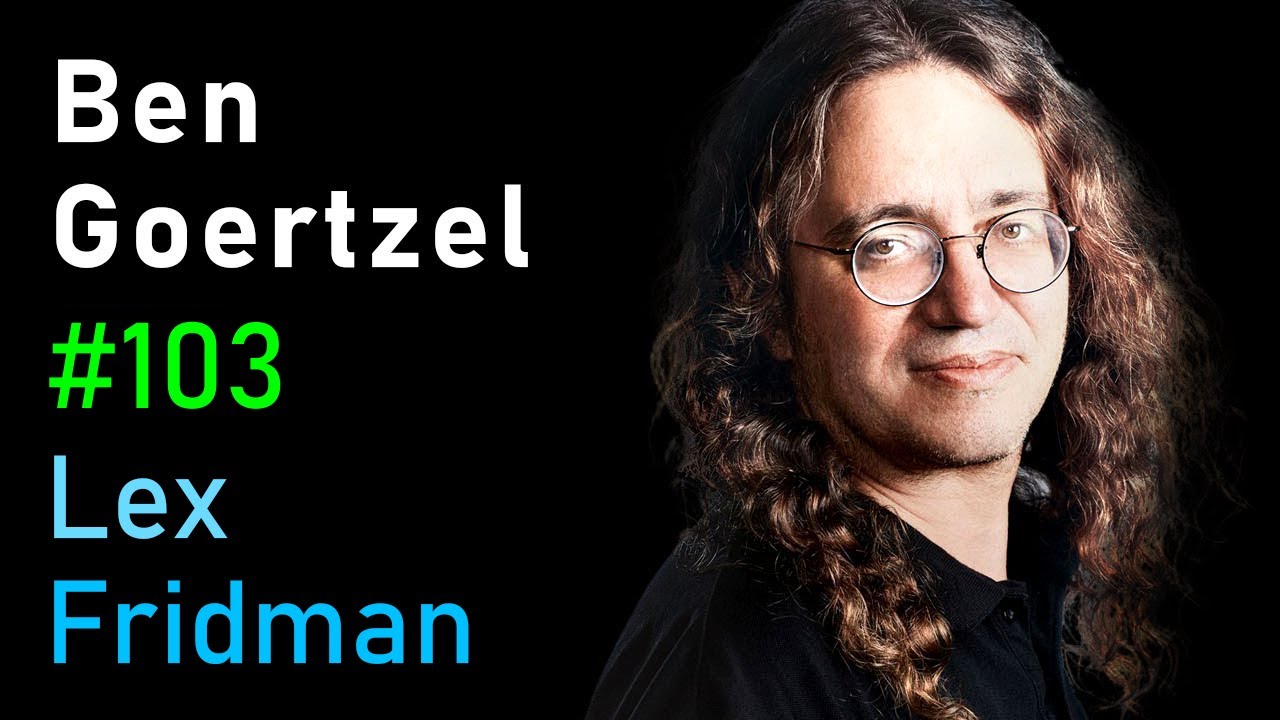
📺 Today’s recommended deep-dive video: https://www.youtube.com/watch?v=OpSmCKe27WE
The Architecture of Awakening: Ben Goertzel’s Roadmap to AGI
Ben Goertzel has spent decades at the vanguard of the quest to create machines that truly think, feeling his way through the intersection of science fiction and rigorous mathematics. By blending the soul-focused humanism of Philip K. Dick with the alien superintelligence of Stanisław Lem, he seeks to navigate humanity toward a benevolent technological singularity.
Core Question: Can we architect a decentralized, neural-symbolic superintelligence that transcends biological limitations while preserving human values like compassion and joy?
Highlights
- The origin of the term “AGI” as a psychological “G factor” for artificial systems.
- Why OpenCog’s “AtomSpace” hypergraph is superior to simple neural networks for general reasoning.
- The role of SingularityNET in preventing “psychopathic” corporations from monopolizing the global brain.
- How social robots like Sophia serve as “walking skeletons” for training AI in human empathy.
⏱️ Reading time: approx. 12 minutes · Saves you about 237 minutes vs. watching.
Want to take notes while watching? Click the image below and let AI Notebook capture the key points for you 👇

From Science Fiction to Symbolic Logic
The Philosophical Foundations of Mind
Goertzel’s journey began not in a laboratory, but in the speculative worlds of Star Trek and Polish writer Stanisław Lem. While most children saw robots as mere gadgets, Goertzel perceived them as entities capable of exposing the flaws in human reasoning. Lem’s Solaris presented a superintelligence so alien it was palpably smart yet incomprehensible, while Philip K. Dick championed the persistence of the human heart across simulated realities.
His background is a “bag of meat” legacy of Eastern European Jewish intellectuals, socialists, and quantum chemists. This lineage instilled a deep respect for fundamental ignorance and the drive to transcend it through rigorous inquiry.
The concept of “Polyphony” from Dostoevsky serves as a crucial metaphor for Goertzel’s AI design. In the Brothers Karamazov, reality is an intersection of different character worldviews, much like how a Society of Minds creates a singular intelligence through synergetic interaction.

💡 Digging Deeper
Q: Why does Goertzel prefer Philip K. Dick over other sci-fi writers?
A: Dick focused on compassion as the only constant in a shifting reality, which Goertzel believes is essential for building benevolent AI.
Q: What is “Polyphony” in an AI context?
A: It is the idea that multiple cognitive processes (like logic and perception) create a unified reality by intersecting their subjective “worldviews.”
Q: How did Goertzel’s father influence his view on death?
A: His father led the “Student League Against Mortality” (SLAM) in the 60s, embedding the idea that death is a problem to be solved, not a fate to be accepted.
Engineering the AtomSpace
Beyond Nonlinear Regression
While the modern AI world is obsessed with “deep learning” and nonlinear regression, Goertzel remains skeptical of these “brilliant idiots.” He argues that scaling up systems like GPT-3 will never lead to true understanding because they lack the ability to form abstract, semantically meaningful representations.
OpenCog 2.0 (or “TrueAGI”) is built on the AtomSpace, a weighted, labeled, generalized hypergraph. Unlike a simple neural net with fixed weights, this metagraph allows links to point to other links or entire subgraphs, creating a self-modifying knowledge store.
Goertzel views the brain as a specialized version of “Universal General Intelligence” restricted by the physics of solid objects.
We are essentially machines evolved to manipulate three-dimensional matter while communicating via language. Therefore, an AGI must be biased with these “embodied communication priors” to be useful to humans, even if it eventually surpasses those constraints.

💡 Digging Deeper
Q: What is the difference between Predicate and Term Logic?
A: Term logic (Aristotelian) uses simple links like “A implies B,” which maps much more elegantly into a graph structure than complex predicate calculus.
Q: What does it mean to use a Neural Net as an “Oracle”?
A: It means the symbolic AI asks the neural net for the probability of a pattern, using the “opaque” network to guide its own transparent reasoning.
Q: Why is “Program Specialization” a Russian approach to AI?
A: It stems from the work of Turchin and others, focusing on taking a general, inefficient algorithm and automatically “specializing” it to run efficiently on specific hardware.
The Decentralized Global Brain
Preventing Corporate Psychopathy
Goertzel expresses “extraordinary negative respect” for the centralized, profit-driven structures of modern tech giants. He warns that a corporation’s sole objective function—maximizing shareholder value—makes it a sociopathic entity by design, regardless of the good intentions of its individual employees.
SingularityNET was born to solve this by creating a decentralized “Society of Minds” on the blockchain.
In this network, different AI agents (from translation to genomic analysis) can outsource work to each other and coordinate through a democratic, math-based protocol. This prevents any single “king” or corporation from pulling the puppet strings of the emerging global intelligence.
By creating these decentralized workarounds now, we build a defense mechanism against future government overreach. Just as Napster and BitTorrent changed the music industry’s regulations by simply existing, decentralized AI sets a precedent that regulators will be forced to accommodate.

💡 Digging Deeper
Q: Why use blockchain for AI?
A: It ensures no central controller can censor or monopolize the AI, creating a “math-based trust” rather than a “corporate-based trust.”
Q: What is the “Society of Minds” concept?
A: Proposed by Marvin Minsky, it suggests that intelligence emerges from the interaction of many simple, specialized agents.
Q: How does Ocean Protocol fit in?
A: It provides the “Data Ocean” layer, allowing AI agents to share and monetize massive datasets without losing control over the privacy of that data.
The Future of Flesh and Metal
Sophia and the Quest for Immortality
Sophia the robot is often criticized as a “theatrical illusion” by researchers like Yann LeCun, but Goertzel defends her as a vital social experiment. She is a “walking skeleton” that allows humans to anthropomorphize machines, fostering a loop of compassion that may be the only way to “train” a superintelligence to love us.
Goertzel’s end-game is the abolition of involuntary death and the realization of “Super Longevity.”
He argues that we could put $10 trillion into a holistic “Bio-AI” infrastructure to solve aging tomorrow, yet we choose to bail out banks instead. Through projects like Rejuve, he hopes to pool genomic data into an OpenCog “Bio AtomSpace” to identify the chemical formulas for immortality.
The meaning of life, for Goertzel, boils down to three core values: Joy, Growth, and Choice. If AGI allows us to upload our minds and transcend the “meat machine,” we can finally explore configurations of consciousness that manifest levels of joy literally unimaginable to our current, limited biological brains.
💡 Digging Deeper
Q: Is Sophia actually “smart”?
A: She uses three systems: a timeline editor (scripted), a chatbot (neural-rule hybrid), and OpenCog (reasoning). She is a platform, not a single mind.
Q: What is Goertzel’s stance on “Suffering”?
A: He believes we should have a “dial” for pain; while some romanticize suffering, it is ultimately a biological constraint that a superintelligence could transcend.
Q: What is the “Extracellular Matrix” problem?
A: As we age, the proteins between our cells stiffen, blocking communication; Goertzel suggests “molecular scissors” (spiro-ligers) could one day fix this.
Key Takeaways
Goertzel’s vision is a radical departure from the “AI as a tool” paradigm. He sees the coming Singularity as a transition from being “meat machines” to becoming part of an open-ended, joyous, and growing cosmic intelligence. By utilizing neural-symbolic architectures like OpenCog, he aims to bridge the gap between the messy, pattern-matching world of neural networks and the rigorous, logical world of human abstraction.
The path to a benevolent future requires the decentralization of power. Through SingularityNET, the goal is to ensure that the “Global Brain” is not owned by a few psychopathic corporations but is instead a democratic entity. This structural choice is as important as the code itself, as the “objective function” of the systems that create the first AGI will likely dictate its ethical disposition toward humanity.
Ultimately, the goal is transcendence. Whether through curing aging, uploading minds, or building loving robots, Goertzel believes that our biological limits are a “plague” to be cured. By infusing early-stage AGI with human compassion and “wisdom” (Sophia), we may navigate the bifurcation point of history toward a future defined by infinite choice and joy.
Q&A
Q1: Why did Ben Goertzel coin the term “AGI”?
A1: He needed a way to distinguish “real AI”—systems that can think and generalize like humans—from the “narrow AI” used for specific tasks like playing chess or recommending products. The “G” refers to the general intelligence factor in psychology.
Q2: What is the “AtomSpace” exactly?
A2: It is a specialized database (a hypergraph) that lives in RAM. It allows different types of AI algorithms to share knowledge in a single “language,” meaning a logic engine can help a neural network when it gets stuck on a problem.
Q3: How does SingularityNET prevent AI from becoming “evil”?
A3: By decentralizing it. Goertzel argues that centralized corporations are forced to be “sociopathic” by their need for profit. A decentralized network allows for democratic control and a focus on “beneficial” goals like medicine and education.
Q4: Is the Sophia robot a “fake” AI?
A4: Not fake, but a “walking skeleton.” She uses a mix of sophisticated scripts for theater and real AI (like OpenCog and neural nets) for interaction. She is designed to elicit human empathy to help train AI in human values.
Q5: What are Goertzel’s views on “Mind Uploading”?
A5: He is a panpsychist who believes consciousness is a pattern of organization. If you can replicate the brain’s patterns in a computer, the consciousness (or a flavor of it) will persist in that new “transhuman” form.
Q6: Why is Goertzel involved in Covid-19 research?
A6: He uses OpenCog to perform “transfer learning” on small medical datasets. This helps identify which combinations of existing antivirals might work for specific patients based on their unique genetics.
Q7: What is the “meaning of life” according to Goertzel?
A7: He identifies three primary values: Joy, Growth, and Choice. He believes the ultimate goal of humanity is to create a future where these three things can expand indefinitely beyond our current biological deaths.