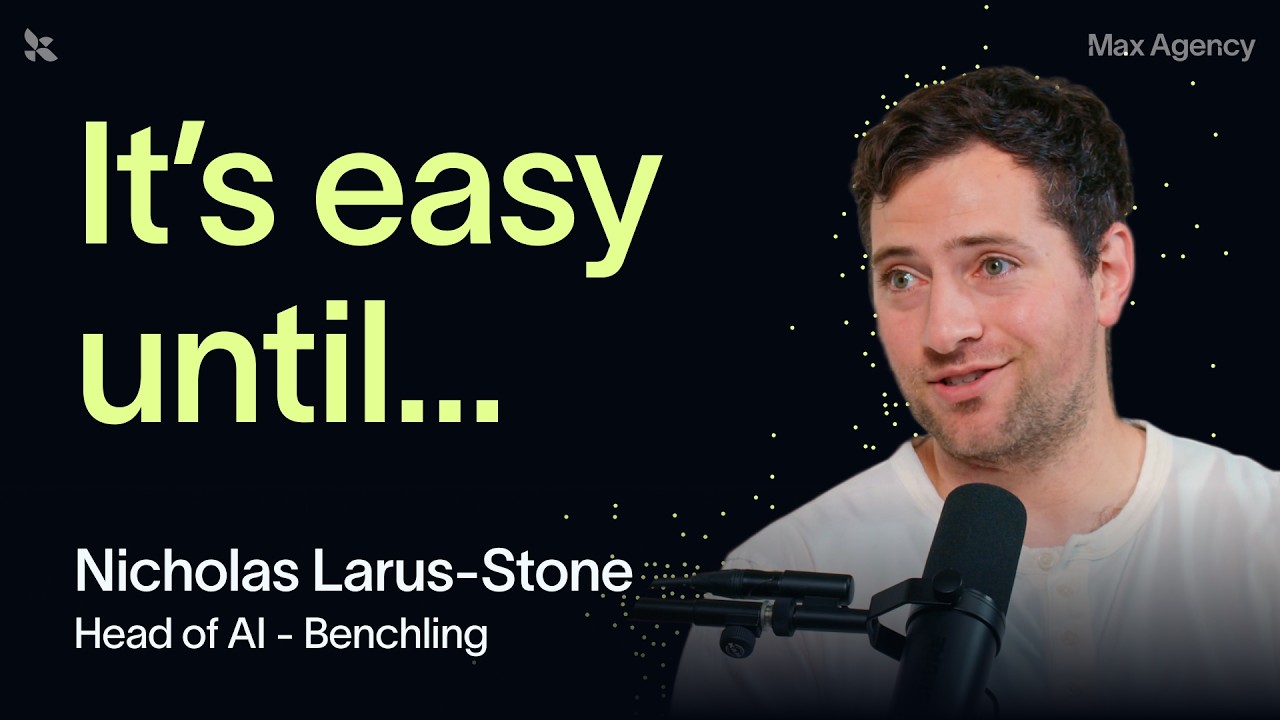
📺 Today’s recommended deep-dive video: https://www.youtube.com/watch?v=RjpTrffSMjE
The AI Scientist: How Benchling is Halving Drug Discovery Timelines
Benchling has spent 14 years building the data foundation for life sciences; now, they are unleashing agents to act on it. By moving beyond generic chatbots and building specialized harnesses for R&D, they are transforming the “black box” of biology into a structured, agentic workflow.
Core Question: How can specialized agent architectures and massive historical datasets accelerate the journey from initial discovery to patient delivery?
Highlights
- Context is King: Why generic LLMs fail science but Benchling agents succeed by leveraging 14 years of proprietary experimental data.
- Beyond Coding Harnesses: Why scientific discovery requires tournament-style hypothesis generation rather than simple spec-to-code loops.
- Multi-Model Consensus: The strategy of using different model families (Claude, GPT, Gemini) to cross-verify sensitive data entry.
- Eliminating “White Space”: Achieving a 2x speedup in drug discovery by automating the administrative and analytical gaps between experiments.
⏱️ Reading time: approx. 7 minutes · Saves you about 44 minutes vs. watching.
Want to take notes while watching? Click the image below and let AI Notebook capture the key points for you 👇

The Data Moat: Why Context Beats Raw Intelligence
Contextualizing the Agent
Generic AI models often hallucinate or provide ignorant answers when questioned about specific, narrow scientific domains because the relevant information is buried or absent in general pre-training data. Benchling’s core advantage is its 14-year history as a system of record for experiments, instruments, and biological entities. When you place an agent on top of this structured “right data,” the quality of answers skyrockets because the model isn’t guessing; it’s querying a specialized knowledge base.
Speed is a byproduct of accessibility.
By building from the inside out, Benchling avoids the limitations of generic protocols like MCP (Model Context Protocol). While they support such standards, having native access to the underlying SQL architecture allows them to change the system itself to better suit agentic needs. This includes specialized chunking strategies and embedding table descriptions so agents can navigate complex schemas with minimal latency.

💡 Digging Deeper
Q: Why isn’t a generic agent with external tool access enough?
A: Third-party systems often provide a limited view; by being the platform itself, Benchling agents access data and tools that external integrations simply cannot see.
Q: How has the underlying platform changed to support agents?
A: The engineering teams have optimized the search infrastructure, specifically updating chunking strategies and storage backends to facilitate more accurate embedding-based retrieval.
Q: Is the goal to replace the scientist?
A: No, the goal is to provide a layer of intelligence that helps scientists find data, design experiments, and analyze results faster, keeping the human as the final reviewer.
Architecture for Discovery: Beyond the Coding Harness
The Scientific Harness vs. Coding Specs
Most modern agents are built on “coding harnesses” designed to turn a specification into executable code, but science doesn’t always have a defined end condition that can be verified in a digital sandbox. Scientific tasks often involve high-stakes hypotheses that can only be proven through weeks of physical lab work costing hundreds of thousands of dollars. Consequently, Benchling avoids standard coding harnesses in favor of architectures that support “tournament-style” play, where multiple LLMs propose and critique ideas iteratively.
Intelligence in biology is often non-deterministic.
While coding is a tool the agent uses—specifically for data manipulation and file formatting—it is not the driving force. The agent must handle unstructured data like instrument PDFs and Excel sheets, transforming them into structured records. To ensure accuracy in these high-stakes imports, Benchling employs a multi-model consensus strategy.
Multi-Model Consensus and Verifiability
When a task requires high fidelity, Benchling routes the same problem to different model families—such as Anthropic’s Claude, OpenAI’s GPT, and Google’s Gemini. They have found that if different model providers agree on a result, the data quality is usually sufficient. However, if they disagree, it signals a potential error that requires human intervention. This “spiky intelligence” approach leverages the unique strengths of each provider, such as Gemini’s proficiency with images or Claude’s reasoning capabilities.

💡 Digging Deeper
Q: Why use multiple model families instead of just different sizes of the same model?
A: Different providers make different types of errors; cross-comparing across providers catches “blind spots” that a single family might share across its small and large versions.
Q: How do you evaluate an agent when the “ground truth” takes weeks to lab-test?
A: The team relies heavily on production traces and user feedback (thumbs up/down) rather than purely academic benchmarks, as scientific discovery is often at the bleeding edge where no benchmark exists.
Q: Does the agent write its own code?
A: Yes, it uses a coding sandbox for data analysis and file manipulation, but the architecture is designed to handle tasks where no code is required at all.
The 2x Speedup: Eliminating the “White Space”
Background Agents and the End of the Flash Drive
The most significant bottleneck in drug discovery isn’t always the science itself, but the “white space” between steps—the time spent moving data from a lab machine to a flash drive, emailing it to a statistician, and waiting days for a report. Benchling agents aim to close these gaps by acting as background processors. For example, an event-based agent can trigger the moment an instrument registers a result in the cloud, performing the analysis and suggesting the next experiment before the scientist even returns to their laptop.
Small administrative wins aggregate into massive timeline shifts.
Agents also assist in the “Design of Experiments” (DOE). Instead of a scientist tweaking one parameter at a time—a slow, linear process—the agent can help design factorial experiments. This allows a scientist to run 12 experiments simultaneously with high statistical power, potentially replacing two or three rounds of traditional, six-experiment cycles.
UX and the “SOP” for Agents
For scientists, the concept of an “Agent Skill” is best understood through the lens of a Standard Operating Procedure (SOP). Just as a human follows an SOP to ensure consistency, a scientist can define a Skill for an agent to ensure it handles data or writes reports in a standardized way. Benchling is currently building a system where agents can even proactively suggest the creation of new Skills based on a user’s recurring chat patterns.

💡 Digging Deeper
Q: What are the two types of background agents Benchling uses?
A: Schedule-based agents (e.g., weekly discovery reports) and event-based agents (e.g., immediate analysis triggered by a new instrument measurement).
Q: How do you handle “review fatigue” for scientists?
A: Unlike software engineers who may tire of reviewing code, scientists generally enjoy the high-level strategy of discovery; agents offload the “ticky-tack” data entry they dislike.
Q: Will an agent ever discover a drug entirely on its own?
A: We are still years away from a “solely agent-discovered drug” because models still struggle with physical world tolerances and the underlying knowledge of biology is still being built.
Key Takeaways
The transition from software engineering to “biological engineering” with AI represents a shift from deterministic systems to black-box probing. Building agents for life sciences is more akin to conducting biology research than traditional coding; it involves poking a complex system and observing how it responds. The most successful builders in this space are “product-minded engineers” who can bridge the gap between LLM capabilities and the specific bottlenecks of a laboratory workflow.
We are currently intelligence-limited, not just data-limited. While models are excellent at following instructions, the next frontier is “novelty”—building harnesses that allow agents to make non-obvious connections across an organization’s entire research history. By automating the mundane and assisting in the complex, agents are positioned to double the pace of human health innovation.
Q&A
Q1: How does Benchling’s age benefit its AI strategy?
A: Being 14 years old means they have a massive, structured data platform. Agents perform significantly better when they have a decade of experimental context to draw from rather than starting from scratch.
Q2: Why not just use a standard coding agent harness?
A: Coding harnesses assume a verifiable end-state (like code that passes a test). Science often lacks an immediate “in-silico” verification, requiring a different approach focused on hypothesis generation and tournament-style selection.
Q3: How do you ensure data integrity for FDA-regulated reports?
A: The AI produces the first draft, but Benchling maintains a “human-in-the-loop” requirement. They also use a pattern where a second, fresh agent session is used to critique the work of the first agent.
Q4: Do users care which model (GPT-4 vs. Claude 3.5) is being used?
A: Generally, no. Benchling treats model selection as an internal optimization problem, using the best tool for the specific task (e.g., Gemini for images, Claude for reasoning) without exposing that complexity to the scientist.
Q5: Can agents learn from their users?
A: Yes, through “Skills.” Users can create personal or organizational skills that teach the agent how to perform specific tasks. Agents can even be prompted to create their own skills based on recurring workflows.
Q6: What is the biggest blocker to an AI-discovered drug?
A: It is a combination of models lacking a deep understanding of the physical world (like robot tolerances in lab automation) and the fact that we simply haven’t generated enough biological data yet to “think” our way to a cure without new experiments.
Q7: How does Benchling charge for these agents?
A: They use a usage-based credit model. This allows organizations to have a baseline of activity but “spike” their usage during credit-heavy tasks, like compiling a massive IND application for the FDA.