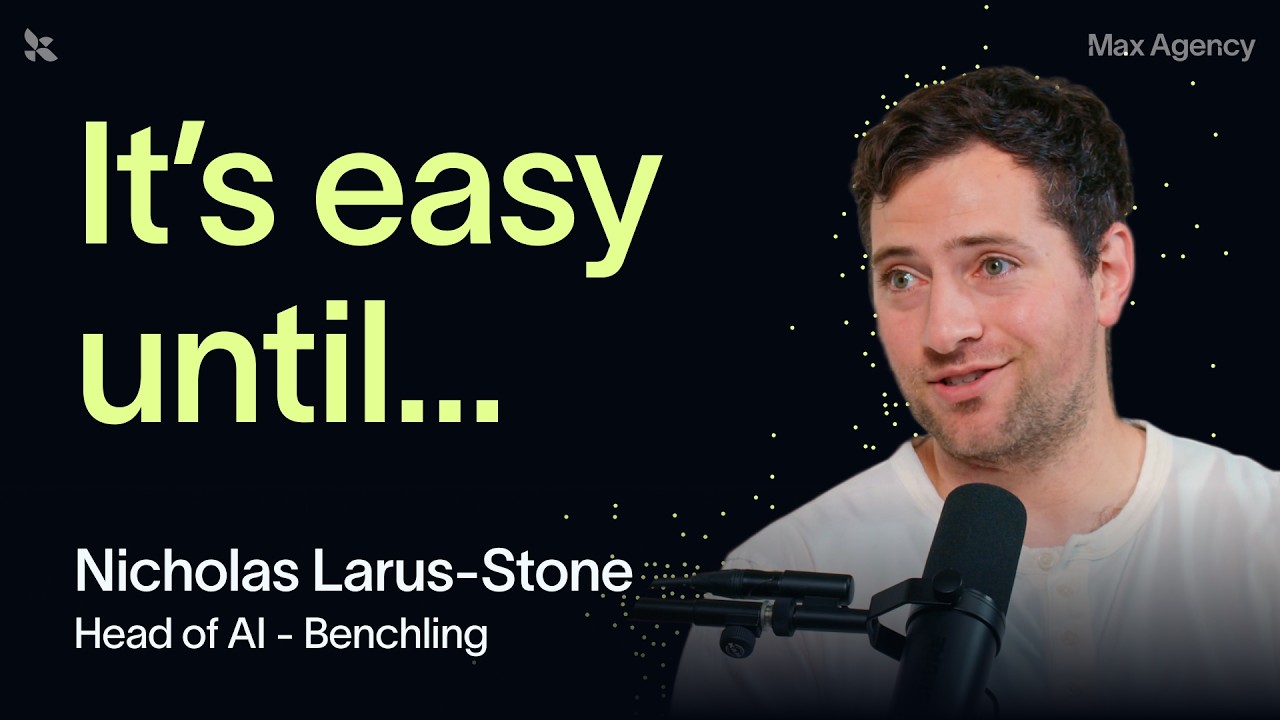
📺 Today’s recommended deep-dive video: https://www.youtube.com/watch?v=RjpTrffSMjE
Accelerating Biology: How Benchling is Building AI Agents for Life Science R&D
Benchling has spent 14 years organizing the world’s scientific data. Now, they are layering intelligent agents on top of that foundation to help scientists design experiments, automate reporting, and bridge the gap between the physical lab bench and the cloud.
Core Question: How can specialized AI agents leverage a decade of structured scientific data to cut drug discovery timelines in half?
Highlights
- Why the “SOP” (Standard Operating Procedure) is the perfect mental model for teaching scientists to use agentic “Skills.”
- The strategy of using cross-provider verification (multi-model families) to ensure high-fidelity data extraction from messy PDFs.
- Why traditional coding agent harnesses fail in biology due to the lack of an immediate, “in-silico” feedback loop for ground truth.
- The philosophical shift from deterministic software engineering to a “biology-style” approach of probing LLM black boxes.
⏱️ Reading time: approx. 7 minutes · Saves you about 44 minutes vs. watching.
Want to take notes while watching? Click the image below and let AI Notebook capture the key points for you 👇

The Foundation of Data-First Agents
Beyond Generic Chatbots
Benchling isn’t a newcomer; it’s a 14-year-old platform that has become the digital backbone for life science R&D. While many startups attempt to build agents first and find data later, Benchling reverses this order by placing intelligence directly on top of a massive repository of experimental records. This legacy data is the “secret sauce” that prevents the hallucinations commonly seen when scientists use generic tools like ChatGPT.
Scientists who tried generic LLMs early on often walked away disappointed by superficial answers that lacked the depth required for high-stakes research. By contextualizing LLMs with specific data models and experimental histories stored within the platform, the quality of answers skyrockets because the agent isn’t just predicting tokens based on the open web—it’s analyzing the specific, proprietary biology of the user’s organization.
This “inside-out” architecture allows the agent to access granular metadata that external protocols might miss.

💡 Digging Deeper
Q: Is Benchling moving away from traditional search?
A: Not entirely. They have a dedicated search team that recently shifted toward agentic search. Improvements to chunking and embedding search benefit both the AI agents and the human scientists using the platform.
Q: How much does the agent actually code?
A: While it has a coding sandbox for data analysis and file manipulation, many tasks—like data retrieval or simple reasoning—require no code at all. Coding is an “ability,” not the “driving force.”
Architecture and the “Scientific” Harness
Why Coding Frameworks Aren’t Enough
You can’t unit-test a drug candidate in five milliseconds. Traditional coding agents thrive on a rapid feedback loop where a compiler or test runner provides immediate verification. In biology, the “ground truth” requires weeks of physical experimentation and hundreds of thousands of dollars, making standard goal-setting loops largely incompatible with the current state of in-silico prediction.
Because verification is so difficult, Benchling utilizes a multi-model approach to cross-verify high-stakes tasks like data entry. If GPT-4 and Claude 3.5 Sonnet disagree on a PDF extraction, it triggers a human review, ensuring that the structured data entering the system remains pristine. This “spiky intelligence” strategy leverages the unique strengths of different model providers—using Gemini for image-heavy tasks and others for reasoning.
The agent loop itself is standard, but the skills it calls are highly specialized.

💡 Digging Deeper
Q: How many models are hit in a single run?
A: Usually one or two as “drivers,” but complex tasks can hit up to seven or eight different models to cross-compare results.
Q: How do they handle evals if the science is novel?
A: They lean heavily on production traces. Since academic benchmarks don’t reflect industry R&D, the team conducts weekly “fire chief” rotations where engineers and PMs manually review anonymized traces to understand agent performance.
Skills, SOPs, and the Future of Lab Work
Closing the “White Space” in Discovery
For many researchers, the concept of “agent skills” feels abstract or overly technical. However, when framed as a “Standard Operating Procedure” (SOP) for an AI, it immediately clicks, mapping a familiar scientific construct onto the new digital workforce. This helps bridge the gap for users who aren’t software engineers but need to automate repetitive parts of their workflow.
Benchling believes agents will eventually speed up drug discovery by 2x by eliminating administrative “white space.”
Think of a scientist returning from the lab after running a manual sequence; historically, they would have to manually transfer files from a machine via flash drive and wait days for a statistician’s analysis. Background agents can now ingest that data the moment it hits the cloud, performing the analysis and suggesting the next experimental step before the scientist even sits back down at their laptop. These event-based triggers turn the platform from a passive notebook into an active collaborator.
The goal is to move from “Design-Execute-Analyze” as three distinct phases to a continuous, agent-supported loop.

💡 Digging Deeper
Q: Do agents learn from their users?
A: Yes, but conservatively. Agents can create their own “Skills” based on repeated tasks, but Benchling currently biases toward user-instantiated skills to avoid cluttering the environment with unhelpful automation.
Q: How is this being charged?
A: It’s a usage-based model. Customers get a monthly allotment of credits, allowing them to “spike” their usage during intense periods, such as when writing a thousand-page regulatory application for the FDA.
Key Takeaways
Building agents for biology requires a fundamental shift in the “engineering” mindset. Traditional software engineering is deterministic, but working with LLMs is more akin to biology itself: you are probing a black box, perturbing the system, and observing how it responds. This “experimental” approach to AI development is why product-minded engineers who are willing to listen to scientists often outperform pure technical specialists in this domain.
The immediate value of agents in R&D isn’t in finding a “cure for cancer” via pure thought, but in removing the friction of the scientific process. By automating data entry, drafting regulatory reports, and suggesting structured experimental designs (DOE), agents allow scientists to spend more time on high-level hypothesis generation. The future of the “AI Scientist” isn’t a replacement for the human, but a background system that understands the totality of an organization’s science and proactively suggests the next breakthrough.
Q&A
Q1: How does Benchling AI fit into the existing platform?
A: It’s a chat interface layered on top of the 14-year-old platform. The agent can interact with objects in Benchling—like experiments and data tables—to help scientists find data, design experiments, and analyze results.
Q2: Why not use standard coding agent harnesses?
A: Coding harnesses are designed for tasks that can be verified “in-silico” (in code). Science requires physical lab experiments for verification, which can take weeks. Benchling’s harness is customized to handle these longer, less verifiable horizons.
Q3: What is the “multi-model family” strategy?
A: For high-accuracy tasks like data entry from PDFs, Benchling routes the same task to different model providers (e.g., OpenAI and Anthropic). If they agree, the data is trusted; if they disagree, a human intervenes.
Q4: Can agents create their own skills?
A: Technically yes. The system is tuned to allow agents to instantiate or update skills, though they are currently prompted to be responsive to user requests rather than autonomously generating them in the background.
Q5: How do background agents work in the lab?
A: They are either schedule-based (e.g., generating weekly reports) or event-based (e.g., triggered when an instrument uploads new measurement data to the cloud). This allows for near-instant analysis.
Q6: What is the “SOP” analogy for skills?
A: A Standard Operating Procedure (SOP) is a set of steps a human follows in a lab. Benchling describes “Agent Skills” as SOPs for the AI, helping scientists understand how to guide the agent’s behavior.
Q7: Will agents ever discover a drug on their own?
A: We are years away from a solely agent-discovered drug. While they can speed up the process by 2x, they currently lack a deep enough understanding of physical world constraints and the “totality of biology” to work without human concert.