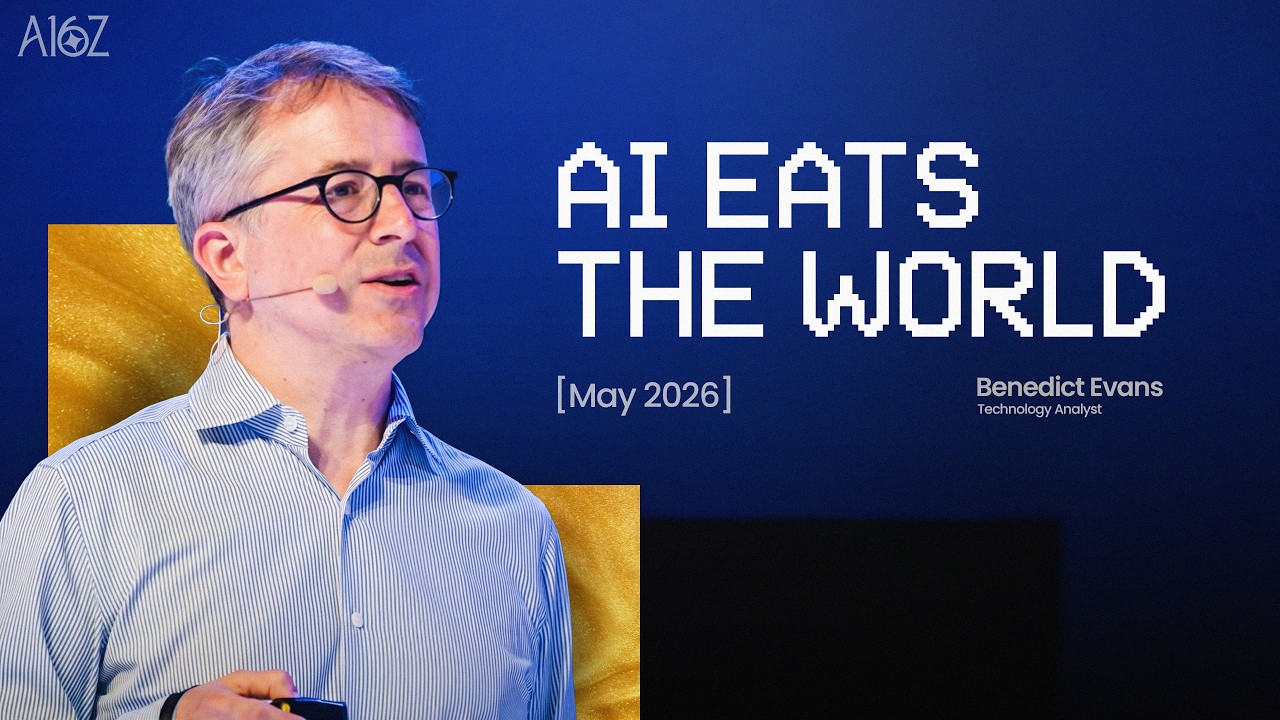
📺 Today’s recommended deep-dive video: https://www.youtube.com/watch?v=ktl8mNiWqMM
Beyond the Chatbot: Benedict Evans on AI’s Industrial Realignment
For the last year, Silicon Valley has been mesmerized by a tool that feels like magic but often acts like a toy. Benedict Evans argues that we are finally moving past the speculative “what if” phase into a brutal economic reality where AI technology fades into the background of everyday industry.
Core Question: Will foundation models become high-margin operating systems, or are they destined to be the low-margin commodity pipes of the next industrial revolution?
Highlights
- Agentic coding has emerged as the first application with true product-market fit, where customers are “pulling it out of developers’ hands.”
- Foundation models currently lack clear network effects, suggesting they may evolve into commodity infrastructure similar to telcos or electricity.
- The staggering $700 billion annual Capex explosion is a transitory response to scarcity that will eventually hit the limits of financial gravity.
- The most critical questions about AI’s future are moving from San Francisco to “Los Angeles questions” centered on industry-specific expertise.
⏱️ Reading time: approx. 8 minutes · Saves you about 52 minutes vs. watching.
Want to take notes while watching? Click the image below and let AI Notebook capture the key points for you 👇

The Pivot from Theory to PMF
Agentic Coding as the First Breakthrough
At the start of the year, AI was a curiosity for many, but agentic coding changed the narrative by providing a tool that software developers—the very people building the revolution—couldn’t live without. We have transitioned from a moment of “this might work” to “this works for coding,” narrowing the industry’s focus onto a sector where the demand is essentially infinite.
While the broader public still views chatbots as a weekly novelty, the developer community has integrated these models into their daily workflow, marking the first time we’ve seen a “bridge” crossed from experimentation to essential utility.
This shift is deterministic; it is only natural that the creators of the technology would solve their own problems first, mirroring how the first use cases for early PCs were often the creation of more sophisticated software tools.

💡 Digging Deeper
Q: Has AI solved the problem of hiring junior engineers?
A: It is too early to tell; while we are automating tasks traditionally given to juniors, we haven’t yet redefined what a “team” looks like in this new era.
Q: Why did coding take off before other sectors?
A: Software developers are the primary users and have the highest incentive to automate their own bottlenecks, making it the path of least resistance for early PMF.
Q: Is the current supply crunch permanent?
A: No, Evans compares it to the 2009-2010 mobile data crunch where infrastructure had to frantically scale to meet the sudden surge in iPhone usage.
The Foundation Model Commodity Trap
The Illusion of Differentiation
We are currently witnessing a massive capital arms race among model providers, yet there is a growing argument that these models lack the fundamental network effects required to sustain high-margin dominance. Unlike Instagram or YouTube, where the value scales with the number of users, a foundation model doesn’t necessarily become more “defensible” just because more people prompt it.
If the models are largely built on the same chips with the same data to produce similar outputs, the market likely trends toward commodity infrastructure.
In this scenario, the value doesn’t stay with the “pipe” providers but migrates up the stack to the applications that solve specific, messy human problems.
Pricing Power and the Telco Parallel
Mobile networks spend hundreds of billions on global infrastructure only to see the actual profit captured by Apple, Google, and Netflix. Evans warns that the “model labs” might be building the most sophisticated technology in history, but if they are selling a commodity at marginal cost, they will lack the pricing power to capture the value they create.
Current pricing is in a state of extreme disequilibrium where $20 a month might buy $10,000 worth of tokens, a gap that must eventually close as the market matures and efficiency increases.
💡 Digging Deeper
Q: Can a chatbot be a final product?
A: Evans argues no; a chatbot is a limited “V1” interface, and real value requires tooling, data integration, and specific UI designed for professional tasks.
Q: Do model providers have leverage over SaaS companies?
A: Likely not; most enterprise customers won’t care which model is under the hood, just as they don’t care which cloud provider hosts their payroll software.
Q: Will there be a “winner-take-all” in models?
A: History suggests that when 3-6 players offer similar frontier capabilities, price wars become inevitable, destroying the “winner-take-all” math.
Moving Toward “Los Angeles” Questions
The Migration of Expertise
As AI matures, the most interesting questions are moving out of the tech sphere and into the specialized domains of law, finance, and media. Evans calls these “Los Angeles questions,” referring to how the future of Netflix is decided by content strategy and Hollywood talent deals rather than just San Francisco server optimization.
If you want to know how AI changes a law firm, you shouldn’t ask a Silicon Valley engineer; you should ask a partner at a top-tier firm who understands how their pyramid hiring structure actually functions.
The “San Francisco” phase of AI—building the engine—is well underway, but the “Los Angeles” phase—building the car and deciding where to drive it—is just beginning.
Automating the “Average”
AI excels at tasks where you want the “average” response—the kind of work an associate or a junior analyst would produce by following a standard playbook. The disruption happens when these “unreasonably expensive” tasks become free, forcing industries to redefine what they actually sell to their clients.

Key Takeaways
We are living through a period of “financial gravity” defiance, where the big tech players are spending over 50% of their revenue on Capex to ensure they aren’t left behind. While $700 billion a year sounds like an impossible sum, it is comparable to the global oil and gas industry’s infrastructure spend, though it cannot grow indefinitely without a clearer line to ROI.
The ultimate fate of AI is to become “magic” that we no longer notice, much like how we no longer marvel at the fact that a smartphone can stream HD video without crashing. In twenty years, we won’t talk about “AI companies” any more than we talk about “electricity companies” today; the technology will simply be the invisible foundation upon which all modern work is built.
Ultimately, the transition from “useful” to “magic” is a journey of normalization where the tools we currently find mind-blowing become the boring, expected standards of the future.
Q&A
Q1: Is the massive Capex spending sustainable?
A1: Only up to a point. There are physical and financial limits to spending; you cannot spend $10 trillion on infrastructure if that money doesn’t exist in the global economy.
Q2: Will AI lead to a “SaaS Apocalypse”?
A2: It will lead to more software, not less. While some companies will be wiped out, Evans notes that “all software exists to solve problems created by other software,” suggesting a cycle of expansion.
Q3: Why does Evans compare AI to the 1990s internet?
A3: Because in 1997, you could see the internet would change distribution, but you couldn’t yet predict Uber or Airbnb. We are currently in that “missing middle” where the future is visible but the specific winners aren’t.
Q4: What is the “Jevons Paradox” in the context of AI?
A4: It suggests that as AI makes a task cheaper (like financial analysis), we won’t just do it for less money; we will do 50 times more of it, potentially increasing total spending.
Q5: How should companies approach AI today?
A5: By looking for things that were “unreasonably expensive” or “impossible” before. Don’t just do the old thing better; do the new thing that was previously cost-prohibitive.
Q6: Does Apple have an advantage in the AI race?
A6: Apple’s advantage lies in “on-device” AI where the compute is free to the developer, avoiding the massive marginal costs of running frontier models in the cloud.
Q7: Will AI replace senior professionals?
A7: Unlikely. AI handles the “average” and the “documented.” Senior roles involve exception handling, judgment, and navigating undocumented organizational politics—things LLMs struggle to replicate.