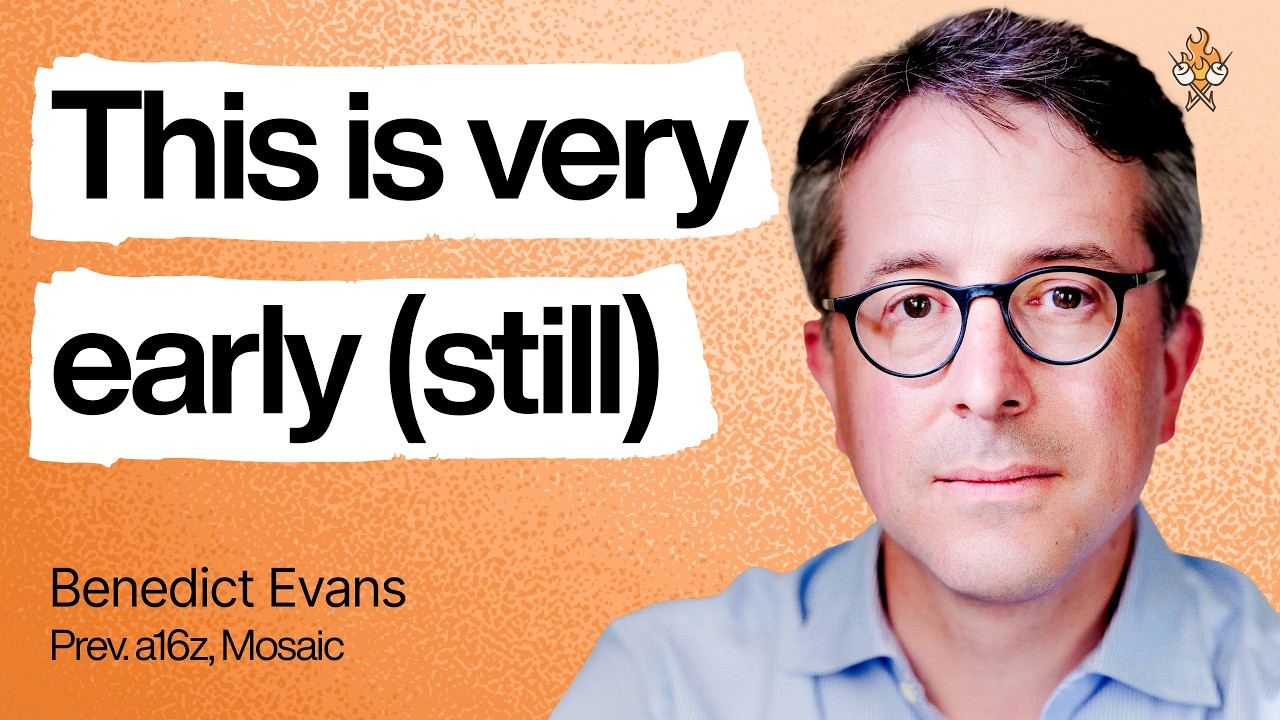
📺 Today’s recommended deep-dive video: https://www.youtube.com/watch?v=BD3vLtWhT5A
AI is Eating the World, but It’s Not the Apocalypse
Tech analyst Benedict Evans argues that while AI is a transformative platform shift on par with the internet, we are still in its “1997” phase where the most impactful applications haven’t been built. Rather than a job apocalypse, he sees a complex cycle of automation that unlocks new, currently unimaginable roles through price elasticity and expanded capabilities.
Core Question: Will AI foundation models become high-margin monopolies like Windows, or commodity utilities like mobile data and electricity?
Highlights
- AI is a fundamental shift equal to mobile and the internet, but likely not bigger.
- Consultants are safe for now because implementing AI is a massive organizational “project” that machines can’t manage alone.
- The “Hard Part” of a job (strategy, politics, customer empathy) is rarely the specific task that gets automated.
- Value capture will likely shift from the “commodity” models to specialized applications with established distribution.
⏱️ Reading time: approx. 8 minutes · Saves you about 72 minutes vs. watching.
Want to take notes while watching? Click the image below and let AI Notebook capture the key points for you 👇

The 1997 Timeline of Artificial Intelligence
Navigating the Radical Uncertainty of a New Platform
We are currently living through the “1997” era of artificial intelligence.
While tech enthusiasts act as if the entire world has already adopted these tools, the reality is a massive distribution gap. Most people outside the Silicon Valley bubble use ChatGPT maybe once a week, and many of the “revolutionary” products we see today are the equivalent of early Yahoo! or Excite—likely to be replaced by something we haven’t even conceived of yet. We forget that it took nearly twenty years after the invention of Google Docs for the full suite of modern SaaS companies to actually emerge.
This uncertainty is the defining characteristic of a platform shift. Benedict Evans points out that his most controversial opinion is that AI is exactly as big as the internet, but only as big as the internet, rejecting the “Industrial Revolution” hyperbole that suggests it is a unique break from human history.

💡 Digging Deeper
Q: Why the 1997 comparison?
A: Because in 1997, the internet was exciting but mostly didn’t work yet; we knew it would change everything, but we couldn’t have predicted Uber or Airbnb.
Q: Is AI “bigger” than the smartphone?
A: It is a fundamental change, but the smartphone put a computer in 5 billion hands; it’s hard to be “orders of magnitude” bigger than total global connectivity.
Why Consultants and “The Hard Part” Still Matter
The Paradox of Increasing Headcount in the Age of Automation
There is a paradoxical trend where the leading AI labs—OpenAI and Anthropic—are aggressively hiring consultants and professional services firms.
You would expect AI to kill the “PowerPoint jockey,” but companies don’t have idle staff waiting to rewire their internal workflows. Automating a law firm or an accounting practice is a distinct project that requires human coordination, politics, and strategic implementation before any code is written. You don’t just “buy AI” and fire everyone two weeks later; the enterprise sales and implementation cycle is often longer than a startup’s entire funding round.
The task is not the job.
An elevator attendant’s job was a single task—moving a lever—which made it easy to automate out of existence. However, most modern professional roles involve a “jagged frontier” of responsibilities where the easiest parts to automate are just the administrative friction. You hire McKinsey for their ability to navigate your company’s internal politics and talk to your customers, not just to generate a 75-page slide deck.

💡 Digging Deeper
Q: Will AI kill entry-level jobs?
A: There is frictional pain and dislocation, but historically, automating the “crap” parts of a job allows for more complex, higher-value work to emerge.
Q: What is the Jevons Paradox?
A: It’s the idea that making a resource more efficient (cheaper) often leads to increased total consumption rather than less.
The Commoditization of Foundation Models
Where Will the Value Actually Accrue?
There is a growing debate about whether the companies building the foundation models will capture all the economic value.
Evans draws a sharp parallel to the telecommunications industry, where companies spend hundreds of billions on infrastructure to provide amazing technology that ultimately becomes a low-margin utility. If there is no “winner-takes-all” network effect and several companies provide a similar model, they lose pricing power. The “intelligence” becomes a meter like water or electricity, where the provider doesn’t get a cut of the value created by the things plugged into it.
Distribution, not the underlying model, becomes the ultimate moat in a world of abundant intelligence.
If the models themselves are commodities, then the advantage shifts to companies that already have a billion users. This is why Google is “spraying” Gemini across all its products and why Apple Intelligence is so formidable; they don’t necessarily need the best model, they just need an adequate model integrated into the hardware and software people already use every day.

💡 Digging Deeper
Q: Do model labs have “moats”?
A: Currently, they lack network effects; if Claude is better this week, you use Claude; if GPT is better next week, you switch. That is a commodity market.
Q: Will startups or incumbents win?
A: Incumbents have the distribution, but startups win when they move past “doing the old thing better” and invent something that wasn’t possible before.
Key Takeaways
The narrative of a “job apocalypse” ignores the history of the last 200 years of technology. While it is true that specific roles—like the typesetter or the telephone operator—disappear, the resulting wealth and efficiency have consistently created more jobs than they destroyed. AI is a “manual labor” tool for the mind, automating the boring parts of intellectual work so humans can focus on the strategic “Hard Part.”
For individuals worried about their future, the best defense is immersion. Avoid the trap of “moral superiority” by shouting from the sidelines; instead, dive into the tools and understand their limitations and strengths. Those who can articulate how AI changes their specific industry will be the ones who remain indispensable as the technology matures over the next decade.
Ultimately, we must embrace “radical uncertainty.” We are standing on the shoulders of giants, using infrastructure built by the internet and mobile revolutions to launch a third wave. It won’t look like what we expect, but history suggests that in the long run, it’s probably going to be okay.
Q&A
Q1: Is AI more significant than the Industrial Revolution?
A: Benedict argues it’s as big as the internet or mobile, which were massive, but he’s skeptical of claims that it’s a completely unprecedented break in human history.
Q2: Why hasn’t Excel reduced the number of accountants?
A: Because making accounting easier meant we just did more accounting and more complex financial modeling, rather than hiring fewer people.
Q3: What is the “Jagged Frontier” of AI?
A: It refers to the reality that AI can do some incredibly difficult things (like coding) perfectly, but fails at “simple” things (like basic logic or current facts), making its utility unpredictable.
Q4: Will AI models have pricing power like Microsoft Windows did?
A: Unlikely. Windows had a massive developer network effect. AI models currently behave more like AWS or mobile data—essential utilities with heavy competition and shrinking margins.
Q5: What should parents teach their children about the AI future?
A: Focus on skills that involve synthesis and understanding what to do with the tools. Don’t stick your head in the sand; understand the tech so you aren’t replaced by those who do.
Q6: Is the anti-AI sentiment around water and energy usage valid?
A: While data centers use significant energy, the water usage claims are often exaggerated or based on planning issues rather than a global shortage caused by AI.
Q7: Why is “distribution” the most important word in the AI race?
A: Because when the software becomes easy to build (a commodity), the person who already has the customers (Google, Apple, Microsoft) wins by default.