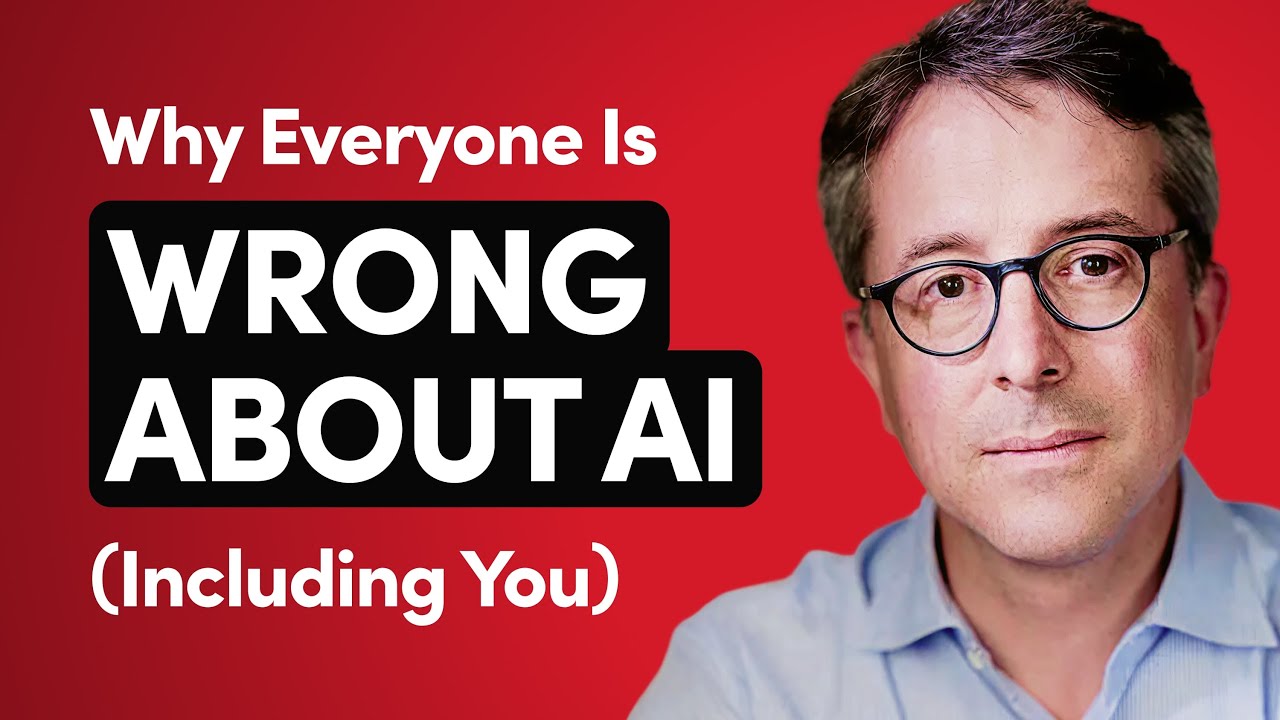
📺 Today’s recommended deep-dive video: https://www.youtube.com/watch?v=2NgdQf2GzJg
AI as the Next Platform Shift: A Skeptic’s Guide to the Future
Technology analyst Benedict Evans explores why AI is a massive transformation akin to the iPhone, yet warns against the “industrial revolution” hype that ignores historical patterns. He breaks down how incumbent tech giants are scrambling to avoid a “Kodak moment” in a world where data has become a commodity and product differentiation is harder than ever to find.
Core Question: How will the shift to generative AI redefine value capture for tech giants and fundamentally change the way humans interact with information?
Highlights
- AI is a platform shift similar to mobile, not necessarily a transhumanist or “electricity-level” revolution.
- Data is largely a level playing field because LLMs require more generalized text than any single company possesses.
- Incumbents face a “Kodak threat” where they must transition from high-margin search to potentially lower-margin AI results.
- The “Double-Blind” problem: Most consumers cannot tell the difference between outputs from Grok, Claude, Gemini, or ChatGPT.
⏱️ Reading time: approx. 7 minutes · Saves you about 65 minutes vs. watching.
Want to take notes while watching? Click the image below and let AI Notebook capture the key points for you 👇

The Historical Rhythm of Platform Shifts
From Automatic Elevators to Smartphones
Benedict Evans views AI through the lens of history, comparing it to the rise of the internet and mobile computing. Just as 1995 wasn’t clear about the web’s eventual dominance, 2024 remains a fog of potential winners and losers. We tend to forget how strange “automatic elevators” once felt before their “electronic politeness” became a standard part of the air we breathe.
Every platform shift feels unique to those living through it, yet they all follow a predictable pattern of unbundling and re-bundling incumbent power.
In the early 90s, the “information superhighway” was expected to be a centralized, media-controlled entity, but it turned out to be a decentralized web. Similarly, the iPhone wasn’t just a phone with a better UI; it was a small Mac that eventually replaced the PC as the center of the tech universe. This shift didn’t happen overnight—it took a decade for the infrastructure and consumer behavior to align, eventually making the term “mobile internet” redundant.

💡 Digging Deeper
Q: Why is the Kodak example relevant to Google?
A: Kodak didn’t fail because they ignored digital; they failed because their high-margin film business was replaced by a low-margin commodity hardware business where they had no differentiation. Google faces a similar risk if high-margin search links are replaced by AI answers.
Q: Is this the first time incumbents have a data advantage?
A: People always think the incumbents have the advantage. People thought IBM would win the PC, and Microsoft would win the Internet. History shows that incumbents usually try to make the new tech a “feature” before getting unbundled by new players.
Q: What is the “moment of discontinuity”?
A: It is a point where everyone resets their defaults. When a platform shifts, users reconsider their habits, and “going to Google” is no longer the automatic first step.
The Data Illusion and Incumbent Advantage
Is Proprietary Data the New Oil?
Contrary to popular belief, having proprietary data silos like YouTube doesn’t grant Google an insurmountable lead in training generalized large language models. While these repositories are massive, the specific type of data needed for LLMs is different from what most incumbents hold.
To train a competitive LLM, companies need an astronomical amount of generalized text, which is effectively a level playing field because the internet’s “common crawl” is available to anyone with a billion dollars. While Google has a massive repository of scraped data, the sheer volume required means that meta-data and short snippets are less valuable than the massive corpus of public books and websites. The advantage, therefore, lies not in the raw data, but in the distribution and the capital to run the compute.
This shifts the battleground from data ownership to the “reset of defaults.”
If consumers stop reflexively going to Google Search for answers, the incumbent’s primary advantage—habit—evaporates. This discontinuity allows new players to compete on product experience rather than just historical data dominance.

💡 Digging Deeper
Q: Is AI making itself better yet?
A: No. We aren’t at the stage of autonomous recursive improvement. Most stories about AI “threatening” humans are just the machines following a “story-generating” prompt based on human fiction.
Q: Why do many people “not get” ChatGPT?
A: Adoption is high because it’s free and accessible, but daily use is still low (~10%). Many people look at a blank prompt and don’t know what to do with it because it isn’t wrapped in a specific product UI yet.
Q: What is the “Double-Blind” test?
A: It’s the idea that if you gave the same prompt to five different top-tier models, most users couldn’t identify which model produced which result, suggesting the models themselves are becoming commodities.
The Big Five and the Commodity Trap
Different Paths to Value Capture
Meta and Amazon are playing a strategic game of commoditizing the infrastructure of AI to protect their core businesses. By open-sourcing models like Llama, Meta aims to turn the underlying technology into “commodity infrastructure” sold at cost, allowing them to differentiate through social features rather than model proprietary-ness.
Apple’s strategy remains focused on the “glowing rectangle,” ensuring the iPhone remains the primary interface for any AI service, regardless of who provides the model.
Microsoft and Google find themselves in a complex double-bind. They are both the threatened incumbents of search and the primary providers of the cloud infrastructure required to host the very technologies that threaten them. If AI becomes an “accounting product” running on Azure, Microsoft wins regardless of which model the customer chooses. The danger is “getting Microsofted”—owning the hardware but losing the user’s engagement to a third-party cloud service like OpenAI.
💡 Digging Deeper
Q: How does Amazon win in an AI world?
A: Amazon wins through AWS (selling the “picks and shovels” to run models) and their massive advertising business, which is less likely to be disrupted by a chatbot than a general search query.
Q: What is the “Apple Bear Case”?
A: The risk that you buy an iPhone for its hardware, but every meaningful interaction happens inside a third-party model (like ChatGPT), effectively turning the OS into a “dumb pipe” for someone else’s intelligence.
Q: Is “Learning to Code” still relevant?
A: Coding should be treated like learning a musical instrument. It’s a great skill to have, but the definition of what a software engineer does will change fundamentally in the next decade.
Key Takeaways
We are currently in the “MySpace phase” of AI. The early leaders have massive traction, but the network effects aren’t yet solidified, and the switching costs remain relatively low. Benedict Evans suggests that we are moving toward a world where the model itself is infrastructure, while the value migrates back to brand, distribution, and specialized application layers.
The most important skill for the future isn’t a specific technical ability, but the capacity for “thinking by writing” and synthesis. As AI raises the baseline for average output, the premium on unique insight, curation, and the ability to ask the “next question” will only increase. We should expect a world of infinite content “slop,” which will paradoxically make human-curated boutiques and authentic voices more valuable than ever.
Q&A
Q1: Is AI really the biggest thing since the Industrial Revolution?
A1: Evans argues it is likely just another platform shift, similar to the transition from PC to Mobile, rather than a fundamental shift in the nature of humanity or electricity.
Q2: Does more usage make an LLM better through a network effect?
A2: Currently, no. There is no evidence of a self-reinforcing loop where more users automatically make the model smarter in real-time, unlike Google Search’s feedback loops.
Q3: Why doesn’t Evans reflexively use AI for his own work?
A3: He focuses on qualitative insight and “thinking by writing.” If an AI could have said what he’s writing, he believes it isn’t worth publishing.
Q4: How should a country “dominate” AI?
A4: Not through national champions, but by getting out of the way. Regulation should focus on specific harms (like bioweapons) rather than treating the software itself as a nuclear-level threat.
Q5: What happened to the “Information Superhighway”?
A5: It was a 1990s centralized vision of the internet controlled by cable companies that was ultimately destroyed by the decentralized, permissionless web.
Q6: Is Tesla a software company or a car company?
A6: Currently, it’s a car company facing a “flood” of Chinese EVs. The “iPhone of cars” metaphor is failing as the industry moves toward a generic “Android” model with no clear iPhone-like leader.
Q7: What is the value of a liberal arts education in the AI age?
A7: It teaches you how to synthesize information and ask the “next question,” which are the exact skills needed when the “first question” can be answered instantly by a machine.