📺 Today’s recommended deep-dive video: https://www.youtube.com/watch?v=WEDIj9JBTC8
The Lemonade Stand MBA: Bill Ackman’s Blueprint for Wealth
Finance is often treated like a black box of complex jargon, but billionaire investor Bill Ackman proves that every massive corporation is fundamentally just a lemonade stand scaled up. In this comprehensive breakdown, Ackman demystifies the mechanics of compounding, business valuation, and market psychology to provide a clear roadmap for long-term financial success.
Core Question: How can an understanding of basic business unit economics and the power of compounding transform a modest $10,000 investment into a multi-million dollar retirement?
Highlights
- The Structural Hierarchy: Why debt provides safety with limited upside, while equity offers high-risk residual claims on all future profits.
- The Compounding Miracle: How the timing of your first $10,000 investment can create a $4 million difference in retirement savings.
- The “Moat” Framework: Identifying high-quality businesses through brand loyalty, low capital intensity, and barriers to entry.
- Market Psychology: Understanding why the stock market is a “voting machine” in the short term but a “weighing machine” in the long term.
⏱️ Reading time: approx. 8 minutes · Saves you about 38 minutes vs. watching.
Want to take notes while watching? Click the image below and let AI Notebook capture the key points for you 👇

From Lemons to Leverage: Building a Business
The Anatomy of a Startup
Starting a business begins with a legal framework. By forming a corporation, you create an entity that can sell pieces of itself—shares of stock—to raise capital. If you start with 1,000 shares and sell 500 to an investor for $500, you have established a market value: your idea plus their cash now equals a $1,500 company.
To grow, you must choose between selling more equity or taking on debt.
Borrowing $250 at a 10% interest rate allows you to keep a larger percentage of the profits for yourself, rather than diluting your ownership by selling more shares to outside investors. This is the fundamental trade-off of leverage: it magnifies your potential returns if the business succeeds, but it introduces the risk of bankruptcy if you cannot meet interest payments during a lean year.
Financial Statements 101
Every investor must speak the language of three core documents: the Balance Sheet, the Income Statement, and the Cash Flow Statement. The Balance Sheet is a snapshot in time showing your assets (what you own, like the lemonade stand and lemons) versus your liabilities (what you owe). Whatever is left over is your “shareholder equity,” or the true net worth of the business.
Profitability, however, is tracked on the Income Statement.
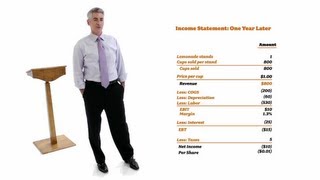
You start with Revenue—the $1 per cup you charge customers. From there, you subtract the Cost of Goods Sold (sugar, water, lemons), labor costs for your staff, and depreciation, which accounts for your lemonade stand wearing out over time. What remains is your EBIT (Earnings Before Interest and Taxes), the raw profit generated by the business operations before the bank and the government take their cut.

💡 Digging Deeper
Q: Why is “Goodwill” listed as an asset on the balance sheet?
A: Goodwill represents the premium paid for a business above its physical assets; in our example, it is the $1,000 value assigned to the founder’s idea and effort that the investor acknowledged by paying $500 for only a third of the company.
Q: What is the difference between a fixed asset and inventory?
A: A fixed asset is a long-term piece of infrastructure, like the lemonade stand itself, which is used over years and depreciates. Inventory consists of short-term supplies like lemons and cups that are consumed and replaced daily.
Q: Why would a business show a loss on the income statement but still have cash?
A: Non-cash expenses like depreciation can lower reported profits on paper without actually removing cash from the bank account, though eventually, that equipment will need to be replaced with real money.
Good vs. Bad Businesses & The Risk Hierarchy
The Characteristics of Quality
A truly “good” business is one that achieves a high return on invested capital. If you spend $2,100 to build seven lemonade stands and those stands generate $2,300 in annual profit, you have a business earning over a 100% return on your investment. This is the hallmark of a “growth company,” where reinvesting every dollar of profit back into the business creates exponential value.
Not all businesses are created equal; the best ones are “capital light.”
High-capital intensity businesses, like General Motors, must constantly reinvest their profits into expensive new factories just to stay competitive, often leaving little for the shareholders. In contrast, “royalty” businesses like American Express or Coca-Cola take a small percentage of other people’s spending or sell a low-cost syrup to bottlers who handle the expensive manufacturing. These businesses generate massive amounts of free cash flow that can be returned to owners.
Understanding the Risk Ladder
Risk is not just about a stock price moving up or down; it is the probability of the permanent loss of your money. This risk is managed by where you sit in the “capital structure.” Lenders are at the top; they get paid first and have a claim on assets if the business fails, making debt a safer, lower-return investment.
Equity holders are at the bottom, holding a “residual claim.”
They only get what is left over after the employees, the bank, and the government are paid. While this makes equity riskier, it also means that if the business grows 1,000%, the lender still only gets their 10% interest, while the equity holder captures all the remaining upside. To justify this risk, investors look for “moats”—barriers to entry like brand loyalty or unique products that prevent competitors from stealing profits.

💡 Digging Deeper
Q: What defines a “barrier to entry”?
A: It is anything that makes it difficult for a competitor to start a rival business, such as a famous brand name (Coke), high startup costs, or customer habits that are hard to break.
Q: How should an investor view a 10-year Treasury bond?
A: As a “risk-free” floor; any other investment (like a loan to a lemonade stand) must offer a significantly higher return to justify the added risk of that business failing.
Q: Why is brand loyalty important for profitability?
A: It allows a company to charge a premium price. People will pay more for a Hershey’s bar than a generic chocolate bar, even if the ingredients are similar, because they trust the brand.
The Path to Public Markets and Valuation
The Mechanics of an IPO
When a private business owner needs a large sum of cash—perhaps to buy a car or diversify their wealth—they can take the company public through an Initial Public Offering (IPO). This process involves hiring investment banks and lawyers to create a “prospectus,” a document that discloses every major risk and financial detail of the company to the public.
Going public transforms the business into a “liquid” asset.
Instead of needing to find one private buyer for the whole company, you can sell tiny slices of it to thousands of people on an exchange like the New York Stock Exchange. While this provides the owner with cash and a market-validated price, it also requires them to answer to a Board of Directors and follow strict government regulations to protect minority shareholders.
Calculating What a Business is Worth
Valuation is the art of comparing a company’s earnings to its price. A common tool is the P/E (Price-to-Earnings) ratio. If a company earns $1 per share and similar companies sell for 20 times their earnings, your company is worth $20 per share. Ackman suggests thinking of a stock like a “bond with a growing coupon.”
If you flip the P/E ratio, you get the “Earnings Yield.”
A stock with a P/E of 10 has a 10% earnings yield ($1 profit / $10 price). If a government bond pays 3%, the 10% yield from the stock is attractive because it offers a “spread” over the risk-free rate, especially if those earnings are expected to grow over time. The higher the expected growth, the higher the multiple investors are willing to pay today.

💡 Digging Deeper
Q: Is a high P/E ratio always bad?
A: Not necessarily; if a company’s profits are growing at 50% per year, a P/E of 30 might actually be “cheaper” in the long run than a stagnant company with a P/E of 8.
Q: What is the main benefit of “liquidity” for an investor?
A: Liquidity allows you to change your mind and sell your investment instantly for cash, whereas a private investment might take months or years to exit.
Q: Why do public companies need a Board of Directors?
A: The Board acts as a watchdog to ensure the management team is running the company in the best interest of all shareholders, not just themselves.
The Psychology and Strategy of Investing
The Power of Starting Early
The most potent weapon in an investor’s arsenal is time. If you invest $10,000 at age 22 and earn a 10% annual return, you will have $600,000 by age 65. However, if you wait until age 32 to start, that same $10,000 only grows to about $232,000.
Compounding is exponential, not linear.
The difference between a 10% return and a 15% return over 40 years is the difference between $600,000 and $4 million. This is why Albert Einstein reportedly called compound interest the “eighth wonder of the world.” To harness it, you must avoid the “permanent loss” of capital; as Warren Buffett says, the first rule of investing is to never lose money.
Dealing with the “Voting Machine”
In the short term, the stock market is a “voting machine” driven by human emotion, fear, and greed. Prices fluctuate wildly based on news events that often have nothing to do with a company’s long-term value. To be successful, you must have the stomach to ignore these fluctuations and avoid the “herd mentality” of selling when prices drop.
Investing is as much about psychology as it is about math.
If you understand the business you own and have no debt, a falling stock price is an opportunity to buy more at a discount rather than a reason to panic. Ackman recommends focusing on businesses you could “own forever”—simple, predictable companies like McDonald’s or See’s Candies that provide products people need regardless of the economic climate.

💡 Digging Deeper
Q: When is the right time to start investing?
A: Only after you have paid off high-interest debt (like credit cards) and saved a 6-to-12-month “emergency fund” of cash in the bank.
Q: How many stocks should a person own?
A: Ackman suggests 10 to 20 high-quality, well-researched companies provide enough diversification without diluting your best ideas.
Q: What should you look for in a Mutual Fund manager?
A: Integrity, a long-term track record (10+ years), a simple investment strategy, and “skin in the game”—meaning they have their own money invested in the fund.
Key Takeaways
Success in finance is built on the foundation of understanding “unit economics.” Whether it’s a lemonade stand or a global conglomerate, a business must generate more cash than it consumes, maintain a competitive advantage (a moat), and operate with manageable debt. By viewing stocks as ownership in real businesses rather than just flashing numbers on a screen, investors can move away from gambling and toward wealth creation.
The math of compounding proves that youth is an investor’s greatest asset. Starting early, even with small amounts, creates a gravitational pull on wealth that is impossible to replicate later in life. However, the technical skills of valuation are useless without the emotional discipline to stay the course.
Ultimately, the best strategy is to buy high-quality, understandable businesses at reasonable prices and hold them for decades. Avoid the noise of the market “voting machine” and focus on the “weighing machine” of long-term earnings growth. If you can master your own psychology and avoid the temptation of leverage, financial independence becomes a matter of time rather than luck.
Q&A
Q1: What is the most important rule for a new investor?
A: Never lose money. While this sounds simplistic, it means prioritizing the avoidance of “permanent capital loss” over the pursuit of risky, high-return “home runs.”
Q2: Why does Bill Ackman prefer “capital light” businesses?
A: These businesses (like software or brands) don’t require heavy reinvestment in factories or machinery to grow. This allows them to return more cash to shareholders through dividends or buybacks.
Q3: Is debt always a bad thing for a business?
A: No, but it is dangerous. Debt is a tool that can amplify returns on equity, but if a company takes on more debt than its profits can cover during a recession, it risks being wiped out.
Q4: How does an IPO help a business founder?
A: It provides “liquidity.” It allows the founder to sell a portion of their ownership to the general public to get cash for personal use while usually maintaining control over the company.
Q5: What is the “Earnings Yield” and why use it?
A: It is the inverse of the P/E ratio (Earnings / Price). It allows you to compare a stock directly to a bond. If a stock has a 10% earnings yield and a bond has 3%, the stock is likely a better value if it is a stable company.
Q6: Should I invest in the stock market if I have student loans?
A: Ackman suggests paying down high-interest debt first. If your loan is at 7%, paying it off is a “guaranteed” 7% return, which is often safer than the uncertain returns of the stock market.
Q7: How do you identify a business with a “moat”?
A: Look for brand loyalty (customers won’t switch even for a lower price), unique products, and businesses that are immune to “extrinsic” factors like fluctuating commodity prices or interest rates.