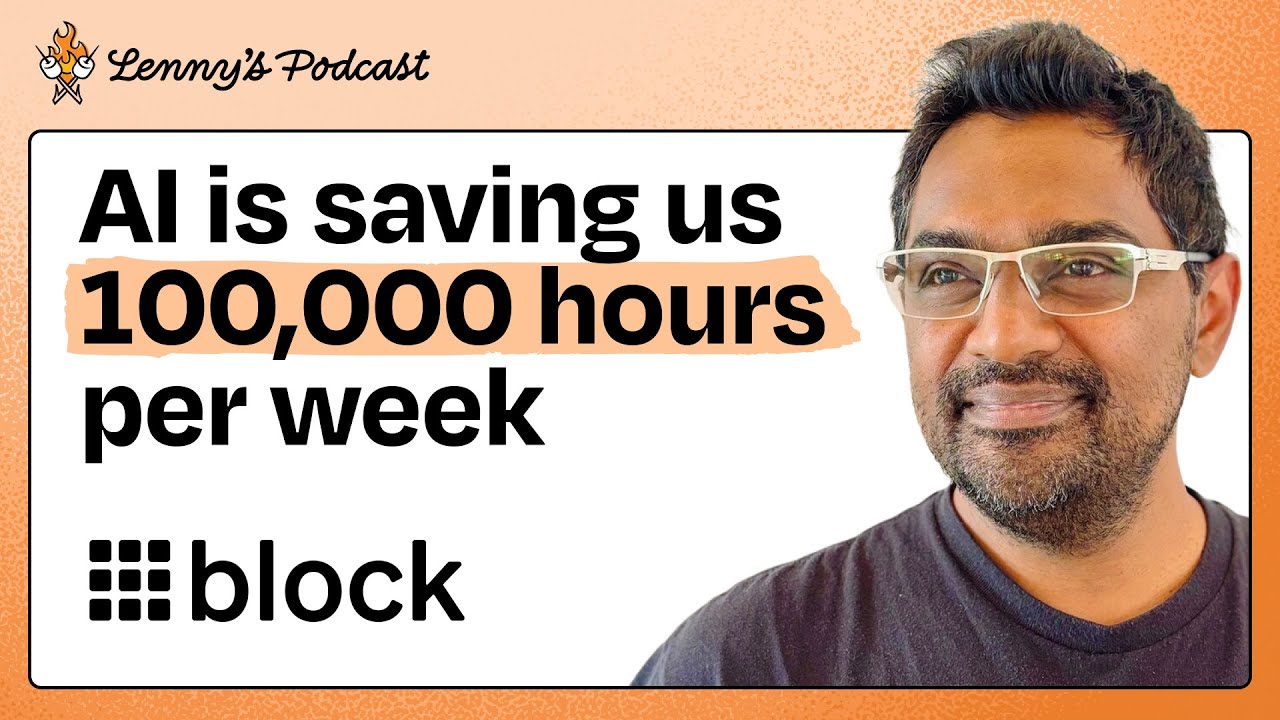
📺 Today’s recommended deep-dive video: https://www.youtube.com/watch?v=JMeXWVw0r3E
The AI Manifesto: How Block Reimagined Engineering for the Agentic Era
While most companies are still running timid AI pilots, Block (the parent company of Square and Cash App) has integrated artificial intelligence into its organizational DNA. CTO Dion Almaer reveals the internal shift from siloed business units to a functional, AI-native powerhouse where agents don’t just chat—they build.
Core Question: How can a global tech giant reorganize its entire structure to capture 25% productivity gains through autonomous AI agents?
Highlights
- The “AI Manifesto” that convinced Jack Dorsey to pivot the entire company toward an AI-native future.
- How “Goose,” Block’s open-source agent, is saving engineers up to 10 hours of manual work every week.
- Why a functional organizational structure is a prerequisite for successful AI adoption.
- The controversial truth about code quality: why it has almost nothing to do with building a successful product.
⏱️ Reading time: approx. 7 minutes · Saves you about 80 minutes vs. watching.
Want to take notes while watching? Click the image below and let AI Notebook capture the key points for you 👇

From Silos to Functionality
The AI Manifesto and Organizational Drift
When Dion Almaer joined the executive circle at Block, he noticed a dangerous “identity drift” where the company began seeing itself more as a financial services firm than a technology powerhouse. To course-correct, Dion penned an “AI Manifesto” to Jack Dorsey, arguing that the company had to become AI-native to survive the next decade of industry shifts.
Organizational structure dictates technical outcomes.
For years, Block operated under a General Manager (GM) structure where Cash App, Square, and Tidal ran as independent silos with their own separate engineering and design practices. While this was effective for scaling individual products, it created massive duplication and prevented the company from moving as a singular, technologically advanced unit.
To solve this, Dion oversaw a painful but necessary transition back to a functional organization. Now, all engineers report to a single head of engineering, and all designers report to a single head of design, mirroring the structure Steve Jobs famously used to save Apple. This alignment allows the company to share tools like Goose across all business units, ensuring that a breakthrough in one area immediately benefits the entire ecosystem.

💡 Digging Deeper
Q: Why is a functional structure better for AI?
A: Because AI tools require a common technical language; silos prevent the data and tool sharing necessary for agents to operate across the whole company.
Q: Was the transition to a functional model easy?
A: No, it was a “painful transformation” because it required breaking down established power structures and forcing teams to speak the same technical language after years of independence.
Q: What does “Technology First” mean in this context?
A: It means prioritizing engineering and design excellence over short-term commodity thinking, treating engineers as creative builders rather than interchangeable units of production.
The Rise of Goose: Agents with Arms and Legs
Beyond Chatbots: The Model Context Protocol
The most significant breakthrough at Block is the creation of “Goose,” a general-purpose AI agent that is now entirely open-source. Unlike standard chatbots that simply provide text responses, Goose uses the Model Context Protocol (MCP) to interact with the real world.
Goose gives the LLM “brain” digital arms and legs to execute tasks.
By wrapping existing enterprise tools like Snowflake, Tableau, and Slack in MCP, Goose can autonomously pull data, write Python code for analysis, generate charts, and email reports without human intervention. This capability has led to a self-reported saving of 8 to 10 hours per week for engineering teams, and an overall company-wide reduction in manual hours of roughly 25%.
Dion highlights a specific case of an engineer who lets Goose “watch” his screen via screenshots. While the engineer discusses a feature in a Slack thread, Goose observes the conversation, anticipates the need, and opens a Pull Request on GitHub before the human even starts typing. This level of anticipation is the “new baseline” for productivity.

💡 Digging Deeper
Q: What is vibe coding?
A: It is the practice of describing a desired outcome to a chatbot and letting it generate the code, rather than writing the lines by hand.
Q: How does Goose handle failure?
A: It is designed to be “back-trackable”; if one route to a solution fails, it backs up, tries a different logic path, and continues until it makes progress.
Q: Can non-technical people use these tools?
A: Yes, the biggest surprise at Block has been non-technical teams (like Risk or Legal) using Goose to build their own internal software tools, bypassing the need for a dedicated engineering roadmap.
The Counterintuitive Philosophy of Building
Why Code Quality is Overrated
One of the most provocative lessons Dion shares is that high code quality and successful products have almost zero correlation. He cites the early days of YouTube, which was famously built on a “terrible” architecture that stored videos as blobs in MySQL and ran on a slow Python stack. Despite its “ugly” code, it decimated Google Video, which was technically superior but lacked the same product-market resonance.
The purpose of code is to solve a human problem, not to be a monument to engineering perfection.
This philosophy drives Block’s current experimentation with “disposable code.” Dion is pushing teams to imagine a workflow where, for every new release, they delete the entire app and rebuild it from scratch using AI agents. While impossible for humans, AI makes this radical refactoring viable, ensuring the codebase never carries the weight of “legacy” baggage or incremental technical debt.
Dion also emphasizes the “Start Small” principle. Cash App began as a simple Hack Week project, and the first Bitcoin transaction at Block was just three people—including Jack Dorsey—buying a cup of coffee at Blue Bottle. By narrowing the scope to the smallest possible unit of value, teams can iterate toward massive success without “boiling the ocean to make a cup of tea.”

Key Takeaways
The transition to an AI-native company is as much about organizational chart design as it is about model selection. By moving to a functional structure, Block eliminated the silos that prevent AI agents from accessing the data and tools they need to be useful. This structural shift is the silent engine behind their 25% productivity gain.
Furthermore, the “agentic” era represents a shift from “human-in-the-loop” to “human-as-orchestrator.” When tools like Goose can work overnight to build multiple variations of an experiment, the human’s role changes from a builder of code to a judge of taste and value. The goal is no longer to write the best code, but to solve the problem most effectively.
Finally, the most successful leaders in this era will be those who “feel” the product themselves. Dion and Jack Dorsey’s insistence on using Goose daily ensures they understand the “ergonomics” of AI. They aren’t just reading white papers; they are building apps to organize receipts or extract images from Google Docs, keeping them grounded in the reality of the technology.
Q&A
Q1: What was the main argument of the “AI Manifesto” sent to Jack Dorsey?
A: It argued that Block needed to stop identifying as a fintech company and return to its roots as a technology company, specifically by centralizing AI efforts to stay ahead of the industry curve.
Q2: How does Block measure the impact of AI on productivity?
A: They use a combination of self-reported “hours saved” (averaging 8-10 per week for engineers) and data-driven “check metrics” like Pull Request throughput, distilled by data scientists into a manual-hours-saved percentage.
Q3: What is the “Model Context Protocol” (MCP)?
A: Developed by Anthropic and contributed to by Block, MCP is a standardized way for LLMs to connect to external tools like databases, APIs, and local files, essentially acting as a universal translator between the “brain” and the “tools.”
Q4: Which level of engineer benefits most from AI tools?
A: Senior engineers benefit by offloading repetitive tasks they’ve done a thousand times, while junior engineers use them to “blitz” through problems. However, the biggest gains are often seen in non-technical employees who can now build their own software.
Q5: What is Dion’s take on the “Rewrite vs. Refactor” debate?
A: He believes AI will eventually make the “never rewrite” rule obsolete. He advocates for a future where apps are essentially rebuilt from scratch for every release to ensure they respect the most current specifications without legacy debt.
Q6: Why does Dion recommend reading fiction and poetry over business books?
A: He believes classical literature and philosophy expand the mind and offer deeper insights into the human condition, which is more valuable for creative problem-solving than the “self-help” advice found in professional manuals.
Q7: How can other companies start their AI transformation?
A: Use the tools yourself. Dion stresses that leaders must “feel the product” by solving their own small, real-world problems with AI to understand its strengths and ergonomic limitations before trying to scale it.