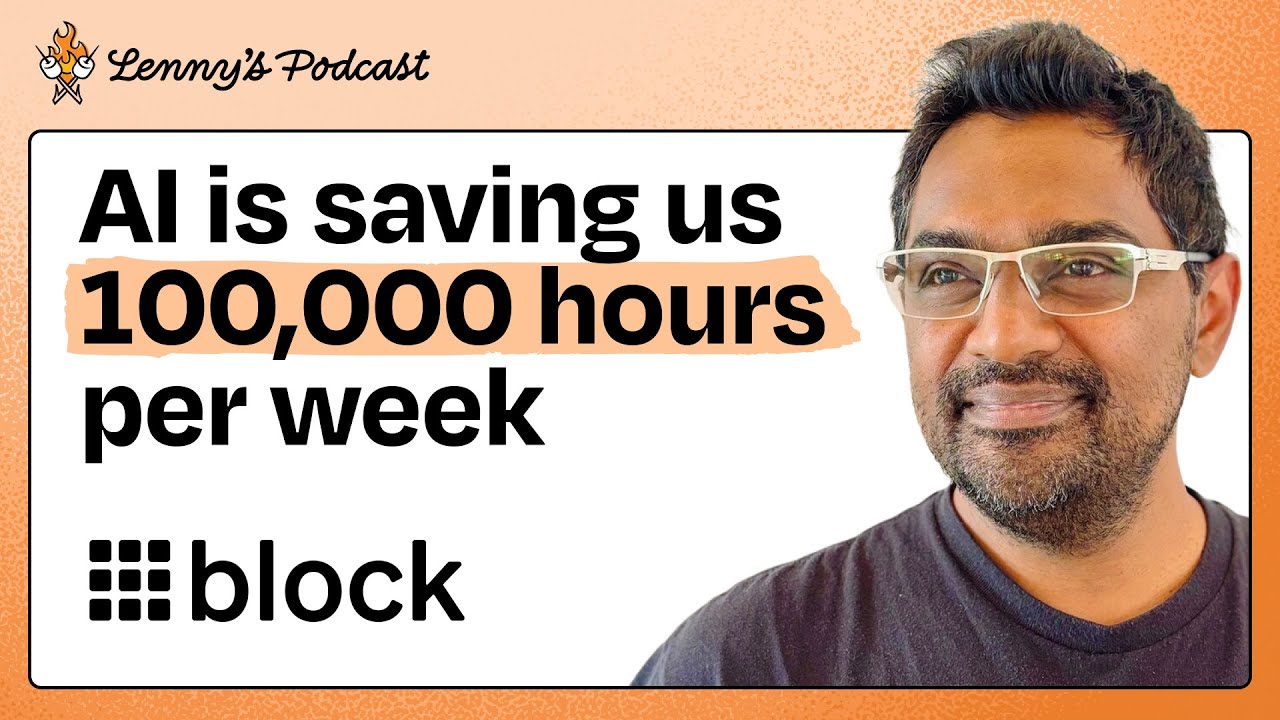
📺 Today’s recommended deep-dive video: https://www.youtube.com/watch?v=JMeXWVw0r3E
The AI-Native Pivot: How Block Reimagined Engineering for the Autonomous Era
AI productivity is often dismissed as hype, but at Block, it has become a measurable reality where engineering teams reclaim up to 10 hours per week. CTO Dion Almaer reveals how the company transitioned from a siloed “General Manager” structure to a functional powerhouse to facilitate this shift. By building “Goose,” an open-source AI agent, Block isn’t just assisting developers; it is preparing for a future where software builds itself overnight while humans provide the “taste.”
Core Question: How can a large-scale technology company reorganize its culture and tooling to move from manual coding to AI-driven autonomy?
Highlights
- The Functional Reorg: Why moving away from independent business silos (GMs) was the mandatory precursor to becoming AI-native.
- Goose & MCP: How Block’s open-source agent uses the Model Context Protocol to give LLMs “arms and legs” across the enterprise.
- Vibe Coding to Autonomy: The shift from chat-based nudging to agents that work for hours on complex tasks without human intervention.
- The Code Quality Myth: Why high-quality architecture matters far less than solving a specific human problem, as proven by the early days of YouTube.
⏱️ Reading time: approx. 8 minutes · Saves you about 79 minutes vs. watching.
Want to take notes while watching? Click the image below and let AI Notebook capture the key points for you 👇

The Foundation: Strategy Over Tooling
Reclaiming Technical DNA through Functional Reorganization
Organizational structure is the ultimate predictor of technical success.
Before Block could embrace AI, it had to solve an “identity drift” problem where it began viewing itself more as a financial services firm than a technology company. To fix this, Dion Almaer spearheaded a massive shift from a General Manager (GM) structure—where units like Cash App and Square operated as independent silos—to a functional model. Under this new regime, all 3,500+ engineers report into a single technical organization, allowing for the standardization of tools, policies, and AI strategies that were previously impossible to scale across fragmented teams.
This transformation was not merely an administrative change; it was a deliberate application of Conway’s Law. When teams are siloed, they build siloed technology, resulting in duplicated efforts and a lack of shared platforms. By centralizing engineering and design, Block created a unified “surface area” where AI tools like Goose could be deployed universally, ensuring that a senior engineer in the Square division speaks the same technical language as one in Cash App.

💡 Digging Deeper
Q: Why was the GM structure a barrier to AI adoption?
A: In a GM model, engineering is often treated as a commodity to be added per feature. Centralization allows for the creation of common platforms and modules that AI can leverage much more effectively than fragmented codebases.
Q: What is the primary benefit of “Functional” leadership?
A: It puts engineering and design first. Instead of engineers reporting to a business-focused GM, they report to technical leaders who prioritize technical depth and long-term architectural health over short-term feature counts.
The Agentic Revolution: Giving LLMs “Arms and Legs”
Meet Goose: The Open-Source Agent Running Block
Goose is a general-purpose AI agent that acts as a resident “digital employee” on a developer’s machine.
Unlike a standard chatbot that simply suggests text, Goose is built on the Model Context Protocol (MCP), a formalized wrapper system that connects the LLM to internal databases like Snowflake and tools like Jira or Slack. This allows an engineer to ask a single question—”Generate a marketing report with charts and email it to the team”—and watch as Goose pulls SQL data, runs a Python analysis script, generates JavaScript visualizations, and handles the communication. It effectively moves AI from a passive “autocomplete” tool to an active orchestrator of the digital workspace.
One of the most surprising outcomes of Goose’s deployment at Block was its adoption by non-technical teams. The Enterprise Risk Management team, for instance, used Goose to build their own internal self-service tools, compressing weeks of traditional development into a few hours of agent-guided creation. This “democratization of building” reduces the burden on central engineering teams, as departments no longer have to wait for a Q3 roadmap slot to solve their minor internal bottlenecks.

💡 Digging Deeper
Q: Is Goose exclusive to Block?
A: No, it is entirely open-source and pluggable. Anyone can download it, add their own API keys (Anthropic, OpenAI, or local models via Ollama), and build their own MCP extensions.
Q: How does Block measure the impact of these tools?
A: They track “manual hours saved,” currently estimated at 20-25% across the company. Engineering-heavy teams report saving 8 to 10 hours per week, a figure Dion believes is the “lowest it will ever be.”
The Future of Work: Autonomy and “Human Taste”
Shifting from “Vibe Coding” to Overnight Autonomy
The current era of “vibe coding”—chatting back and forth with a bot—is just a transition phase.
Dion anticipates a shift toward long-form autonomy where agents don’t just work for five minutes but for several hours or even weekends. Imagine a scenario where an engineer describes five different experimental architectures before leaving for the day; by morning, the AI has built all five, allowing the human to review the results and “throw away” the four that don’t feel right. This moves the engineer’s role from “writer” to “editor” and “judge,” where the most valuable skill is no longer syntax, but “human taste.”
This philosophy also challenges the traditional software wisdom that says “never rewrite your code.” With AI, the cost of a total rewrite drops so significantly that it might become more efficient to “RM -RF” (delete) an entire app and rebuild it from a modern specification rather than spend years refactoring legacy debt. While AI handles the heavy lifting of the rewrite, the human ensures the new version respects the incremental bug fixes and nuances of the original.

💡 Digging Deeper
Q: Will AI replace the need for senior engineers?
A: No. Senior engineers are more critical than ever for “portfolio judgment.” AI can build things quickly, but it cannot yet determine if a process is even necessary or if a design aligns with a company’s core mission.
Q: What is the most counterintuitive lesson about code quality?
A: Code quality and product success are often unrelated. YouTube’s early code was famously chaotic (using Python and storing videos as blobs in MySQL), but it succeeded because it solved a real human problem better than Google’s hyper-optimized “Google Video.”
Key Takeaways
To remain competitive in an AI-forward market, companies must stop viewing AI as a peripheral tool and start viewing it as a core architectural shift. This requires a “learning-first” mindset where every experiment—successful or not—is treated as a data point for future growth.
Productivity gains aren’t found by simply giving every employee a ChatGPT subscription. They are found by restructuring the organization to remove silos, building open protocols that allow agents to interact with internal data, and encouraging a culture where “vibe coding” leads to total autonomous development.
Ultimately, the most successful builders of the next decade will be those who use AI to handle the “drudge work” of coding, leaving the humans free to focus on the high-level judgment and creative taste that define truly great products.
Q&A
Q1: What was the “AI Manifesto” Dion sent to Jack Dorsey?
It was a letter arguing that Block needed to become “AI native” and move centrally to stay ahead of the industry. It resulted in Dion being promoted to CTO and a complete overhaul of the company’s functional structure.
Q2: How does Goose differ from tools like Cursor or GitHub Copilot?
Goose is a platform, not just an editor. Because it uses the Model Context Protocol (MCP), it can be extended to control any digital tool, from Snowflake to Google Docs, making it a general-purpose agent rather than just a code assistant.
Q3: Is Block still hiring engineers at the same rate?
While AI saves time, the desire for features and velocity remains infinite. Block is being more thoughtful about headcount, but they aren’t slowing down; they are looking for “learning-mindset” candidates who embrace these new tools.
Q4: What is “Vibe Coding”?
It is a term for natural-language programming—building software by describing it to a chatbot rather than writing lines of code by hand. It’s highly effective for greenfield projects and non-technical staff.
Q5: Why did Dion mention the “Master and Margarita” and poetry?
He believes CTOs should read fiction and philosophy to expand their minds beyond daily professional tasks. This helps in questioning the “human condition” and making better judgments about why a product exists in the first place.
Q6: What is “Fail Corner”?
It is a reflection on past failures like Google Wave, Google+, and Secret. Dion notes that these failures provided the humility and technical lessons necessary to build massive successes like Cash App.
Q7: Can a regular person use Goose?
Yes, it is open-source and available for Mac, Windows, and Linux. It supports both a GUI and a command-line interface for more technical users.