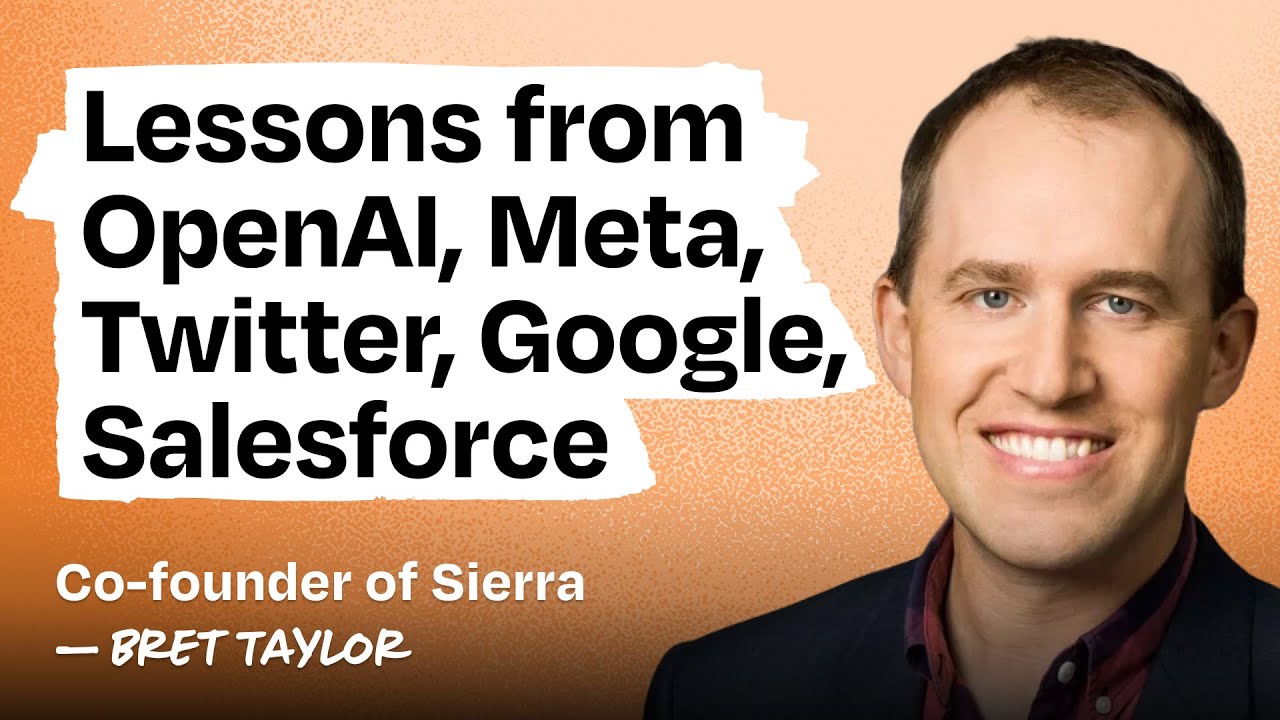
📺 Today’s recommended deep-dive video: https://www.youtube.com/watch?v=qImgGtnNbx0
The Builder’s Playbook: Bret Taylor on Agents, Impact, and Engineering the Future
From co-creating Google Maps and inventing the “Like” button to serving as the co-CEO of Salesforce and Chairman of OpenAI, Bret Taylor has navigated every tier of the technology stack. In this deep dive, he shares the hard-won lessons from his most public failures and his thesis on why the next era of software belongs to autonomous agents driven by outcome-based pricing.
Core Question: How can builders adapt their mindsets and business models to thrive in a world where AI agents replace traditional software applications?
Highlights
- The “Impact” Heuristic: How a blunt feedback session with Sheryl Sandberg shifted Taylor’s focus from personal preference to organizational impact.
- The AI Market Map: Why startups should avoid the “CapEx war” of frontier models and focus on the high-margin “Applied AI” and “Agent” segments.
- Outcome-Based Pricing: A breakdown of why selling software as a service is evolving into selling autonomous business results.
- Systems Thinking vs. Syntax: Why computer science remains a vital discipline even as AI begins to generate the vast majority of our code.
⏱️ Reading time: approx. 9 minutes · Saves you about 80 minutes vs. watching.
Want to take notes while watching? Click the image below and let AI Notebook capture the key points for you 👇

The Psychology of Impact and the Anatomy of Failure
Moving from Feature Polish to Market Reality
Identity is the most dangerous limiter for a founder, often forcing us to view every complex business challenge through the narrow lens of our specific technical training.
Taylor recalls his time at Facebook when he was struggling to transition from a hands-on architect to a leader of thousands, a shift that only occurred after a blunt, uncomfortable intervention from Sheryl Sandberg. She challenged him to stop editing partner decks and start managing his team to a world-class standard, forcing him to confront the fact that he was hiding in his comfort zone.
This pivotal moment transformed his entire philosophy, shifting his morning routine from checking off tasks to asking one fundamental question: “What is the most impactful thing I can do today?” By detaching his ego from the act of engineering and attaching it to the outcome of impact, he gained the flexibility to move between C-suite roles and founding teams with a fluidity that few in Silicon Valley have ever replicated.
When you are a great engineer, every problem looks like a bug to be fixed, yet the biggest business failures often have nothing to do with code and everything to do with distribution or celebrity-driven market shifts.

💡 Digging Deeper
Q: Why did Google Local fail despite having a link on the Google homepage?
A: It was a “me-too” product that merely digitized the Yellow Pages without offering a native, differentiated experience that justified a change in user behavior.
Q: How did the Google Maps “V2” fix this?
A: By inverting the hierarchy—making the map the canvas rather than a sidebar—and adding “sizzle” like satellite imagery that created viral, culturally relevant moments.
Q: What is the “Single Issue Voter” trap for founders?
A: It is the tendency for founders to use their primary skill (engineering, design, or BD) as the default solution for every company problem, regardless of whether that skill is the appropriate tool for the job.
The Three Segments of the AI Market
Mapping the Opportunity for Startups
The AI landscape is consolidating into three distinct tiers, and for the vast majority of entrepreneurs, the “Frontier Model” tier is a graveyard of capital.
Frontier models are now entirely a function of CapEx capacity, requiring billions in investment for assets that deteriorate in value almost as fast as they are trained. Unless you possess the unique capital-raising gravity of an Elon Musk, Taylor argues that startups have no viable path to escape velocity in this segment, as evidenced by the rapid consolidation of early labs like Inflection and Adept.
The second tier, Tooling, offers high potential but carries the “close to the sun” risk where infrastructure providers like AWS or OpenAI can easily absorb a startup’s core functionality during a single developer day.
Applied AI—specifically the creation of autonomous agents—represents the most fertile ground for new companies because it focuses on solving deep, industry-specific business problems rather than just selling compute. These companies will likely have higher margins because they sell outcomes, though they will continue to pay a “model tax” to the frontier providers who maintain the underlying intelligence layers.

💡 Digging Deeper
Q: Why is the tooling market considered “risky”?
A: Because infrastructure providers are constantly moving up the stack to differentiate, meaning any successful tool is at risk of becoming a native feature of the platform.
Q: What defines a successful “Applied AI” company?
A: It is a company that focuses on the “last mile” of a business problem, such as legal contract review or customer service, where the model is just a component of a larger workflow.
Q: Will model costs always stay high for startups?
A: While they pay a tax to labs, the cost of intelligence is trending toward zero, which shifts the competitive moat from technical achievement to product differentiation and customer integration.
Outcome-Based Pricing: The End of the Seat License
Selling Work, Not Software
The software industry is entering a “step-change” moment similar to the transition from on-premise servers to the cloud, driven by the shift from productivity tools to autonomous agents.
Traditional SaaS pricing models are based on seats or utilization, but in an AI world, these metrics are often inversely correlated with the actual value delivered to the customer. If an AI agent solves a customer’s problem in three seconds, charging by the “token” or the “hour” punishes efficiency and fails to capture the true economic benefit of the resolved issue.
Taylor’s company, Sierra, exemplifies this shift by utilizing “resolution-based” pricing, where the company only gets paid when the AI agent successfully solves a user’s problem without human intervention. This aligns the vendor’s incentives perfectly with the customer’s goals, transforming the relationship from a simple software provider to a strategic business partner that shares in the success of the operation.
This model requires a radical rethinking of how companies are built, forcing teams to move away from “throwing code at the wall” and toward a rigorous focus on customer-centric results.

💡 Digging Deeper
Q: Why is it hard to sell traditional “productivity” software?
A: Because it is nearly impossible to prove that a tool made an employee 10% more productive, whereas an agent’s resolution of a specific task is binary and measurable.
Q: Is outcome-based pricing possible for every product?
A: It requires the agent to be autonomous and the outcome to be highly attributable; if you can’t prove the agent did the work, the pricing model falls apart.
Q: How does Sierra handle “negative value” interactions?
A: By ensuring the pricing is tied only to successful resolutions; if the agent fails or causes frustration, the company doesn’t get paid, which drives a relentless focus on quality.
The Future of Creation and Engineering
Why Systems Thinking Beats Syntax
The act of writing code is moving from a high-cost manual labor process to a near-zero marginal cost byproduct of generative machines.
We are quickly approaching a world where the “ergonomics” of a programming language like Python—designed to be readable by humans—may become a hindrance rather than a benefit for AI-generated software. Taylor envisions a new “programming system” that prioritizes formal verification and memory safety over human readability, allowing operators to oversee incredibly complex systems without needing to manually inspect every line of emitted code.
Despite this automation, the foundational principles of computer science—Big O notation, algorithms, and caching—remain essential because they provide the “systems thinking” required to constrain and guide AI.
Education must evolve to treat AI like a graphing calculator; it shouldn’t replace the need to understand the underlying logic, but it should fundamentally change the complexity of the problems we ask students to solve.

💡 Digging Deeper
Q: Should students still learn to code?
A: They should learn computer science foundations to build mental models of systems, but the specific “syntax” of typing into a terminal will become less valuable.
Q: What is “Vibe Coding”?
A: It is the early phase of AI development where people generate prototypes quickly, but Taylor warns that the real challenge remains maintaining and scaling these complex systems.
Q: How can AI democratize education?
A: By providing every child with a personalized tutor that can explain complex topics like Shakespeare or Calculus in the specific style that the student learns best.
Key Takeaways
The transition to an agent-led economy is not just a technological shift; it is a fundamental restructuring of the relationship between builders, software, and business outcomes. Success in this new era requires a “flexible identity,” where founders are willing to step outside their technical comfort zones to focus relentlessly on organizational impact and market distribution.
Startups must be wary of the “CapEx trap” of frontier models and the “absorption risk” of tooling, instead finding moats in the applied AI space where they can solve high-value, autonomous tasks. By adopting outcome-based pricing, companies can finally align their financial success with the actual value they provide, moving beyond the arbitrary limitations of seat licenses and token counts.
Ultimately, the role of the “engineer” is transforming into that of a “system operator.” The builders who win will be those who master the art of context engineering and systems thinking, using AI to amplify their agency rather than replace their judgment.
Q&A
Q1: What was the biggest lesson from the failure of FriendFeed?
A: That distribution often beats product polish. While FriendFeed had better features than early Twitter, Twitter won by aggressively recruiting celebrities like Oprah and Ashton Kutcher.
Q2: How does Taylor recommend giving feedback?
A: He points to Sheryl Sandberg’s style—direct and uncomfortable, but delivered in a way that makes it clear she cares about your long-term success.
Q3: What is the most impactful way to use AI as a parent?
A: Encourage children to use it as a personalized tutor and a tool for agency, such as using it to quiz themselves or explain difficult passages in a book.
Q4: Why does Taylor prefer Rust for AI-generated code over Python?
A: Because AI-generated code is hard for humans to verify; Rust’s compile-time memory safety provides a mechanical way to ensure the code is robust without manual inspection.
Q5: What is the “Like” button’s origin story?
A: It was originally envisioned as a “one-click comment” to remove the clutter of “wow” and “cool” from newsfeed discussions; it beat out the “heart” icon because it felt more neutral.
Q6: How can companies improve AI productivity today?
A: Through “context engineering”—analyzing why an AI made a mistake and providing the specific missing context at the root level to prevent future errors.
Q7: Which go-to-market motion is best for AI startups?
A: Direct sales is coming back into fashion because the “buyer” and the “user” of complex AI agents are often different people, making product-led growth (PLG) harder to execute.