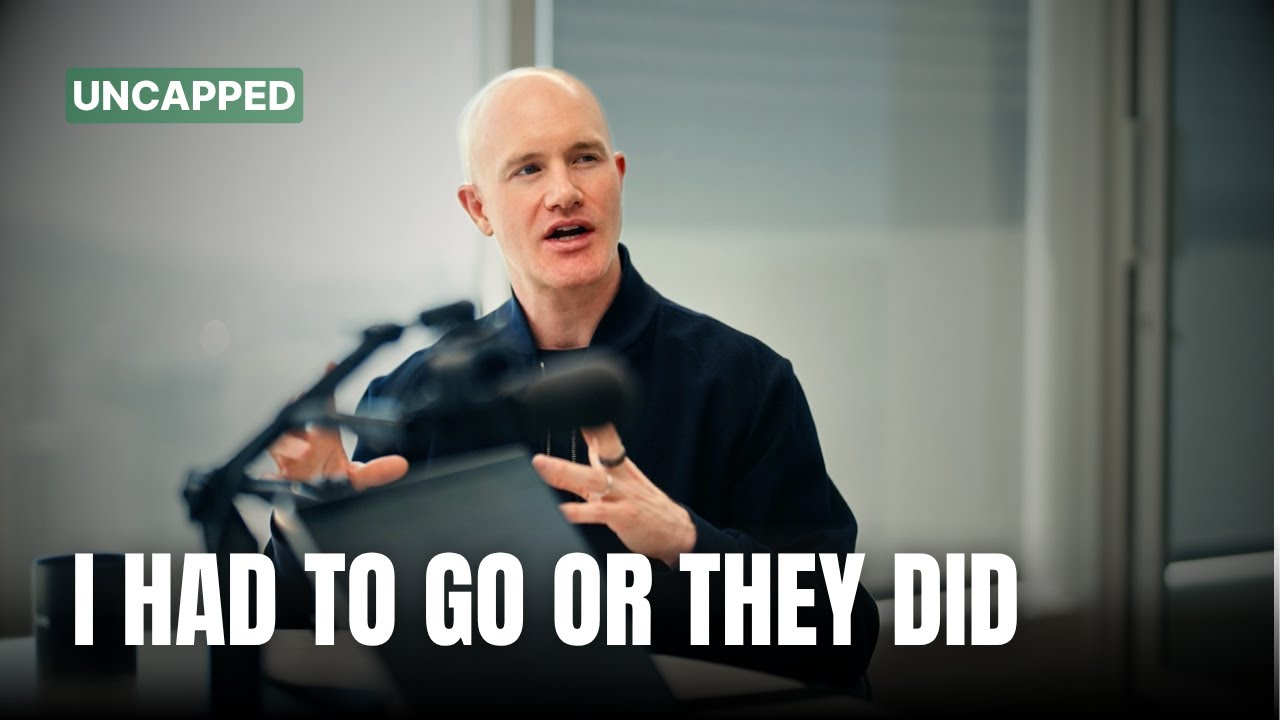
📺 Today’s recommended deep-dive video: https://www.youtube.com/watch?v=mSToBYLSSew
The On-Chain Inevitability: Brian Armstrong on the Future of Money, Biology, and Leadership
As the CEO of Coinbase, Brian Armstrong is no longer just building a crypto exchange; he is architecting the infrastructure for a global on-chain economy. From battling federal regulators to funding longevity research that aims to “reprogram” human aging, Armstrong’s vision extends far beyond the ticker tape.
Core Question: How will the convergence of blockchain, decentralized finance, and bio-technological breakthroughs redefine human economic freedom and physical existence?
Highlights
- The shift of all financial assets—stocks, commodities, and votes—to transparent, 24/7 on-chain protocols.
- Strategies for surviving “regulatory weaponization” and how the crypto industry built a political grassroots movement to influence US elections.
- The science of epigenetic reprogramming and why restoring cellular function is the “meta-problem” that could solve heart disease and cancer.
- The Gradual Merge: How non-invasive brain-computer interfaces could lead to digital consciousness and a “ship of Theseus” transition to the cloud.
⏱️ Reading time: approx. 7 minutes · Saves you about 40 minutes vs. watching.
Want to take notes while watching? Click the image below and let AI Notebook capture the key points for you 👇

The Inevitability of the Everything Exchange
The Plumbing of the Future
All assets are moving on-chain because decentralized technology is simply faster, cheaper, and more global than the antiquated plumbing of the legacy financial world.
Think about the current friction in international stock trading; currently, a wealthy individual in Argentina struggles to open a US brokerage account, but tokenization democratizes that access instantly to anyone with a smartphone and an internet connection. Beyond just simple trading, on-chain assets enable programmable governance where voting rights can be restricted to long-term holders, preventing activist raids and aligning incentives between companies and their investors for decades to come.
We are moving toward a world where prediction markets, startup capital formation, and even basic property rights are no longer controlled by local gatekeepers but by open-source code. This shift represents the most significant update to the financial system since the invention of the internet itself.

💡 Digging Deeper
Q: Why is corporate permission important for tokenizing stocks?
A: Armstrong believes collaboration is key to avoiding legal derivatives messiness; companies will eventually opt-in because on-chain fundraising is more efficient for reaching accredited investors globally.
Q: What is the “Genius Act” for stablecoins?
A: It is a symbolic and functional piece of legislation that clarifies that dollar-backed stablecoins must have 100% reserves in transparent assets like treasuries, effectively ending the “Wild West” narrative used by critics.
Q: How does crypto help with governance?
A: On-chain protocols can enforce novel rules, such as requiring a user to hold a token for over a year before they are granted voting power in a company’s direction.
The Political War and Macro Discipline
Building a Grassroots Powerhouse
For years, the lack of regulatory clarity in the US was weaponized by political activists who attempted to shut down the industry through unlawful litigation rather than legislation. This hostile environment forced a naive startup community to grow up quickly, accumulating the political power necessary to ensure that crypto voters became a constituency that politicians could no longer afford to ignore.
Through initiatives like StandWithCrypto.org, the industry organized millions of voters and funded super PACs to fire hostile lawmakers.
Bitcoin acts as a new gold standard, serving as a critical check and balance against the reckless deficit spending and inflation that historically erode the wealth of a nation’s poorest citizens. If the United States cannot get its fiscal house in order, Bitcoin offers a lifeboat that prevents citizens from having to flee toward the Chinese yuan or other state-controlled alternatives. By creating a transnational currency that no single government can manipulate, we establish a foundation for property rights and sound money that functions independently of the “fingers on the dial” in any central bank.

💡 Digging Deeper
Q: Is Bitcoin a threat to the US Dollar?
A: No; Armstrong argues it is a check on deficit spending that actually extends Western civilization by providing a digital gold standard when fiat discipline fails.
Q: What was the main failure of the early ICO boom?
A: It happened largely outside the regulatory perimeter, leading to a mix of genuine innovation and bad actors, whereas the new wave of on-chain capital formation will be well-regulated and efficient.
Frontier Tech: Rewriting Aging and the Brain
Reprogramming Human Biology
New Limit is exploring epigenetic reprogramming, a theory suggesting that major diseases like cancer and heart disease are merely symptoms of cellular loss of function over time. By using AI to screen millions of transcription factors, researchers can now test hypotheses in weeks that used to take years, aiming to restore an 80-year-old’s immune system to the potency it had when they were twenty.
If we can restore the function of cells, we might eliminate the root cause of mortality rather than just treating the symptoms of individual diseases.
The ultimate frontier is the brain-computer interface (BCI), where companies like Nudge use non-invasive ultrasound technology to read and write brain states without drilling holes into the human skull. This leads to “The Merge,” a gradual ship-of-Theseus transition where more of our consciousness occurs in the cloud through high-bandwidth connections. Eventually, if the biological body perishes, the digital self remains, ensuring a continuity of identity that feels like a natural progression rather than a destructive, atom-by-atom upload.

💡 Digging Deeper
Q: Why focus on “Healthspan” over “Longevity”?
A: Longevity often conjures images of being kept alive in a decrepit state; healthspan emphasizes maintaining the energy and mental acuity of a 30-year-old indefinitely.
Q: What is the benefit of non-invasive BCI?
A: Using focused ultrasound (Nudge) lowers the barrier to entry, allowing treatments for depression, insomnia, and chronic pain without surgical risks.
Q: How does the “Ship of Theseus” apply to the brain?
A: It suggests a slow augmentation where AI hemispheres are added to the brain; by the time the biological part fails, the individual “still feels like them” in the digital realm.
The Inner Game of Leadership
Leading Through the Fire
Taking an apolitical stance during a period of high social tension was terrifying, and Armstrong recalls his voice literally quivering as he addressed his employees. He was prepared to fire half the staff if they walked out because a leader must create clarity or step aside when the team is no longer aligned.
Great leadership requires “iron in the veins,” a willingness to be disagreeable and move outside the comfort zone until the most stressful tasks—like congressional testimony or mass layoffs—become routine calluses.
To survive decades of this intensity, a CEO must shift from an all-out sprint to a sustainable marathon pace by prioritizing sleep, nutrition, and quarterly “learning weeks.” It is not always fun; in fact, there are days when the weight of litigation and public scrutiny feels utterly awful. However, the fulfillment of building something important outweighs the momentary pain of the struggle, and the ability to stay steady during irrational exuberance or deep market crashes is what separates missionaries from mercenaries.

Key Takeaways
The transition to an on-chain world is less about speculation and more about the fundamental restructuring of human coordination. By removing the friction of legacy banking and introducing programmable sound money, we are creating a global economy that is inherently more equitable and efficient. This same drive for optimization is now being applied to human biology, where the intersection of AI and genomics is turning aging into a solvable engineering problem.
Success in these high-stakes frontiers requires a specific type of psychological resilience. Whether it is standing up to the SEC or managing the internal culture of a multi-billion dollar company, the core requirement is the ability to act on conviction when it is unpopular. Brian Armstrong’s journey suggests that the future belongs to those who can maintain their “missionary” focus while navigating the cyclical volatility of both markets and politics.
Q&A
Q1: Why does Brian Armstrong believe all trading will move on-chain?
A: Because on-chain systems are 24/7, global, faster, and cheaper, allowing for innovations like tokenized stocks and programmable governance that traditional systems cannot support.
Q2: What was the “apolitical” stance and why was it controversial?
A: Armstrong directed Coinbase to focus strictly on the mission rather than societal politics; it was controversial because it challenged the then-dominant trend of corporate activism, leading to a small percentage of staff taking an exit package.
Q3: How does New Limit plan to solve aging?
A: By using AI and single-cell sequencing to identify transcription factors that can “reprogram” cells to a more youthful, functional state, thereby reducing the incidence of age-related diseases.
Q4: What is the “Merge” with AI?
A: A gradual process where brain-computer interfaces allow humans to shift more of their cognitive processing to the cloud, eventually allowing consciousness to persist even if the biological body fails.
Q5: How did Coinbase change its approach to Washington D.C.?
A: It shifted from being a purely “educational resource” to an organized political force, using grassroots movements (Stand With Crypto) and financial influence to support pro-crypto candidates.
Q6: What does Armstrong mean by “mercenary vs. missionary”?
A: Missionaries are driven by the long-term goal and stay through downturns; mercenaries are there for the hype and bail when the “hot new thing” loses its luster.
Q7: How does a CEO avoid burnout according to the transcript?
A: By treating the role as a marathon, focusing on health fundamentals (sleep/exercise), and scheduling mandatory “learning weeks” or breaks every quarter.