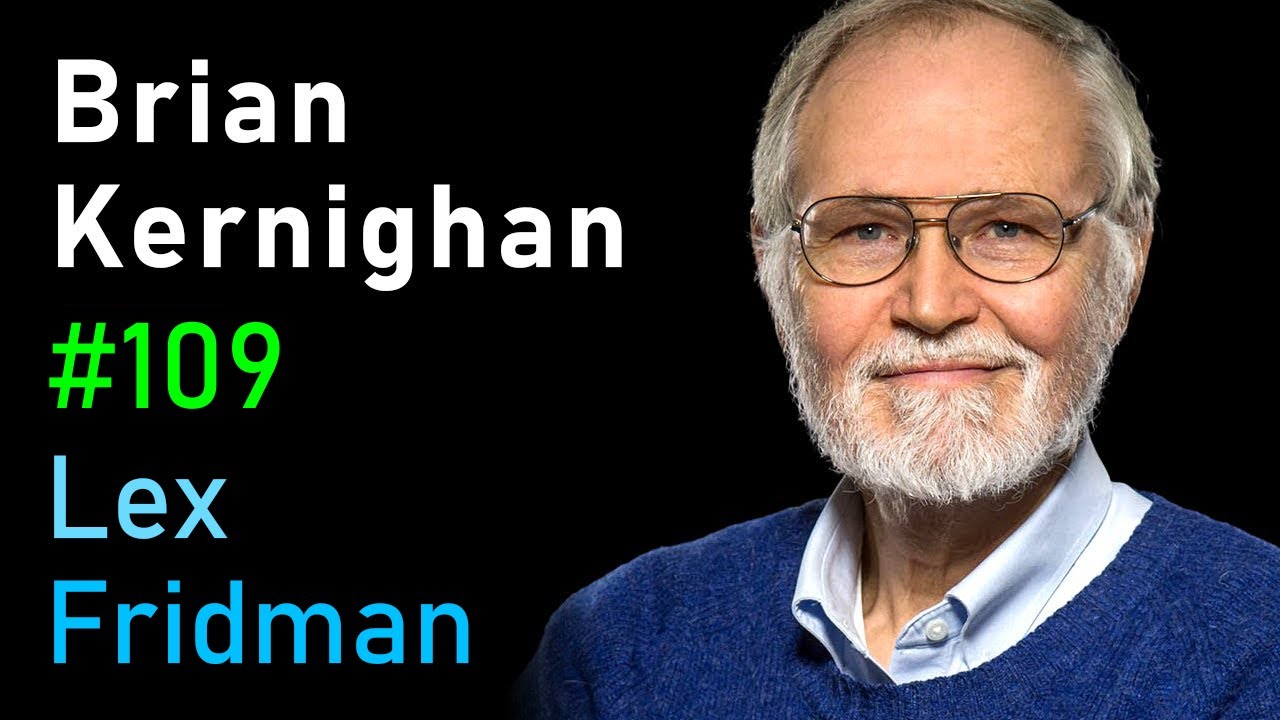
📺 Today’s recommended deep-dive video: https://www.youtube.com/watch?v=O9upVbGSBFo
The Architect of Simplicity: Brian Kernighan on Unix, C, and the Soul of Computing
From the sterile mainframe rooms of Bell Labs to the ubiquity of modern smartphones, few have shaped the digital landscape as profoundly as Brian Kernighan. In this conversation, the co-author of the C programming language and contributor to Unix reflects on why minimalist design and programmer-centric tools remain the bedrock of global infrastructure fifty years later.
Core Question: How did a small group of researchers at Bell Labs create the foundational infrastructure of the modern world through a philosophy of minimalism and interactive design?
Highlights
- The “accidental” birth of Unix following the failure of the ambitious Multics project.
- Why C found the “sweet spot” between high-level expressiveness and low-level hardware efficiency.
- The importance of the “Hello World” philosophy in creating effective technical examples.
- Reflections on the evolution of AI, from the optimism of the 1960s to modern data-driven learning.
⏱️ Reading time: approx. 8 minutes · Saves you about 95 minutes vs. watching.
Want to take notes while watching? Click the image below and let AI Notebook capture the key points for you 👇

The Accidental Genesis of Unix
From Punch Cards to Time-Sharing
Unix was born from a desire to reclaim the interactive computing experience lost when Bell Labs withdrew from the ambitious Multics project.
In the 1960s, computing meant punch cards and long waits; time-sharing broke this bottleneck by giving each user a “slice” of the processor. This created the illusion of private machine ownership, allowing developers to type commands on electric typewriters and receive immediate feedback, which fundamentally changed the speed of software development.
The PDP-7, a relatively obsolete mini-computer by 1969 with only 16K of memory, provided the physical canvas for Ken Thompson’s three-week sprint to build a new operating system. This constraint forced a minimalist architecture where the file system was generalized and every tool did one thing well. Because the hardware was so limited, the software had to be elegant, leading to a system that eventually outlasted the very machines it was designed to run on.

💡 Digging Deeper
Q: How much memory did the original Unix machines have?
A: The PDP-7 had roughly 16K of 18-bit words, which is about 36 kilobytes—thousands of times less than a modern digital photo.
Q: Why is the Unix file system considered a “generalization”?
A: It treated everything—files on a disk, physical hardware devices, and even processes—as a simple stream of bytes, allowing the same tools to interact with different resources.
Q: Was Unix originally open source?
A: Not formally. It was proprietary, but AT&T licensed the source code freely to universities, which allowed a generation of students to study and improve it.
The Language of Systems: From C to Go
The Sweet Spot of C
C succeeded because it found a rare balance between high-level human readability and the brutal efficiency required by 1970s hardware.
Unlike the assembly languages of the 1950s which were tied to specific hardware, C provided a way to describe system behaviors that could run on almost any machine. This portability transformed software into a “virtuous circle” where the operating system and its tools could evolve together, eventually permeating every university and research lab in the country.
Dennis Ritchie’s reference manual for C remains a gold standard for technical writing because it prioritized clarity over jargon. Kernighan notes that the “Hello World” example wasn’t just a triviality; it was a way to prove that the entire toolchain—from the editor to the compiler—was working correctly, providing the programmer with a small, immediate win that builds the confidence necessary for more complex tasks.

💡 Digging Deeper
Q: Why did Kernighan write “The C Programming Language” with Dennis Ritchie?
A: He recognized that C was spreading and there were no books available; he “twisted Dennis’s arm” until they agreed to document it.
Q: What makes AWK unique compared to other languages?
A: It is designed for “one-liners”—tasks like counting or searching text files that take 20 lines in Python but only one in AWK.
Q: What is the main advantage of the Go programming language?
A: Go provides an exceptionally clean model for concurrency, allowing programs to handle multiple simultaneous tasks easily and efficiently.
Optimization and the Human Element
Modeling the World with AMPL
AMPL (A Mathematical Programming Language) highlights a crucial distinction in computing: the separation of a problem’s algebraic model from the specialized “solvers” that do the heavy mathematical lifting.
By allowing users to write constraints in a form that looks like textbook algebra, AMPL made large-scale optimization accessible to those who weren’t experts in numerical analysis. This abstraction meant that a researcher could describe a complex shipping network or a financial portfolio once, then swap out different “solvers” underneath to find the most efficient solution without rewriting their logic.
💡 Digging Deeper
Q: Is the P vs NP problem solvable?
A: Kernighan suspects the answer is “No,” but he notes that most computer scientists simply act as if the two are not equal while using heuristics to solve the hard problems anyway.
Q: What is the “AI Summer” of the 1960s?
A: A period of immense optimism where researchers believed machines would solve language translation and chess within years, only to realize the problems were far more complex than anticipated.
Key Takeaways
The history of computing is not a straight line of progress but a series of adaptations to constraints. Unix succeeded because it was “little” and “humble,” designed by programmers for their own productivity rather than for a corporate mandate. This focus on the “human in the loop” is what allowed Bell Labs to produce so many Nobel Prizes and Turing Awards; they created an environment where the feedback loop between idea and execution was as tight as possible.
As we move into an era dominated by AI and massive libraries, Kernighan warns of the “black box” problem. Modern developers often “pip install” megabytes of code they don’t understand, creating security risks and making debugging nearly impossible. Maintaining a level of tech literacy—understanding what the machine is actually doing at the instruction level—is more important than ever to prevent us from becoming passive subjects of the systems we built.
Ultimately, the most enduring tools are those that provide “bang for the buck” in terms of simplicity. Whether it is a two-line AWK script or a clean C function, the ability to express complex logic through simple, composable parts remains the highest form of the programmer’s art.
Q&A
Q1: What was the primary goal of the original Unix creators?
A1: They wanted to create a collaborative community and a comfortable environment where they could write programs and share them with each other effectively.
Q2: How did “Hello World” become the standard first program?
A2: It was first used in Kernighan’s internal Bell Labs tutorial for the language ‘B’ (the predecessor to C) as a minimal test of a working environment.
Q3: Does Brian Kernighan think everyone should learn to program?
A3: Not necessarily to become a professional, but he believes everyone should understand what programming is so they aren’t mystified by the digital world.
Q4: Which text editor does a legend like Kernighan use?
A4: He primarily uses ‘Sam’ (written by Rob Pike), though he occasionally uses VI for quick edits.
Q5: What is the main concern with modern Machine Learning?
A5: The risk that AI reinforces and amplifies historical biases found in the data, essentially acting as a “mirror” that can propagate our worst social flaws.
Q6: What is the “Unix Philosophy” in a nutshell?
A6: Build small, modular tools that do one thing well and communicate with each other through a universal interface (plain text).
Q7: How did Moore’s Law change the way we design languages?
A7: As processors stopped getting faster individually, languages like Go evolved to handle “horizontal” growth—managing many processor cores simultaneously.