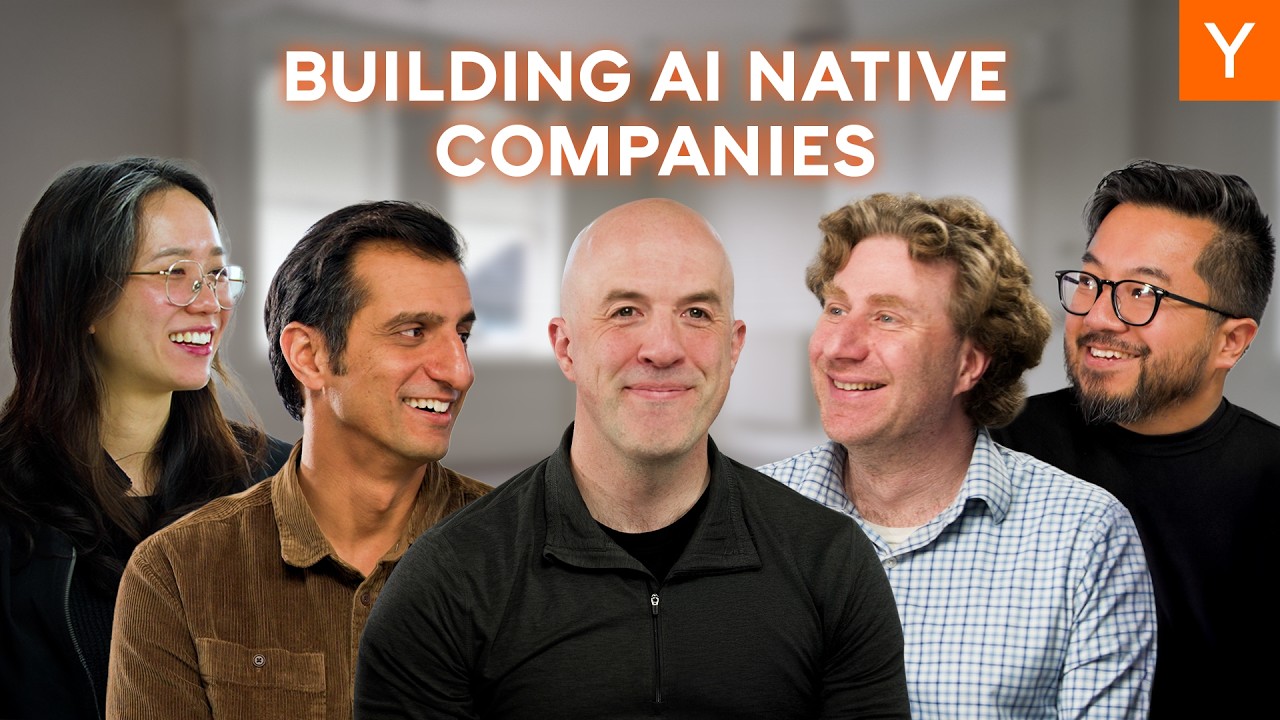
📺 Today’s recommended deep-dive video: https://www.youtube.com/watch?v=B246K_G7mHU
Beyond the Co-Pilot: How to Build a Superintelligent Organization
AI is often sold as a digital sidekick, but the true transformation occurs when it becomes the shared brain of an entire company. By recording organizational artifacts and enabling team-wide agentic loops, Y Combinator has transitioned from static software to a dynamic, just-in-time intelligence layer.
Core Question: How can organizations shift from using AI as a peripheral feature to building an AI-native infrastructure that leverages collective instinct?
Highlights
- The transition from deterministic “software loops” to English-language prompts that give non-technical teams control.
- The power of a “Tool Registry” to centralize and scale specialized organizational skills.
- Why the “Horseless Carriage” approach—adding AI as a small feature to legacy UI—stifles the true potential of the technology.
- The strategic choice between centralized corporate control and the “Homebrew” revolution of personal, open-weight agents.
⏱️ Reading time: approx. 8 minutes · Saves you about 38 minutes vs. watching.
Want to take notes while watching? Click the image below and let AI Notebook capture the key points for you 👇

The Infrastructure of Internal Intelligence
From SQL Queries to General Agents
Most companies treat AI as a decorative layer on top of old workflows, but the real power comes from integrating it into the fundamental data layer. At Y Combinator, this journey began with simple SQL agents that allowed non-technical staff in finance to ask complex questions of the database without writing a single line of Ruby or waiting for an engineering ticket to clear the backlog.
This shift removes the friction of the “software loop,” placing the power to build and automate workflows directly into the hands of the people who actually perform the work.
Once the finance team could query the database using natural language, the volume and complexity of their inquiries exploded. We realized that by centralizing all company context—from founder notes to priced rounds—into a single Postgres database, we had inadvertently created the perfect playground for an autonomous agentic system.

💡 Digging Deeper
Q: Why was a single Postgres database so critical for YC’s AI success?
A: Because most companies farm out data to dozens of third-party SaaS tools, creating silos. By running on internal software with one schema, YC provides agents with a complete, “monolithic” context of the business.
Q: Is this only for technical users?
A: No. The goal is to move the control of software from the developer to the user, allowing someone in finance or operations to “code” a new workflow simply by writing a prompt.
The Shared Organizational Brain
Scaling Skills through Transcripts and Metadata
The most profound realization we had was that an organization’s intelligence isn’t just in its data, but in its artifacts. Every meeting transcript, Slack message, and internal memo is a potential input for improving the organization’s collective capabilities through autonomous, self-improving loops that run while the team sleeps.
We call this “dream cycles,” where agents review the day’s interactions to find context gaps and refine their own prompts automatically.
Take the example of the “two-sentence pitch,” a staple of YC coaching. Initially, a partner wrote a manual prompt to help founders condense their ideas; however, by feeding the system transcripts of group office hours—where partners gave live feedback—the agent learned the nuances of what makes a pitch truly compelling. The result was a skill that became more effective than many individual human experts because it had ingested the collective wisdom of the entire partnership.

💡 Digging Deeper
Q: How do you manage the security of everyone seeing every agent conversation?
A: By defaulting to transparency—broadcasting agent logs to Slack—you create social controls and a high-trust environment where employees learn by watching how others use the tools.
Q: Can this “skillification” be automated?
A: Yes. New systems like “Open Claw” use meta-skills to automatically create new tools based on successful human-agent interactions, effectively “dry-ing” (Don’t Repeat Yourself) the organization’s logic.
The End of Static Software
Just-in-Time Code and the Horseless Carriage
Many tech giants are making the mistake of building “horseless carriages”—merely sticking an AI button into an existing, rigid UI. This approach limits AI because it hides the prompt context from the user under the guise of “safety” or “simplicity,” preventing the user from truly directing the machine’s intelligence.
True AI-native software flips the script: the agent is the core, and the software is just a set of deterministic tools that the agent reaches for when necessary.
We are entering the era of just-in-time software, where a user’s request can generate a bespoke single-page application or a specialized logic script on the fly. Instead of maintaining a million lines of rigid Rails code, you can have a lean system that understands intent and executes tasks using a minimal set of modular skills and markdown entry points.
This represents a fundamental shift in control from the developer, who used to decide what software could do, to the user, who now defines what it should become.

Key Takeaways
Building an AI-native organization requires a radical shift in philosophy, moving away from “AI as a feature” toward “AI as the building layer.” The magic happens when you combine a centralized context (like a single database) with a decentralized tool registry that allows every employee to “skillify” their expertise. This creates a “time warp” effect where a small startup can operate with the institutional knowledge of an incumbent while maintaining the speed of a lean team.
The future of productivity lies in the “Homebrew” revolution of AI—choosing open-weight models and private repositories that allow individuals to program their own extensions. Organizations that embrace transparency and high-trust data sharing will leapfrog those that attempt to lock down AI behind corporate safety policies and rigid, developer-centric interfaces.
Q&A
Q1: What is the main mistake companies make when adopting AI?
A: They treat it as a co-pilot or a “horseless carriage,” trying to fit AI into existing UI boxes rather than letting the AI act as the foundational layer that controls the tools.
Q2: How does YC handle the “back-and-forth” between engineers and other teams?
A: By using agentic tools, the finance and ops teams can encode their own workflows using English prompts, effectively removing the software engineer from the middle of every minor process change.
Q3: What are “Dream Cycles” in an agentic system?
A: These are autonomous loops where an agent reads through the day’s transcripts and logs to identify how it can improve its prompts or skills for the next day.
Q4: Why is “chat” the preferred interface despite recent criticisms?
A: Chat is the closest stepping stone to human language, which is the ultimate expression of thinking. It allows for the highest level of flexibility and multi-modal input (voice, files, images).
Q5: What is the “Tool Registry” mentioned in the discussion?
A: It is a shared library of over 350 YC-specific functions (like booking journal entries or managing office hours) that agents can call upon to perform real-world tasks.
Q6: How can a legacy organization start moving toward this model?
A: They should focus on two things: building a data warehouse where all internal context lives in one place and creating an internal tool registry that agents can use to interface with that data.
Q7: Is AI going to replace humans in these organizations?
A: No. It is an “individual empowerment” story, similar to the transition from mainframes to PCs. It eliminates drudgery and allows people to operate at a much higher level of leverage.