📺 Today’s recommended deep-dive video: https://www.youtube.com/watch?v=4wLaqEwk2yc
Decoding Cangjie: How AI and Community Tools are Revolutionizing Huawei’s Programming Ecosystem
As AI reaches a qualitative “intelligence leap,” the role of the software developer is shifting from manual coder to high-level architect. This deep dive explores how the Cangjie programming language is being paired with advanced AI agents and community-driven tools to optimize HarmonyOS development and boost performance.
Core Question: How can developers utilize AI-native workflows and specialized community infrastructure to master the Cangjie language and build next-generation applications?
Highlights
- The “Intelligence Leap”: How Gemini 3 solved 5-dimensional DP algorithm problems that stumped previous models.
- Performance Gains: Using Cangjie Turbo Modules to improve React Native for HarmonyOS (RNOH) end-to-end performance by 20%.
- Bridging the Data Gap: Creating custom “Cangjie Skills” and knowledge bases to compensate for the lack of native LLM training data.
- Community Innovation: A look at
cjbindfor C bindings and WASM-based playgrounds for browser-integrated development.
⏱️ Reading time: approx. 8 minutes · Saves you about 66 minutes vs. watching.
Want to take notes while watching? Click the image below and let AI Notebook capture the key points for you 👇

The AI Intelligence Leap in Cangjie Development
From Manual Coding to “Taste-Driven” Architecture
Senior Engineer Liu Junjie identifies the release of Gemini 3 in late 2023 as the turning point where AI shifted from a mechanical tool to a qualitative partner. He recounts a specific airport scheduling problem—a five-dimensional dynamic programming challenge—that was solved instantly by the model after failing on earlier platforms.
This shift has profound implications for developer competitions and daily work alike. We are moving toward a “taste-driven” development model where the human’s most valuable asset is their technical “taste” and architectural vision rather than their ability to write syntax.
In this new paradigm, developers act as managers of AI “employees.” Because AI can generate tens of thousands of lines of code in a few hours, the traditional line-by-line review process is dead. Instead, developers must focus on the “big picture”—strategic architecture, coding standards, and user experience—while delegating the implementation details to the agent. This requires a transition from being a simple builder to becoming a high-energy “super-individual” who can oversee complex systems with minimal manual intervention.

💡 Digging Deeper
Q: How did the “Intelligence Leap” change the China ICT Competition?
A: It made traditional closed-form algorithm problems obsolete; the competition shifted to “AI programming” where students implement complex systems, like a music notation language, using AI assistance.
Q: What is the primary role of the developer now?
A: To be a product and project manager who focuses on architecture and “technical taste” while using tests to monitor AI output.
Practical Infrastructure: Boosting RNOH Performance
Optimizing React Native for HarmonyOS
A critical practical application of Cangjie is the optimization of React Native for HarmonyOS (RNOH) through the Turbo Module mechanism. Traditionally, cross-platform frameworks suffer from high interop overhead as calls traverse the JS engine, C++ layers, and finally the native system.
By implementing these modules in Cangjie, the team achieved an end-to-end performance improvement of roughly 20%. While the absolute time of an interop call is short, the cumulative efficiency gains in complex applications—like the commercial use case in Xiaohongshu—are significant.
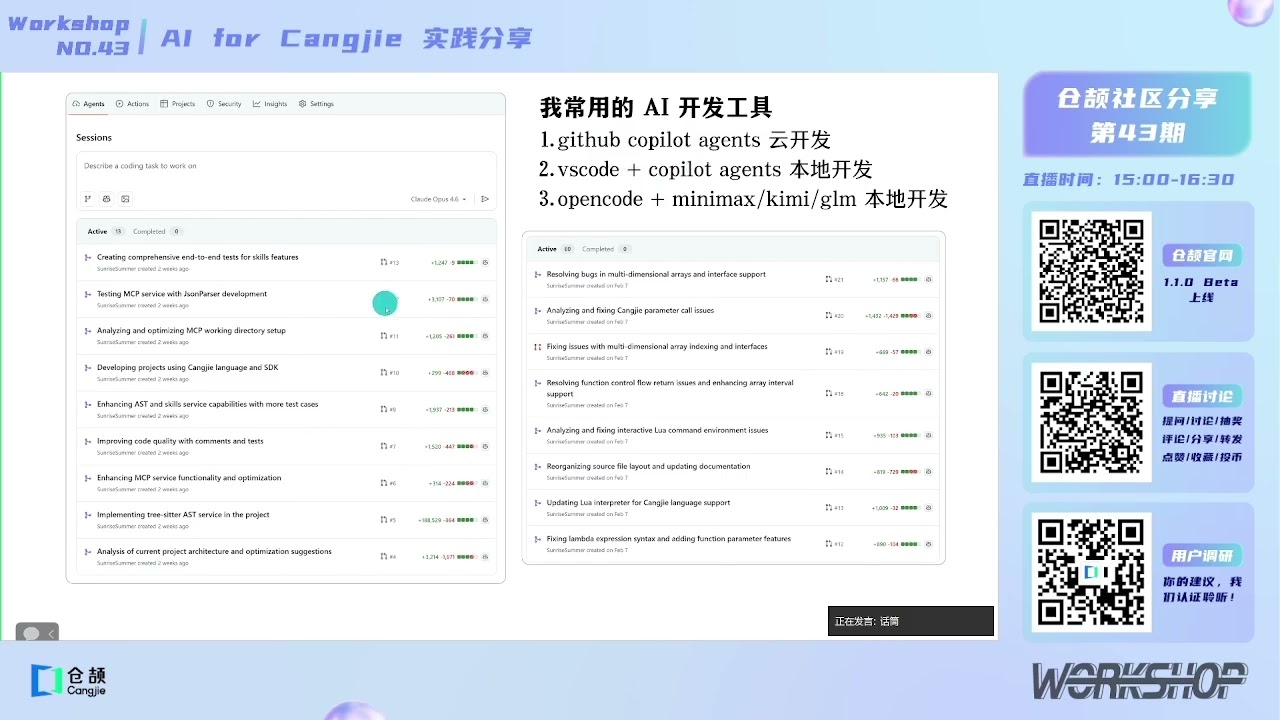
To accelerate this transition, Liu Junjie’s team built an AI-powered code generator for Turbo Modules. This tool automatically produces the bridge glue code and business logic templates from a simple interface description. Developed in just two days using GitHub Copilot agents, this generator demonstrates how Cangjie can be rapidly adapted to existing high-performance frameworks without months of manual labor.

💡 Digging Deeper
Q: Why use Cangjie for Turbo Modules instead of ArkTS?
A: Cangjie offers higher native efficiency and lower interop overhead, providing a 11-20% performance boost in end-to-end scenarios.
Q: How long did it take to build the AI code generator?
A: The initial usable version was completed in just one to two days using AI agents.
Bridging the Knowledge Gap: Custom Skills and Retrieval
Solving the Training Data Deficit
Current large language models (LLMs) suffer from a lack of native training data for Cangjie, as it is a relatively new language compared to Java or Python. To bridge this gap, the team developed specialized “Cangjie Skills” that provide the AI with structured knowledge docs, core library specs, and macro building instructions.
This infrastructure is vital for maintaining coding quality. Without these skills, AI agents might hallucinate syntax or fail to use the STDX library correctly. The team experimented with Knowledge Graphs but ultimately found that “OpenViking”—a retrieval solution that provides progressively disclosed, document-level context—was the most efficient for fast-paced development.

💡 Digging Deeper
Q: What is the main problem with using mainstream LLMs for Cangjie?
A: They have weak native training support, leading to higher token consumption and a higher rate of syntax errors without custom context.
Q: Why was OpenViking chosen over Knowledge Graphs?
A: Knowledge Graphs were too slow and expensive to build for real-time development guidance, despite their high precision.
Community Power: cjbind and Online Playgrounds
Automating Bindings and Browser-Based IDEs
Community contributor Zhou Xinyu introduced cjbind, a tool that automates the generation of CFFI bindings. By using libclang as a frontend, it converts C header files directly into Cangjie code, ensuring that memory layouts are consistent across different platforms.
Another breakthrough is the “Cangjie Playground,” which integrates a Language Server Protocol (LSP) compiled into WebAssembly (WASM). This allows the browser to provide real-time code completion and syntax highlighting without needing a local SDK installation.
Finally, the CTV (Cangjie Version) manager allows developers to switch between LTS, STS, and nightly builds seamlessly. This is essential for a rapidly evolving language where developers might need to support a stable commercial version while testing cutting-edge features in a separate branch.

Key Takeaways
The emergence of “super-individuals” is the defining trend of the Cangjie ecosystem. By combining one developer’s vision with AI agents, 3D printing, and electronic kits, the barrier to creating complex products has vanished. We are entering an era of “agile product developers” who can move from a concept to a commercialized application in weeks rather than years.
However, this coding freedom brings a crisis of purpose: “where to farm” and “what to plant.” As the middle links of software engineering are compressed to the extreme by AI, developers must look toward higher energy levels—combining programming with fields like quantum physics, condensed matter, or biology—to find new growth. The goal is no longer just to write code, but to use code to solve the universe’s more profound problems.
Q&A
Q1: I am a complete beginner. Where should I start with Cangjie and AI?
A: Start with the open-source “OpenCode” tool and the Cangjie skill set. You can find tasks and test code in the community example repository to experience AI-driven development with zero barrier to entry.
Q2: Can I use AI to program in Cangjie if I don’t know the language?
A: Yes. AI tools have reached a point where the process can be an “end-to-end black box.” While understanding the language helps with “big picture” planning, you can generate practical tools starting from simple requirements.
Q3: Does AI programming mean we don’t need Software Engineering anymore?
A: No, but the driver is now human “taste” and aesthetics. Testing becomes an automated safety net that allows us to ignore implementation details and focus on the “Final Cause” or the purpose of the software.
Q4: How do I run Cangjie in a GitHub Copilot online sandbox?
A: You can pass the Cangjie SDK release address to the agent. It will download and deploy the environment within the sandbox automatically during the task.
Q5: What is the benefit of the CTV tool?
A: It allows you to switch between different versions (LTS/STS/Nightly) by simply changing your environment variables, which is crucial for maintaining compatibility with various third-party projects.
Q6: What role does end-to-end testing play in AI development?
A: While AI easily generates unit tests, it often misses complex module interactions. Simulating real agent behavior with Python scripts allows for “replayable” testing that identifies issues unit tests miss.
Q7: Will AI make computer science majors obsolete?
A: Not at all. It forces the transition to higher energy levels. Developers should aim to be “comprehensive people,” combining programming with modern physics, mathematics, and product design.