📺 Today’s recommended deep-dive video: https://www.youtube.com/watch?v=c7URFR8rTe4
China at the UN: 50 Years of Multilateralism and the Rising Tensions of Global Sovereignty
Half a century after restoring its lawful seat at the United Nations, China stands at a geopolitical crossroads, balancing its role as a global stabilizer against escalating friction in the Taiwan Strait and the Pacific. From joint naval drills with Russia to the complexities of U.S. strategic ambiguity, the international stage is being redefined by competing visions of order.
Core Question: How does China’s 50-year UN legacy intersect with modern military pressures and the evolving diplomatic status of Taiwan?
Highlights
- Commemoration of the 1971 UN resolution restoring China’s seat and President Xi’s emphasis on genuine multilateralism.
- The strategic significance of Sino-Russian joint naval cruises as a counter-maneuver to Western naval presence in the East.
- Analysis of the fallout from President Biden’s remarks on Taiwan defense and the White House’s subsequent damage control.
- The domestic push by the DPP for constitutional changes in Taiwan and the resulting regional security concerns.
⏱️ Reading time: approx. 7 minutes · Saves you about 38 minutes vs. watching.
Want to take notes while watching? Click the image below and let AI Notebook capture the key points for you 👇

A Half-Century Milestone in Global Governance
Restoring the Lawful Seat
On October 25, 1971, the UN General Assembly passed Resolution 2758, restoring the People’s Republic of China’s lawful seat in an overwhelming majority vote that fundamentally changed the course of modern history.
President Xi Jinping is set to attend the upcoming commemorative meeting in Beijing, delivering a speech expected to highlight China’s transition from a participant in global affairs to a backbone of the international system and a provider of public goods.
The Chinese Ministry of Foreign Affairs recently released a position paper detailing fifty years of cooperation, emphasizing that Beijing remains committed to genuine multilateralism. Unlike the “small circles” or exclusionary blocs seen in modern Western diplomacy, China advocates for a system where the international community jointly masters the destiny of the world through the UN Charter, resolutely opposing the unilateral protectionism and bullying tactics that have recently resurfaced in global governance.

💡 Digging Deeper
Q: What is the primary focus of the new Position Paper?
A: It demonstrates China’s contributions to UN peace and development while elaborating on its stance against “clique-based” multilateralism and advocating for a more equitable global governance system.
Q: How does China view the current international order?
A: China maintains that the international system must be UN-centric and based on international law, rather than being dictated by a handful of Western powers.
Naval Chess and Strategic Counter-Measures
The Sino-Russian Joint Cruise
Recent Sino-Russian naval cruises near the Japanese archipelago represent a significant shift in regional power dynamics, demonstrating a high level of strategic coordination between Moscow and Beijing in response to Western maritime pressure.
As the joint fleet transited the Tsugaru Strait and moved toward the Pacific, the Japanese Ministry of Defense scrambled fighter jets and destroyers to monitor the activity, revealing the growing anxiety of Tokyo regarding its own maritime security. This navigation, while conducted in accordance with international law, serves as a direct counter-measure to the “freedom of navigation” operations frequently conducted by the U.S. Navy in waters neighboring China, effectively utilizing the same legal frameworks to project presence.
The normalization of these joint patrols signifies a deepening military partnership that challenges the existing U.S.-led security architecture in the Indo-Pacific region.

💡 Digging Deeper
Q: Why is the Tsugaru Strait significant?
A: While it is an international waterway, its narrowness makes it a sensitive point for Japan; the transit of nuclear-capable ships there is a potent political signal.
Q: How does this relate to the AUKUS pact?
A: China views AUKUS as a “law of the jungle” military bloc that triggers an arms race, contrasting it with the “open cooperation” of its own strategic partnerships.
The Taiwan Paradox and Western Interference
Strategic Ambiguity vs. Explicit Commitment
President Biden’s recent remarks during a CNN town hall, where he stated a commitment to defend Taiwan, caused immediate diplomatic ripples and forced the White House into a rapid “emergency cooling” operation to clarify that the long-standing policy of strategic ambiguity has not officially changed. Experts suggest that while Biden may have had a “slip of the tongue,” the repeated nature of these statements hints at a hardening stance that risks violating the three Sino-U.S. joint communiqués, which form the bedrock of the bilateral relationship.
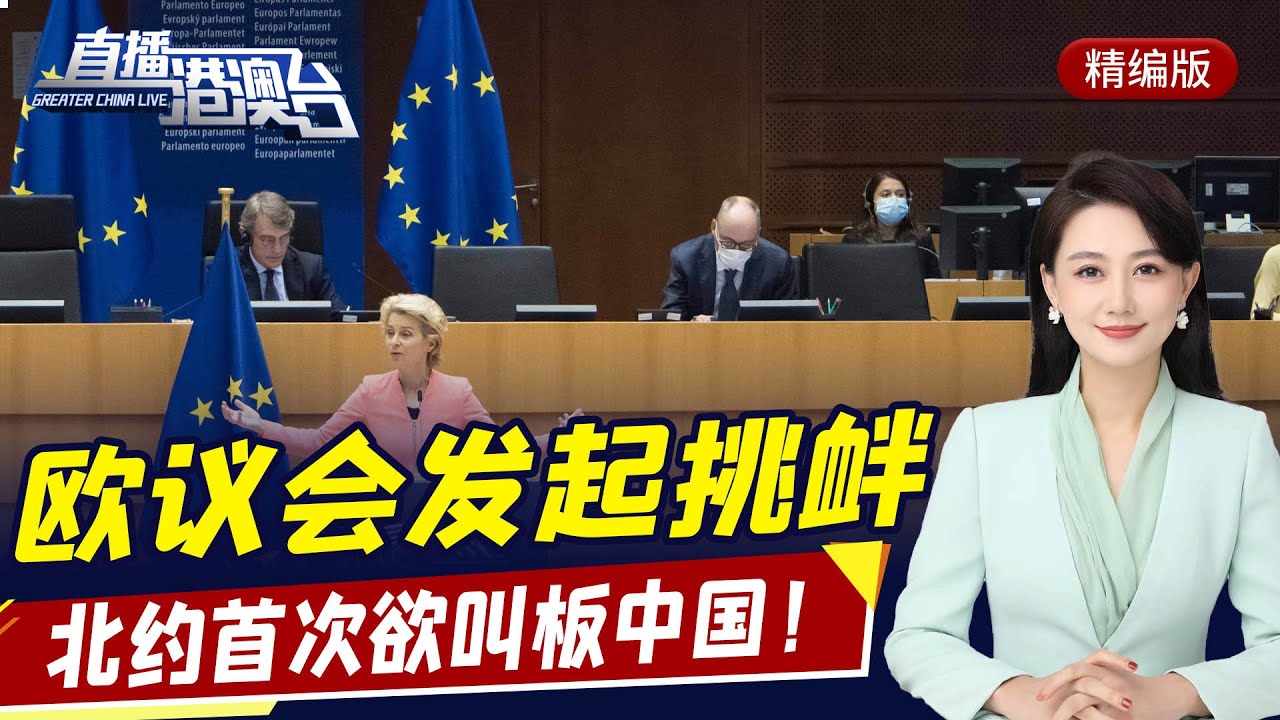
Simultaneously, the European Parliament’s report calling for an “upgrade” of political relations with Taiwan has been met with stern condemnation from multiple Chinese government departments, labeling it a gross interference in internal affairs.
The resolution suggests renaming the European Economic and Trade Office in Taiwan to the “EU Office in Taiwan,” a move that critics argue is an ideological provocation intended to test China’s red lines without the legal weight of official EU policy. This trend of “Taiwanization” of European politics could severely damage Sino-European trust and stall economic agreements.
Domestic Maneuvers and Legal Red Lines
The Push for Constitutional Reform
Within Taiwan, the Democratic Progressive Party (DPP) is pushing for constitutional amendments, including lowering the threshold for future changes and reducing the voting age to 18, which Beijing views as a calculated step toward “legal independence.”
The Taiwan Affairs Office has warned that these maneuvers are designed to manipulate the younger generation, who have grown up under a “de-Sinicized” education system, thereby creating a political insurance policy for the DPP’s long-term survival. By lowering the barriers to constitutional revision, the ruling party essentially opens a “Pandora’s box” that could lead to more radical challenges to the cross-strait status quo, potentially dragging the entire region into a period of uncontrollable instability.
In response, the Kuomintang (KMT) has signaled its intent to form an “Anti-Taiwan Independence” task force to uphold the 1992 Consensus and stabilize relations.
Key Takeaways
The 50th anniversary of China’s restoration to the United Nations serves as a reminder of the shifting pillars of global power. While Beijing seeks to reinforce a UN-centric order through multilateralism and development initiatives, it faces a complex web of Western alliances—such as AUKUS and NATO’s expanding focus—that view China’s rise as a systemic challenge. The naval maneuvers in the Pacific act as a physical manifestation of this diplomatic friction.
The Taiwan issue remains the most volatile flashpoint. Between the U.S.’s wavering “strategic ambiguity” and the European Parliament’s symbolic provocations, the risk of miscalculation is at an all-time high. Furthermore, internal legislative changes within Taiwan threaten to dismantle the legal foundations that have prevented open conflict for decades. The path forward requires a delicate balance of military deterrence and diplomatic adherence to existing international agreements.
Q&A
Q1: How did the White House respond to Biden’s Taiwan defense comments?
A1: The White House issued an emergency clarification stating that U.S. policy toward Taiwan has not changed and remains guided by the Taiwan Relations Act and the Three Communiqués.
Q2: What was the result of the 1971 UN vote?
A2: Resolution 2758 passed with 76 votes in favor, 35 against, and 17 abstentions, restoring all rights to the People’s Republic of China.
Q3: What specific changes is the DPP proposing for the Taiwan constitution?
A3: Key proposals include lowering the voting age to 18, shortening the leadership transition period, and significantly lowering the threshold for passing future constitutional amendments.
Q4: How has Russia characterized its military relationship with China?
A4: President Putin recently stated that Russia and China are not forming a closed military alliance, but rather a mutually beneficial partnership that is not hostile toward third countries.
Q5: What is the “EU Office in Taiwan” controversy?
A5: The European Parliament suggested renaming its representative office in Taipei to include the word “Taiwan,” which Beijing views as a violation of the One China principle.
Q6: Why is the KMT forming an anti-independence group?
A6: The KMT aims to reaffirm its historical mission as a centennial party that opposes independence and promotes cross-strait peace based on the 1992 Consensus.
Q7: What is the “Five Power Defense Arrangements” (FPDA)?
A7: It is a loose security alliance involving the UK, Australia, Singapore, Malaysia, and New Zealand, which recently discussed regional stability amid the AUKUS controversy.