📺 Today’s recommended deep-dive video: https://www.youtube.com/watch?v=1s3zslFOSh0
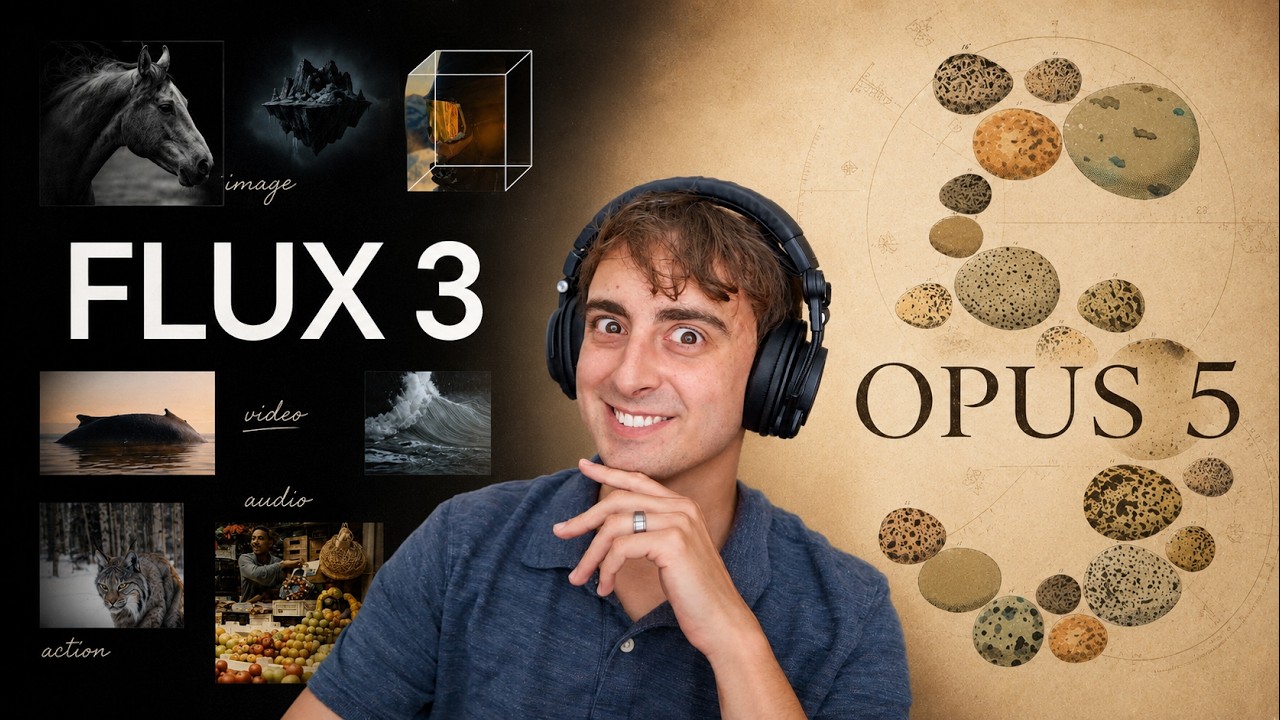
Claude Opus 5 vs. Flux 3: The New Titans of AI Development and Video
After a brief hiatus, the AI landscape has shifted significantly with the arrival of two massive frontier releases that redefine price-to-performance and multimodality. This breakdown explores how Anthropic is undercutting the competition with Claude Opus 5 and how Black Forest Labs is bridging the gap between digital video and physical robotics.
Core Question: How do the latest releases from Anthropic and Black Forest Labs shift the balance of power between closed-source giants and the open-source community?
Highlights
- Claude Opus 5 delivers Fable 5-level intelligence at half the cost with a massive 30% jump in Arc AGI 3 reasoning scores.
- Black Forest Labs unveils Flux 3, a “multimodal-multimodal” model capable of generating high-fidelity video, audio, and robotic actions.
- Live coding tests demonstrate Claude Opus 5’s superiority in building complex, scratch-made 3D applications compared to OpenAI’s GPT-5.6 Soul.
- The emergence of Video Action Models (VAMs) marks a new era where AI moves from digital screens into physical robotic manipulation.
⏱️ Reading time: approx. 6 minutes · Saves you about 26 minutes vs. watching.
Want to take notes while watching? Click the image below and let AI Notebook capture the key points for you 👇

Claude Opus 5: The New Value King
Benchmarking the Leap
Anthropic’s latest release, Claude Opus 5, has arrived with a clear objective: to offer frontier-level intelligence at a price point that makes the competition look obsolete.
While the system cards suggest it rivals the powerful Fable 5, the real shocker lies in the Arc AGI 3 benchmark where it jumped from a mere 1.5% to a staggering 30%. This massive leap is forcing the community to question whether the model is exhibiting truly novel reasoning or if we are simply witnessing the pinnacle of benchmark-specific training techniques designed to game visual puzzles into explicit algebra.
Beyond the raw numbers, the model is significantly more accessible, costing half as much as its predecessor while maintaining a high level of agentic terminal coding capability. This aggressive pricing strategy positions Anthropic to potentially steal significant market share from OpenAI’s GPT-5.6 Soul in professional development workflows.

💡 Digging Deeper
Q: Is the 30% jump in Arc AGI 3 legitimate AGI progress?
A: It is debated; while Anthropic claims novel behavior, some experts suggest the model may be “benchmaxing” by converting visual puzzles into trainable algebraic strategies.
Q: How does the pricing of Opus 5 compare to Fable 5?
A: It is launched at half the price, making it far more accessible for developers who need frontier capabilities without the “Titan model” cost.
Q: Is Opus 5 better than GPT-5.6 Soul?
A: It depends on the use case; Opus 5 excels in 3D and coding, while GPT-5.6 Soul often feels more “generalized” for everyday life and pop culture.
Flux 3 and the Multimodal Revolution
From Pixels to Pistons
Black Forest Labs is back with Flux 3, an ambitious multimodal backbone that generates not just images, but video, audio, and even robotic action predictions.
This model represents a shift toward “Visual Intelligence,” where the AI isn’t just dreaming up scenes but understanding the physics required to interact with the physical world. By partnering with Mimic Robotics, Black Forest Labs is proving that the same architecture used to generate a cinematic samurai duel can also be fine-tuned to help a robot arm navigate the unstructured environment of a car engine.
The video generation quality is being hailed as the “open-source Sora” we have been waiting for, featuring impressive character consistency and native audio synchronization. Unlike previous models that required lengthy, pedantic prompts, Flux 3 appears to have a higher “creative IQ,” filling in the blanks of a simple request with believable, high-fidelity details.

💡 Digging Deeper
Q: What makes Flux 3 different from previous video models?
A: It is a unified architecture that handles audio and action prediction natively, rather than “stitching” separate models together.
Q: When will Flux 3 be available for public use?
A: It is currently in an early access phase, with a broader rollout including open-weights expected around the holiday season.
Q: How does the audio generation feel?
A: The audio has an “in-your-face” Foley attitude, providing very immersive, hyper-realistic sound effects that sync perfectly with the video.
The “Cutaway” Experiment: Coding with Opus 5
Building 3D Logic from Scratch
To truly test the “frontier intelligence” of Opus 5, a complex prompt was used to invent a completely new 3D spatial awareness game called “Cutaway.”
The model didn’t just write code; it acted as a game designer, creating a system where players must draw the 2D cross-section of a 3D object before the “slice” is revealed. This required the AI to handle analytical geometry and zero-dependency software rendering without relying on external libraries like Three.js.
The result was a fully functional, browser-based application with a complex scoring system that calculates the percentage of overlap between the user’s drawing and the true geometric slice. While ChatGPT’s GPT-5.6 Soul struggled to produce a working prototype for the same prompt, Opus 5 delivered a polished, playable experience on the first attempt.

💡 Digging Deeper
Q: Why did GPT-5.6 Soul fail this test?
A: The model struggled with the open-ended nature of the prompt and failed to implement the complex 3D rendering logic required for the “Cutaway” concept.
Q: What is a “Z-buffer renderer”?
A: It is a method of managing image depth coordinates in 3D graphics, which Opus 5 had to code from scratch for this experiment.
Q: Can players actually learn from this game?
A: Yes, it is designed to drill spatial reasoning skills used by surgeons, radiologists, and engineers who must visualize internal structures from 2D slices.
Key Takeaways
The era of the “all-in-one” model has arrived, but the winner depends entirely on your specific workflow. Claude Opus 5 has effectively replaced Fable 5 as the go-to model for heavy-duty coding and logical construction, proving that Anthropic can lead the pack in technical reasoning while simultaneously slashing costs. Its ability to create complex software from a single, open-ended prompt suggests we are moving toward a “natural language to software” pipeline that is more robust than ever before.
On the visual front, Flux 3 is setting the stage for a future where digital content and physical action are controlled by the same brain. The “Video Action Model” (VAM) framework suggests that our most creative video generators will eventually become the operating systems for robotics. While SeaDance 2.0 remains a strong cinematic competitor, the open-source nature and multimodal breadth of Flux 3 make it the most exciting development for creators and researchers alike.
Ultimately, the competition between OpenAI, Anthropic, and Black Forest Labs is no longer just about who can chat the best. It is about who can best bridge the gap between abstract reasoning and practical execution, whether that is through a browser-based 3D game or a robotic arm on an assembly line.
Q&A
Q1: Is Claude Opus 5 genuinely better than Fable 5?
A: In terms of raw value, yes. It achieves similar “frontier” intelligence levels but at half the price, making it the practical choice for most users.
Q2: How does Flux 3 handle “character consistency” in video?
A: Early tests show it is remarkably stable, maintaining character features across different scenes better than most current video generators, including SeaDance.
Q3: What is “Mimic Robotics”?
A: It is the partner company Black Forest Labs is working with to apply Flux 3’s visual intelligence to real-world robotic manipulation and dexterous tasks.
Q4: Can Flux 3 generate audio for existing videos?
A: Yes, it features native audio-video sync, allowing it to generate sounds that match the specific physics and actions occurring in a video clip.
Q5: Why is the Arc AGI 3 benchmark considered controversial?
A: Some argue that the tasks can be “gamed” through specific training tactics rather than representing a leap in general intelligence.
Q6: Should I switch from ChatGPT to Claude for daily use?
A: For general life advice and pop culture, ChatGPT (Soul) remains strong, but for coding, 3D projects, and technical builds, Opus 5 is currently superior.
Q7: Will Flux 3 be open-source?
A: Yes, Black Forest Labs has committed to an open-weights release of the multimodal backbone, following their successful strategy with Flux 2.