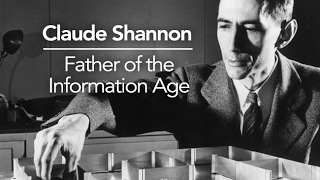
📺 Today’s recommended deep-dive video: https://www.youtube.com/watch?v=z2Whj_nL-x8
Claude Shannon: The Mathematical Architect of the Digital Age
Claude Shannon was the quiet genius who transformed our world into bits and bytes long before the first personal computer existed. By proving that information could be quantified and transmitted flawlessly, he laid the mathematical foundation for the internet, cell phones, and deep-space communication.
Core Question: How did Shannon’s 1948 theory of information redefine the limits of communication and spark the digital revolution?
Highlights
- Developed “Digital Logic” by applying Boolean algebra to electronic switching circuits.
- Defined the “bit” as the fundamental unit of information in his 1948 Magna Carta of the information age.
- Established the “Shannon Limit,” the absolute maximum speed for data transmission over any medium.
- Invented early AI and computer chess algorithms while tinkering with unicycles and juggling machines.
⏱️ Reading time: approx. 7 minutes · Saves you about 22 minutes vs. watching.
Want to take notes while watching? Click the image below and let AI Notebook capture the key points for you 👇

The Logic Machine and the Birth of Computing
From Symbolic Logic to Silicon Circuits
In 1938, a 22-year-old Claude Shannon wrote what is widely considered the most influential master’s thesis in history. He realized that the two-value binary algebra of George Boole could be directly mapped onto the on-and-off positions of electrical switching circuits.
This insight bridged the gap between abstract philosophy and practical engineering, showing that electronic switches could perform logical operations like “AND,” “OR,” and “NOT.” It is the very reason computers can “think” today. Without this discovery, the complex integrated circuits that power our smartphones and laptops would have no logical framework to follow, remaining mere collections of wires and vacuum tubes.
Shannon’s early career at Bell Labs was defined by the pressures of World War II, where he worked on cryptography and anti-aircraft systems. He helped build the scrambling machines used by Churchill and Roosevelt for secret transatlantic calls, ensuring that the Allied leadership could communicate without German interception. His paper, Communication Theory of Secrecy Systems, later became the gold standard for modern data encryption standards.

💡 Digging Deeper
Q: Was Shannon the first to use binary?
A: No, but he was the first to prove that binary logic could control any electronic circuit, creating the field of digital logic.
Q: How did his work affect WWII?
A: He developed mathematical targeting for anti-aircraft missiles and created the foundational theory for secure military encryption.
Q: What was his relationship with Einstein?
A: While teaching at Princeton, Shannon briefly met Einstein, who famously interrupted his class just to ask where tea was being served.
Quantifying Information: The 1948 Revolution
The Mathematical Theory of Communication
Before 1948, information was a vague, qualitative concept rather than a measurable physical quantity. Shannon changed this forever by publishing A Mathematical Theory of Communication, which introduced the world to the “bit” as a fundamental unit of information.
He argued that all information—whether it was a radio broadcast, a telephone call, or a handwritten letter—could be boiled down to a sequence of ones and zeros. This “common commodity” allowed engineers to stop worrying about the specific medium of transmission and focus on the data itself. By digitizing signals, Shannon proved that we could save, store, and replicate information perfectly, ensuring a bit remains the same today, tomorrow, and forever.

The Shannon Limit and the War on Noise
The most daunting challenge Shannon presented to the engineering world was the concept of channel capacity, now known as the Shannon Limit.
He mathematically proved that every communication channel has an absolute speed limit based on its bandwidth and the level of noise present. Much like the speed of light in physics, you cannot exceed the Shannon Limit; however, he demonstrated that you could get incredibly close to it through clever encoding. This prediction set a 50-year challenge for mathematicians and engineers, who spent decades designing algorithms to reach the efficiency levels Shannon proved were possible in 1948.
💡 Digging Deeper
Q: What is the difference between a “Tukey bit” and a “Shannon bit”?
A: A Tukey bit is just a binary digit (0 or 1), while a Shannon bit is a specific measure of information content.
Q: How did Shannon solve the problem of signal noise?
A: He proposed using “regenerative repeaters” that identify and recreate bits perfectly rather than just amplifying the signal and the noise together.
Q: Why is his 1948 paper called the “Magna Carta” of the information age?
A: Because it founded the entire field of Information Theory and provided the blueprints for every digital communication system we use.
Redundancy, Compression, and the Modern World
The Power of Extra Bits
Shannon realized that the key to flawless transmission in a noisy world was redundancy. By adding extra “check bits” to a message, a receiver could reconstruct data even if some parts were corrupted or lost during transmission.
This principle is exactly why you can scratch a CD and it will still play without skipping a beat. The disc contains enough redundant information to fill in the gaps created by the scratch. Today, these error-correction codes are the silent workhorses of our lives, enabling clear cell phone calls in crowded cities and allowing space probes to send high-definition photos from the edge of the solar system.
We also owe our ability to stream video and music to Shannon’s insights into data compression. He saw that most information is naturally redundant—like the “u” that almost always follows a “q”—and could be shortened for faster transmission. This theory led directly to the development of ZIP files, JPEGs, and MP3s, which discard unnecessary data to fit more information into smaller spaces.
💡 Digging Deeper
Q: How does a scratched CD still work?
A: It uses Reed-Solomon codes, a form of redundancy Shannon envisioned, to recalculate and restore the missing data caused by the scratch.
Q: What role did transistors play?
A: The transistor was invented at Bell Labs just one year before Shannon’s paper; it provided the hardware necessary to make his complex mathematical theories practical.
Q: Did Shannon help with space exploration?
A: Yes, researchers at the Jet Propulsion Laboratory used his theories to design the digital communication systems for the first deep-space probes.
The Polymath’s Playful Legacy
AI, Chess, and Unicycles
Claude Shannon was not just a theoretical mathematician; he was an inveterate tinkerer who spent his retirement building machines that many considered “useless.” He created Theseus, a mechanical mouse that could learn to navigate a maze through trial and error—an early and prophetic milestone in artificial intelligence.
His house was filled with gadgets, including a computer that calculated in Roman numerals and a gasoline-powered pogo stick. He even wrote a serious mathematical paper on the dynamics of juggling while practicing the sport himself. Shannon’s playfulness was not a distraction from his work; rather, his curiosity about how things functioned, from unicycles to the stock market, fed the creative intellect that allowed him to see patterns others missed.
Tragically, the man who defined the storage of human knowledge spent his final years losing his own to Alzheimer’s disease. When he passed away in 2001, he was virtually unknown to the general public, despite having a greater impact on the 20th century than almost any other scientist. Today, he is finally being recognized as the man who, by giving us the bit, gave us the future.

💡 Digging Deeper
Q: What was Shannon’s contribution to AI?
A: He built the first learning machine (Theseus) and wrote the foundational strategies for computer chess that are still used in modern algorithms.
Q: Was he successful in the stock market?
A: Yes, he and his wife Betty made a fortune by applying his mathematical insights to early technology startups like Hewlett-Packard.
Q: How is he remembered today?
A: He is honored with the Shannon Award and statues in his hometown, recognized as the “Father of Information Theory.”
Key Takeaways
Claude Shannon’s work represents a rare moment in history where a single individual founded a field, stated its major results, and proved them all at once. His 1948 paper didn’t just suggest a better way to communicate; it provided a comprehensive mathematical framework that defined the digital age. By showing that information could be treated as a quantifiable commodity, he enabled everything from the internet to the high-definition streaming we take for granted today.
His legacy is one of profound intellectual courage and playful curiosity. Whether he was calculating the maximum capacity of a telephone wire or riding a unicycle through the halls of Bell Labs, Shannon approached every problem with a unique perspective. He proved that noise is not an insurmountable obstacle but a mathematical puzzle to be solved through logic and redundancy.
Ultimately, we live in Shannon’s world. Every time we send a text, download a file, or talk to a satellite, we are utilizing the bits and error-correction codes he envisioned decades before the technology to implement them existed. He remains the silent architect of our connected reality.
Q&A
Q1: What is Claude Shannon’s most famous contribution?
A1: He is best known for creating Information Theory in 1948, which introduced the “bit” and defined how to measure and transmit data.
Q2: How did he influence modern computers?
A2: In his master’s thesis, he proved that electronic circuits could represent logical operations using Boolean algebra, forming the basis of all digital logic.
Q3: What is the “Shannon Limit”?
A3: It is the theoretical maximum rate at which information can be transmitted over a communication channel with a specific bandwidth and noise level.
Q4: Why is redundancy important in his theory?
A4: Redundancy allows for error correction; by adding extra bits, a system can reconstruct data that is damaged or lost during transmission, such as on a scratched CD.
Q5: Did Shannon work on artificial intelligence?
A5: Yes, he was a pioneer in AI, creating a maze-solving mouse named Theseus and developing early algorithms for computer chess.
Q6: What was Shannon’s background?
A6: He grew up in Michigan, was a distant relative of Thomas Edison, and studied both mathematics and electrical engineering at MIT.
Q7: How did he spend his time outside of his research?
A7: He was a prolific inventor of “useless” gadgets, an avid juggler, a unicycle rider, and a successful investor in early technology companies.