📺 Today’s recommended deep-dive video: https://www.youtube.com/watch?v=M2iX6HQOoLg
The Computational Genesis of Life: From Noise to Complex Programs
After millions of interactions, a remarkable transformation unfolds: systems transition from pure noise to intricate, self-replicating programs. This phenomenon, central to understanding life’s emergence, suggests a profound connection between computation, stability, and the very fabric of existence.
Core Question: How does life, characterized by function and self-organization, spontaneously arise from non-living matter, and how does it drive increasing complexity?
Highlights
- Complex programs emerge from random interactions, demonstrating a “phase transition” from noise to computational intensity.
- Function, not mere materialism, differentiates living systems from non-living matter.
- Von Neumann’s concept of embodied computation, predating DNA discovery, highlights life as self-constructing, computational processes.
- Symbiogenesis, the fusion of replicators, is identified as the primary engine for evolutionary novelty and complexification, even without mutation.
- Life is defined as embodied autopoetic computation, arising and complexifying through symbiotic events across multiple scales.
⏱️ Reading time: approx. 14 minutes · Saves you about 42 minutes vs. watching.
Want to take notes while watching? Click the image below and let AI Notebook capture the key points for you 👇

The Intrinsic Computability of Existence
From Vital Force to Functional Machines
Historically, the essence of life was often attributed to a “vital force” or spirit, setting it apart from inanimate matter. However, the advent of organic chemistry in the 19th century shifted this view towards a strictly materialist perspective, arguing against any special matter within living organisms. This progress, while crucial, left a lingering question: what fundamentally distinguishes life from non-life?
The answer, the speaker proposes, lies not in matter itself, but in function.
Consider the difference: a rock, when broken, simply becomes two rocks. A kidney, however, when broken, ceases to be a working kidney. This critical distinction highlights that life inherently possesses function, a characteristic absent in inert physical objects. This functional aspect, though seemingly immaterial, is deeply intertwined with physics, representing a separation of concerns where function acts almost as a “spirit” inseparable from its material substrate.
Turing, Von Neumann, and Embodied Computation
The formalization of function in computing traces back to Alan Turing, though his abstract machine, conceptualized in 1936, was not intended for physical construction. A crucial advancement came from John von Neumann, who sought to answer how something could create a copy of itself—a question mirroring Erwin Schrödinger’s “What is Life?” Von Neumann concluded that self-replication requires instructions for self-assembly, a universal constructor to follow those instructions, and a tape copier for offspring. Remarkably, he theorized this before the discovery of DNA’s structure or the function of ribosomes.
Von Neumann’s profound insight was recognizing that a universal constructor is a universal Turing machine, equating life with “embodied computation.” This means life inherently involves computation; self-construction, growth, healing, and reproduction (autopoiesis) all necessitate a universal constructor. Unlike Turing’s abstract symbols, Von Neumann’s vision involves atoms as memory, a “3D printer” that can replicate itself, representing a closure between the medium of computation and the computational entity itself.
Defining Computation Beyond the Trivial
Defining computation itself is complex, extending beyond simple logical gates to physical systems. Following the work of researchers like Susan Stepney, Domenic Horesh, Rob Wagner, and Viv Kendon, computation occurs when a mapping can be constructed between a physical system’s evolution and a logical system’s changes. This mapping should not be infinitely complex; rather, it requires an Ockham’s Razor-like parsimony for validity. This definition underscores computation’s subjective nature, dependent on a model that translates the physical to the logical.
Such computation is intrinsically linked to entropy and free energy. Computational systems, in their process of reducing the entropy of their state space, require a constant input of free energy and must eject waste heat. This thermodynamic reality underpins the very possibility of sustained computation and, by extension, life.
💡 Digging Deeper
Q: How did Von Neumann’s theories predate and align with biological discoveries?
A: Von Neumann theorized the necessary components for self-replication—instructions, a universal constructor, and a copier—before the structure of DNA or the function of ribosomes were understood, correctly predicting these biological mechanisms from pure theory.
Q: What is the key difference between Turing’s and Von Neumann’s conceptualization of computation?
A: Turing’s model separates the computational head, tape, and rules, making symbols abstract. Von Neumann’s is “embodied,” where memory is atoms, and the computational entity can self-replicate, akin to a laptop also being a 3D printer for other laptops.
Q: Why is “function” a critical concept for distinguishing life from non-life?
A: Function describes what living systems do (e.g., a kidney filters), a characteristic not inherent to inanimate matter. The integrity of a functional system is lost when broken, unlike a non-functional object which merely becomes smaller pieces of itself.
BFF: Unveiling Spontaneous Computational Emergence
The Brainf*ck Simulation Setup
To explore the emergence of life from non-life in an artificial system, an experiment dubbed “BFF” (Brainf*ck F**) was developed. It utilizes a modified, minimal Turing-complete language called Brainfck, chosen for its direct resemblance to a Turing machine with only eight simple instructions. Crucially, the language was adapted to be “embodied” by removing the separation between data and code tapes, effectively reducing it to seven instructions. This allows programs to read and write their own code, enabling self-replication within the system.
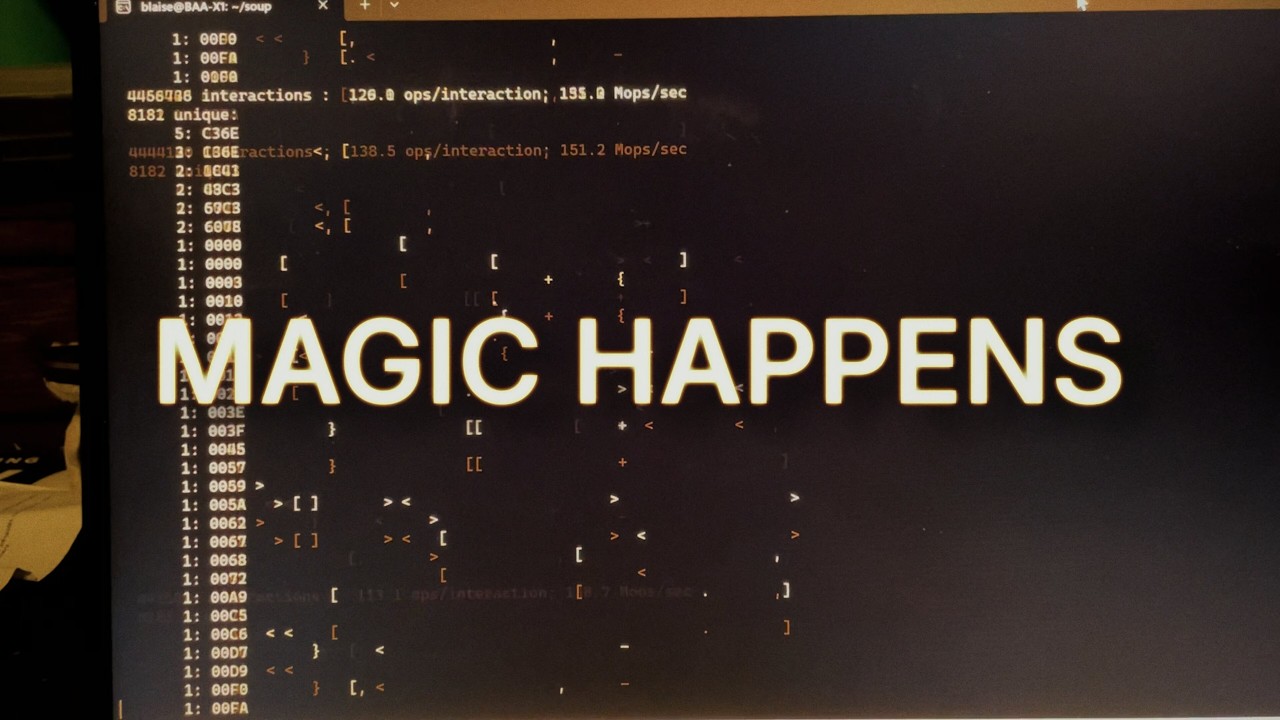
The experiment begins with a “soup” of 1024 fixed-length tapes (64 bytes each), initially filled with random bytes. Given this randomness, only about one in 32 bytes constitute valid instructions, with most functioning as “no-ops.” The core procedure involves randomly selecting two tapes, concatenating them, running the combined code, and then returning them to the soup, repeating this process millions of times.
From Noise to Programs: The Phase Transition
After millions of these random interactions, a remarkable transformation occurs: the system shifts from noise to complex programs. Initially, interactions involve very few operations, typically only two on average. However, a sudden, dramatic “phase transition” takes place, after which the soup becomes intensely computational, with an average of 1,374 operations running per interaction. This represents the spontaneous emergence of complex, functional programs capable of self-copying within the artificial environment, akin to observing abiogenesis.
This transition is visually striking, resembling a phase transition on a scatter plot where computational activity dramatically increases after a certain threshold. Concurrently, the entropy of the “soup” sharply decreases, becoming highly compressible. This indicates the widespread copying and structuring of information. The speaker suggests that this structured, functional phase of matter, distinct from gas, liquid, or solid, could be termed “life” itself.

The Mystery of Complexity Without Mutation
A crucial observation from the BFF experiment is the emergence of complex programs and increasing computational activity even when the mutation rate is set to zero. Conventional evolutionary theory often emphasizes chance mutation as the primary source of novelty. Yet, significant complexification occurs purely through the random combination and interaction of existing tapes.
This challenges the notion that evolution requires mutation for novelty. The inherent stability advantage of self-copying programs drives their proliferation, even if they are initially simple. This phenomenon, where stable forms emerge through self-replication, aligns with the concept of “dynamic kinetic stability”—where cycles or stable processes, rather than just fixed points, can exhibit greater robustness. The fundamental mystery then becomes: how does complexity arise and increase without new information introduced by mutation?
💡 Digging Deeper
Q: How does the “embodied” nature of the modified Brainfck language enable the BFF experiment?
A: By removing the separation between data and code tapes, the modified Brainfck allows programs to read and write their own code, a necessary condition for self-replication and the emergence of embodied computation.
Q: What evidence suggests a “phase transition” occurs in the BFF experiment?
A: Visual plots show a sudden, dramatic increase in computational operations per interaction after millions of runs, and the entropy of the system dramatically decreases, becoming highly compressible, indicating increased structure and copying.
Q: Why is the emergence of complexity without mutation in BFF considered mysterious?
A: It challenges the conventional view that evolution requires random mutation to introduce novelty and drive complexification, suggesting another mechanism is at play for increasing complexity.
Symbiogenesis: The Revolutionary Force in Evolution
Beyond Darwinian Dynamics: The Limitations of Lotka-Volterra
Traditional evolutionary models, such as the Lotka-Volterra equations, effectively describe population dynamics of predator and prey, illustrating concepts like reproduction, predation, and competition. These equations feature a linear growth term and a bilinear suppressive term, leading to oscillatory solutions. However, these models inherently suffer from a critical limitation: they are “closed-ended.” They can describe optimization within a predefined design space (e.g., finch beaks adapting), but they cannot account for the emergence of new species or fundamental changes to the design space itself.
This limitation means that conventional Darwinian models, focused on gradual adaptation and natural selection, struggle to explain the initiation of evolution or the radical shifts that introduce entirely new forms of life. They describe evolution within existing frameworks but not revolution—the creation of novel capabilities or structures that fundamentally alter the landscape of possibility.
Mereshkovsky, Margulis, and the Power of Symbiogenesis
A revolutionary concept that addresses this gap is symbiogenesis, first proposed by Konstantin Mereshkovsky in 1905 and 1910 and later championed and proven by Lynn Margulis in 1967. Margulis famously demonstrated that eukaryotic cells, the building blocks of complex life, arose from the fusion of two different prokaryotic organisms, with mitochondria and chloroplasts being prime examples. This idea, though initially met with resistance, highlighted fusion events as a profound source of novelty in biology.
In the context of the BFF experiment, symbiogenesis provides the missing explanation for increasing complexity without mutation. Small, often unreliable replicators (sequences of bytes that copy themselves) exist from the beginning of the simulation. When two such replicators randomly encounter each other and copy better as a combined unit, a symbiogenetic event occurs. This fusion allows for the construction of more complex programs, as the information on how the two parts fit together is added, driving complexification not through random error, but through combination.
Mathematical Foundations: Smoluchowski Coagulation and Gelation
To mathematically describe symbiogenesis, one can turn to equations for coagulation, such as those formulated by Marian Smoluchowski for polymers or colloids. These equations describe how monomers combine to form dimers, trimers, and larger clusters. The process involves a “merger gain term” (where two components combine to form a larger one) and a “merger loss term” (where individual components are consumed in the merger).
Crucially, Smoluchowski coagulation predicts a “gelation” phase transition. If components stick together with a scaling exponent greater than one, the system can undergo a finite-time singularity where clusters grow to infinite size, effectively “setting” the entire mixture, much like gelatin solidifying in a fridge. This mathematical framework suggests that the dramatic phase transition observed in the BFF experiment—from a gas-like soup to an intensely computational, structured state—is analogous to a gelation event driven by the continuous fusion of replicators.

Replicator Taxonomy: Inanimate, Viral, and Cellular
Within the BFF system, replicators can be categorized based on their relationship between the code that runs and the code that is copied. An “inanimate replicator” is code that copies something entirely outside itself, with no overlap between the copying mechanism and the copied content (like water being made). A “viral replicator” involves partial overlap, where some of the copying code is also copied, but the entire process isn’t self-contained.
The critical development is the “cellular replicator,” where the machinery for copying is fully contained within the thing being copied. This represents true self-sufficiency. The BFF experiments show that inanimate and viral replicators dominate early on. However, as the system approaches the gelation point, cellular replicators suddenly emerge and proliferate. This suggests that self-contained life forms arise from the symbiosis and fusion of simpler, less complete replicators.
💡 Digging Deeper
Q: Why are traditional evolutionary models like Lotka-Volterra insufficient to explain the emergence of life’s complexity?
A: These models are “closed-ended,” meaning they can describe competition and adaptation within a predefined design space but cannot account for the emergence of fundamentally new species or changes to the design space itself.
Q: How does symbiogenesis provide a mechanism for increasing complexity without genetic mutation?
A: Symbiogenesis, or the fusion of existing replicators, creates novelty by combining them into a more complex, unified entity, adding the “information” of how they fit together, rather than through random changes to individual components.
Q: What is the significance of the “gelation” phase transition in the context of BFF?
A: Gelation, as described by Smoluchowski coagulation, signifies a point where components rapidly stick together to form infinitely large clusters. In BFF, this mirrors the dramatic shift from simple random interactions to a highly complex, intensely computational, and structured system.
Implications and the Future of Understanding Life
The Irreversibility of Computation and Causality
A common fallacy, termed the “Sapolsky error” by the speaker, suggests that because underlying physics (like Newtonian mechanics) is reversible, so too must be higher-level phenomena like free will. However, computation is inherently irreversible. When 3 + 5 yields 8, the original inputs are typically lost unless explicitly retained. This irreversibility distinguishes computation from fundamental physics and, critically, is what allows for the concept of causation.
In a purely reversible physical system, “A causes B” is functionally equivalent to “B causes A.” But in computation, the sequential “if-then” logic establishes clear causal directions. This perspective suggests that causality itself makes sense primarily in the light of computation, a notion strongly supported by the inherent irreversibility of computational processes.
Symbiogenesis and the Arrow of Time
Symbiogenesis provides a compelling explanation for evolution’s arrow of time—the observed tendency for life to become more complex over geological time. In classical Darwinian evolution, there’s no inherent drive towards complexity; organisms might simplify or complexify without a clear direction. However, when two self-replicating entities (A and B) fuse through symbiogenesis, the resulting new entity needs to replicate both A and B, plus the additional information of how they fit together.
This “added information” does not come from mutation but from the thermal randomness of encountering other replicators and the selective advantage of stable fusions. Thus, symbiogenesis inherently builds up complexity, creating an escalating hierarchy of “replicators made of replicators.” This challenges the view that major evolutionary transitions are rare, suggesting instead that symbiogenetic events, often smaller and less dramatic than the emergence of eukaryotes, are continuous drivers of novelty throughout life.
Life, Intelligence, and the Modeling of Others
The understanding emerging from these experiments and theories redefines life as “an embodied autopoetic computation arising and complexifying through symbiogenesis.” If life is fundamentally computational, then every symbiogenetic fusion event creates a more parallel computer. These increasingly complex computational systems must not only model themselves but also their environment, including other living entities.
This continuous process of modeling others—from simple interactions to complex “theory of mind” in advanced species—is intrinsically linked to the development of intelligence. Intelligence, therefore, is not a late-stage evolutionary development but an inherent aspect of life from its inception, driven by the need for increasingly sophisticated self- and environmental modeling facilitated by massively parallel computation arising from symbiogenesis. The “intelligence explosions” seen in various lineages like hominins or cetaceans are further manifestations of this runaway modeling of others through symbiotic processes.

💡 Digging Deeper
Q: How does the irreversibility of computation relate to the concept of causation?
A: Unlike reversible physics, computation’s inherent irreversibility (inputs lost after output) allows for a clear “if-then” sequential logic, which is fundamental to defining and understanding causation.
Q: In what way does symbiogenesis provide an “arrow of time” for evolution towards increased complexity?
A: Each symbiogenetic event adds “information” on how components fit together, not from mutation, but from random encounters and selective advantage, thus continuously increasing the overall complexity of self-replicating systems.
Q: How does this theory redefine intelligence?
A: Intelligence is viewed not as a late evolutionary development but as an intrinsic and continuous aspect of life from its start. As life complexifies through symbiogenesis, it creates more parallel computational systems that must model themselves and their environment, including other organisms, driving the ongoing development of intelligence.
Key Takeaways
The prevailing understanding of life and evolution requires re-evaluation, shifting focus from mere materialism to the fundamental role of function and computation. Experiments like BFF demonstrate that complex, self-replicating programs can spontaneously emerge from random interactions, undergoing a dramatic phase transition from noisy systems to intensely computational ones, even in the absence of genetic mutation. This challenges conventional Darwinian models by highlighting a crucial, often overlooked, driver of novelty.
Central to this revised perspective is symbiogenesis—the process of replicators fusing to create more complex entities. This mechanism, exemplified by the origin of eukaryotes, provides the “arrow of time” for evolution, as each fusion inherently adds information and computational complexity to the system. Life is thus redefined as an embodied, autopoetic computation that continually complexifies through these symbiotic events, inherently linking it to the development of intelligence, driven by the increasing need to model both self and the environment.
Q&A
Q1: How can one reconcile the materialist view of life with the speaker’s emphasis on “function” as an immaterial aspect?
A: While life is undeniably built from matter, its functional properties, such as a kidney’s ability to filter, are not directly readable from the atoms themselves. Function acts as an “immaterial spirit” that relies on, yet is distinct from, its material substrate, offering a way to bridge materialism with the unique characteristics of living systems.
Q2: What is the “Sapolsky error” in the context of free will and physics?
A: The “Sapolsky error” refers to the fallacy of assuming that because underlying physics is reversible, higher-level phenomena like free will must also be constrained by determinism. However, computation, which underlies many complex systems, is inherently irreversible, allowing for concepts like causation that are not present in purely reversible physical laws.
Q3: How does the BFF experiment demonstrate complexity without mutation, contradicting traditional evolutionary thought?
A: The experiment shows complex, self-copying programs emerging and proliferating in a simulated environment even when the mutation rate is set to zero. This suggests that symbiogenesis—the fusion of existing replicators—rather than random genetic errors, is a primary driver of novelty and complexification.
Q4: What is the “gelation” phase transition, and why is it significant for understanding the origin of life?
A: Gelation, as described by Smoluchowski coagulation, signifies a point where components rapidly stick together to form infinitely large clusters. In the context of life’s emergence, it represents a dramatic phase transition where simple replicators fuse through symbiogenesis to create a highly complex, intensely computational system.
Q5: How does this theory redefine intelligence?
A: Intelligence is viewed not as a late evolutionary development but as an intrinsic and continuous aspect of life from its start. As life complexifies through symbiogenesis, it creates more parallel computational systems that must model themselves and their environment, including other organisms, driving the ongoing development of intelligence.
Q6: How can the concept of symbiogenesis be mathematically modeled?
A: Symbiogenesis can be modeled using equations similar to Smoluchowski coagulation, which describe the merging of particles into larger clusters. These models include terms for merger gain and loss, accounting for how individual replicators combine to form more complex entities.
Q7: What is the main difference between “evolution” and “revolution” in this context?
A: “Evolution” refers to gradual adaptation and optimization within a predefined design space, as described by Lotka-Volterra equations. “Revolution” refers to the fundamental shifts and creation of novel forms of life and capabilities, driven by symbiogenesis, which alters the design space itself.