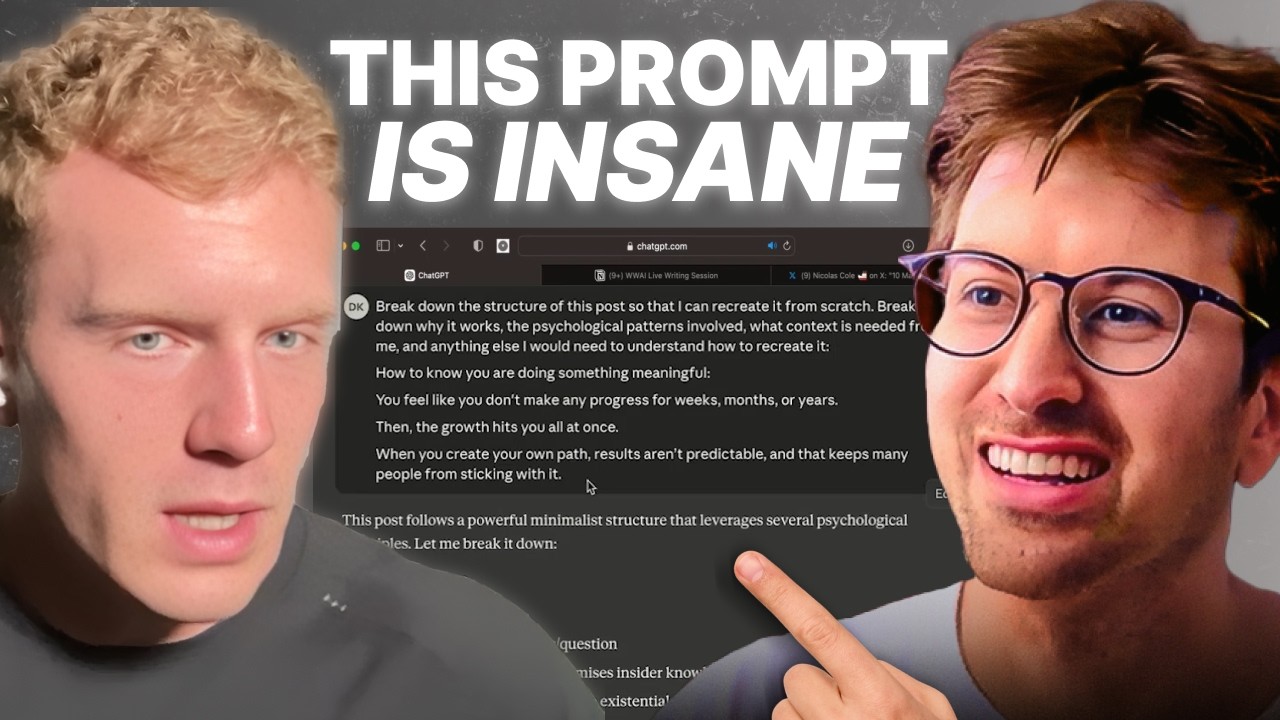
📺 Today’s recommended deep-dive video: https://www.youtube.com/watch?v=HhspudqFSvU
The Dan Koe Playbook: Engineering Virality with AI Systems
Dan Koe has built a massive audience by treating content creation as a repeatable, architectural system rather than a creative whim. By using LLMs to deconstruct why viral posts work, he has turned the “art” of writing into a surgical science that scales across every platform.
Core Question: How can creators leverage LLMs to validate ideas, deconstruct viral patterns, and scale a multi-platform content ecosystem without losing their unique voice?
Highlights
- Using Twitter as a low-cost litmus test to validate ideas before expanding them into newsletters and videos.
- Deconstructing viral “archetypes” to build custom AI prompts that avoid the generic “AI-sounding” output.
- Leveraging long-context LLMs like Gemini to synthesize hours of research into dense, insightful content building blocks.
- Implementing a two-phase “Interview” prompting strategy to ensure AI outputs maintain human depth and specific context.
⏱️ Reading time: approx. 8 minutes · Saves you about 43 minutes vs. watching.
Want to take notes while watching? Click the image below and let AI Notebook capture the key points for you 👇

The Pillar Content Ecosystem
Validation Through Distribution
Dan Koe doesn’t believe in chasing trends or waiting for a lightning strike of inspiration to hit his keyboard. Instead, he treats Twitter (X) as a high-frequency testing ground for human psychology. By focusing on the platform’s strict character limit, he forces himself to refine the most potent version of an idea before ever committing it to a longer script or article.
If a short post resonates, it becomes the foundation for his weekly newsletter. This newsletter then acts as a comprehensive script for his YouTube videos and podcasts. This circular flow ensures that every piece of long-form content is backed by real-world data, significantly reducing the risk of producing a “flop” after hours of work.
Repurposing is the final stage of the machine, where a single validated idea is sliced into Instagram reels, LinkedIn posts, and image quotes. Because the core idea was already proven on Twitter, these spinoffs have a much higher probability of success across different algorithms. Distribution isn’t just about being everywhere; it is about being everywhere with a message you already know people want to hear.

💡 Digging Deeper
Q: Why start with Twitter instead of a longer medium?
A: Twitter’s 280-character limit is a forcing function for clarity and impact, making it the perfect laboratory for testing psychological hooks.
Q: Won’t people get bored seeing the same idea on multiple platforms?
A: Most users prefer specific mediums; readers will read and viewers will watch, but rarely do they feel “spammed” by a high-quality, recurring theme.
Q: How does Dan handle the “follower plateau”?
A: Once a specific post type strikes gold, he creates consistent spin-offs of that archetype while dedicating 30% of his time to experimenting with new formats.
The Research and Deconstruction Engine
Sifting for Gold with Gemini
High-quality content requires high-quality fuel, which usually means hours of reading or watching long-form educational videos. Dan utilizes Gemini 1.5 Pro’s massive context window to ingest multi-hour YouTube videos or massive PDFs, turning them into dense summaries. This isn’t about avoiding the work; it’s about extracting the specific “firepower” needed to start the writing process without staring at a blank screen.
Instead of asking an LLM to “write a post,” Dan asks it to deconstruct why successful posts work. He feeds the AI his best-performing content and asks it to identify the underlying archetypes, such as “The Paradox,” “The Transformation Arc,” or “The Harsh Truth.” This creates a library of structural blueprints that he can then fill with his own unique perspectives and brand voice.
This methodical deconstruction allows him to synthesize his worldview with proven viral structures. By breaking a post down into its “purge list,” “provocative thesis,” and “payoff,” he builds a bridge between raw information and engaging social media copy. The AI acts as a structural engineer, while Dan remains the lead architect of the actual words.
💡 Digging Deeper
Q: Can LLMs actually write good tweets?
A: Not directly. They write “the worst tweets you’ve ever read” unless you provide specific architectural constraints and avoid generic instructions.
Q: What is the “Idea Guy” era?
A: As Sam Altman noted, LLMs make execution cheap, which places a massive premium on the quality and novelty of the original idea.
Q: How do you avoid sounding like a robot?
A: Use the AI to generate the “building blocks”—the paradoxes and problems—then manually assemble those pieces into your own prose.
The Two-Phase Prompting Mastery
Engineering High-Agency AI
The secret to Dan’s high output is a sophisticated “prompt that creates prompts.” Most users fail because they give vague instructions to the AI and receive vague results in return. Dan’s system involves a two-phase interaction: the “Interview Phase” and the “Execution Phase.” This ensures the AI has all the personal context it needs before it ever attempts to generate a single sentence.
In the first phase, the AI is instructed to interview the creator, asking for their domain expertise, the audience’s specific pain points, and unique observations. By providing these specific details, the creator feeds the machine the “human soul” of the content. Only after this context is fully absorbed does the AI move to phase two, where it applies those details to the viral archetypes identified earlier.
This system is equally effective for building business offers, not just content. By feeding the AI the principles of experts like Alex Hormozi and then running it through the two-phase interview process, a creator can build a “Grand Slam Offer” blueprint in minutes. It allows for faster failure and iteration, which is the ultimate shortcut to success in the creator economy.

💡 Digging Deeper
Q: What is the “Prompt to Create Prompts”?
A: It is a meta-instruction that tells the LLM how to be a better prompt engineer, resulting in more comprehensive and logical workflows.
Q: How does this apply to ghostwriters or agencies?
A: You can send the “Interview Phase” questions to a client as an onboarding questionnaire to perfectly capture their voice and insights.
Q: What if I don’t know how to code?
A: You don’t need to. Dan keeps all his prompts in simple notes apps and uses markdown to keep the AI’s instructions organized and clear.
Key Takeaways
The transition from a “Neanderthal” content creator to a systematic one requires a shift from brute force to architectural thinking. Dan Koe’s success isn’t just about his millions of followers; it’s about a circular ecosystem where every idea is tested, deconstructed, and optimized. By using LLMs as research assistants and structural engineers rather than ghostwriters, he maintains his unique voice while producing content at a volume that would be impossible for a manual creator.
The ultimate arbitrage opportunity today lies in the “distribution of attention.” Those who can combine human insight with AI-driven systems can spin up multiple brands and startups for an audience they already own. Whether you are writing a single tweet or building a complex business offer, the goal remains the same: use AI to fail faster, iterate better, and amplify the unique worldview that only a human can provide.
Q&A
Q1: What specific tools does Dan use for his Twitter analysis?
A: He uses browser extensions like Tweet Hunter X or SuperX to view the top-performing posts of accounts he admires, which helps him identify patterns to emulate.
Q2: How important are visuals for growth compared to just writing?
A: Dan focuses almost entirely on writing to refine his ideas, but he acknowledges that images can act as a “force amplifier.” A text post that fails can sometimes go viral just by adding a compelling visual aid.
Q3: What is the “Cringe Mountain” concept?
A: It’s an idea that everything meaningful in life requires you to look stupid and feel uncomfortable (the “cringe”) before you reach a point where you have a unique and valuable perspective.
Q4: How does Dan handle YouTube titles?
A: He uses a custom prompt that analyzes his top 15 performing titles and generates 20-30 new variations based on the psychological patterns of those winners.
Q5: Is it possible to use this for business offers?
A: Yes. By deconstructing the “Grand Slam Offer” framework from Alex Hormozi, Dan uses AI to interview him about his product and then outputs a structured marketing blueprint.
Q6: How long does his daily writing process take?
A: He spends exactly two hours every morning dedicated to writing one newsletter section and three social media posts, which covers his entire content output.
Q7: Can I use this if I have zero followers?
A: Yes. In fact, it is often easier to get impressions with a small account because the algorithm is hungry for high-quality, high-engagement ideas, and these systems help you produce exactly that.