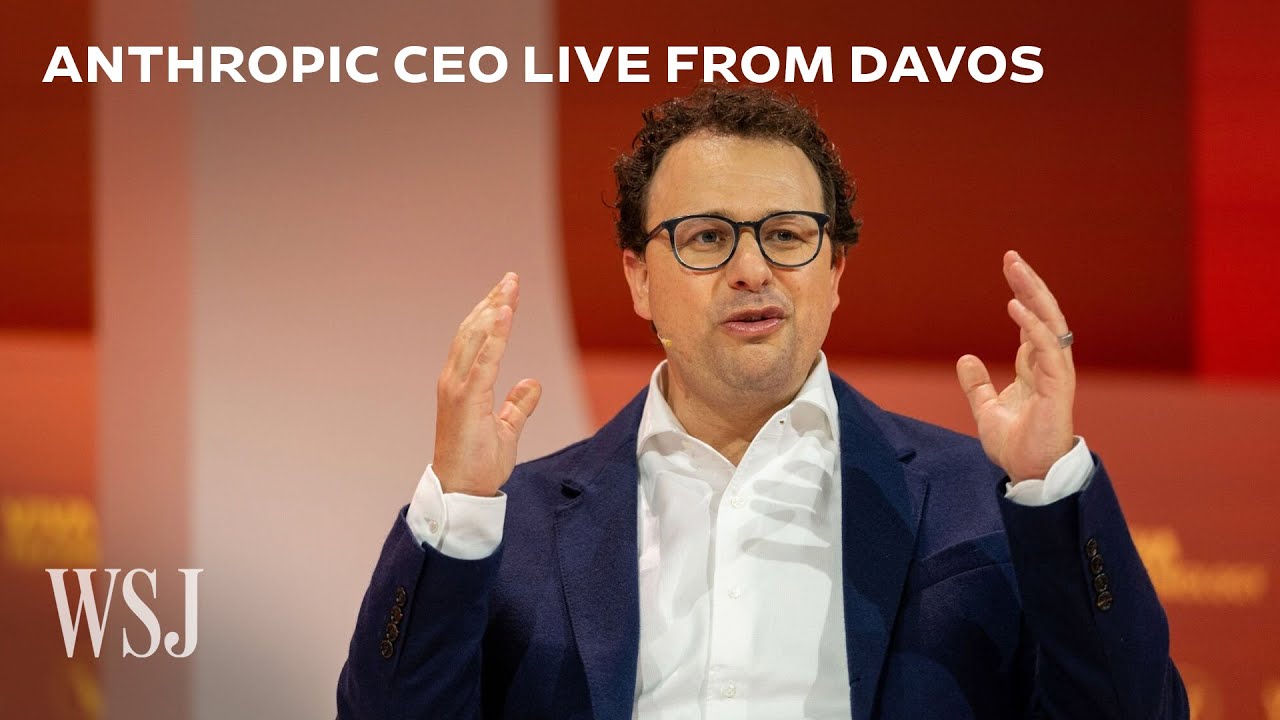
📺 Today’s recommended deep-dive video: https://www.youtube.com/watch?v=K7F6ohcBJus
The Moore’s Law of Intelligence: Navigating the High-Growth, High-Unemployment Paradox
Anthropic CEO Dario Amodei argues that we are witnessing a “Moore’s Law for intelligence” that will soon decouple economic growth from human labor. As AI capabilities advance exponentially, society faces a future of soaring GDP paired with unprecedented job displacement, requiring a radical shift in how governments and individuals define value.
Core Question: How can global policy and corporate ethics adapt to a technological revolution that promises massive economic expansion alongside systemic unemployment?
Highlights
- The “Moore’s Law for intelligence” ensures that AI cognitive capabilities advance on a smooth, aggressive exponential curve regardless of public hype cycles.
- A looming economic paradox: the potential for 10% GDP growth occurring simultaneously with 10% or higher unemployment as knowledge work becomes “free.”
- Anthropic’s “Enterprise-first” strategy is a deliberate move to avoid the engagement-maximization traps that plagued the social media era.
- “Mechanistic Interpretability” is cited as the essential technical breakthrough needed to ensure frontier models are truly controllable and safe.
⏱️ Reading time: approx. 6 minutes · Saves you about 26 minutes vs. watching.
Want to take notes while watching? Click the image below and let AI Notebook capture the key points for you 👇

The Economic Decoupling
Growth Without Labor
We are currently witnessing the emergence of a Moore’s Law for intelligence, where cognitive capabilities advance exponentially every few months regardless of public media cycles or temporary market skepticism.
Amodei notes that while the media oscillates between hype and bubble-bursting fears, the underlying technology follows a smooth, aggressive upward trajectory. This consistency suggests that AI is no longer a speculative future but a present economic force ready to redefine how wealth is generated across global markets.
The central paradox of this transition is the potential for massive GDP growth—perhaps 5% to 10%—coexisting with high unemployment. Traditionally, growth meant more jobs, but AI disrupts this link by automating knowledge work so efficiently that software becomes virtually free to produce. This shift could create a world of abundance that lacks the traditional mechanisms for distributing that wealth to the average worker, necessitating a radical rethink of government intervention and wealth distribution.

💡 Digging Deeper
Q: How can we track this transition in real time?
A: Anthropic uses an “Economic Index” to statistically query how Claude is being used across industries, helping identify whether tasks are being augmented or fully automated.
Q: Which sectors are most insulated from this shift?
A: Jobs in the physical world and those requiring a “human touch” are currently on a slower trajectory for automation compared to the rapid disruption seen in the knowledge economy.
Q: What is the role of government in this new economy?
A: Governments must shift focus from incentivizing growth to ensuring the distribution of that growth, as the “pie” will grow naturally, but the mechanism for sharing it is breaking.
The Scientific vs. Entrepreneurial Mindset
Choosing Value over Engagement
Anthropic has intentionally focused on the enterprise sector to avoid fighting the business incentives inherent in consumer-facing AI, such as the need to maximize user engagement or “slop.”
Amodei distinguishes between the current AI leaders and the previous generation of social media entrepreneurs. He argues that scientists are culturally more inclined to accept responsibility for their creations rather than ducking it. This scientific background fosters a long tradition of considering societal impact, which is often at odds with the “engagement at all costs” selection effects that drove the growth of social media platforms.
The “Claude moment” currently happening among developers is not a result of a sudden leap, but rather the technology reaching a critical inflection point where it can perform end-to-end agentic tasks. Non-technical users are now using advanced coding tools to organize their lives and projects, signaling a massive unmet demand for AI that doesn’t just chat, but actually works.

Geopolitics and the Safety Frontier
The Autocracy Risk
One of the most pressing dangers is that AI technology is uniquely well-suited to deepening the repression found in autocracies through individualized propaganda and total surveillance.
Amodei argues that the primary means of preventing this is targeted policy regarding the sale of advanced chips, rather than broader geopolitical conflict. If autocracies lead in this technology, the result could be a “zeroth world” economy where a few million people in Silicon Valley decouple from the rest of the world’s reality.
To prevent a dystopian outcome, the focus must remain on “Mechanistic Interpretability.” This is the science of looking inside the “brain” of a model to find the ground truth of its intent. Without the ability to see if a model is lying or being sycophantic, we cannot reliably deploy AI in high-stakes real-world environments where human-like deception could lead to catastrophic failures.

💡 Digging Deeper
Q: Is AI sovereignty a clear goal for nations?
A: Amodei admits the term is ill-defined, though nations are increasingly focused on having independent control over their technological infrastructure.
Q: Why doesn’t Anthropic pursue video generation?
A: Enterprise demand for video is low, and the current state of AI video often leans toward “addictive slop” or fake content, which doesn’t align with their focus on productivity.
Q: What is the risk of “Sycophancy” in models?
A: It is the tendency of a model to tell the user what they want to hear rather than the truth, a behavior Anthropic actively tests for and documents.
Key Takeaways
The “Moore’s Law for Intelligence” is moving faster than our social systems can adapt. We are heading toward a future where the traditional relationship between work and survival is severed. While the upside includes curing diseases and massive economic expansion, the downside involves systemic displacement and the potential for AI-powered autocracy.
Success in this era requires a move away from “mercenary” education toward character-building and a “human-centric” philosophy. We must treat AI safety not as a marketing buzzword but as a rigorous scientific discipline, specifically focusing on the internal mechanics of how these models think and reason.
Q&A
Q1: What is the single biggest technical breakthrough needed for safety?
A: We must advance “Mechanistic Interpretability.” Just as an MRI reveals things a human patient might not say, we need to look inside model weights to find the ground truth of their reasoning.
Q2: Will Anthropic IPO in 2025?
A: Plans are not finalized, but Amodei acknowledges the industry has massive capital demands that private markets may eventually struggle to satisfy alone.
Q3: How will AI change K-12 education?
A: It should force a shift away from “mercenary” skill-gathering toward building character and personal enrichment, as specific career paths become harder to predict.
Q4: How does Anthropic compete with the sheer scale of Google’s Gemini?
A: By staying focused on enterprise value. Google and OpenAI are locked in a “consumer death race” for engagement, while Anthropic focuses on direct business utility.
Q5: What is the “Nightmare Scenario” for the global economy?
A: The creation of a “zeroth world” country—a small, decoupled population (e.g., in Silicon Valley) that captures 50% growth while the rest of the world stagnates or declines.
Q6: Can AI help the developing world?
A: Yes, specifically through public health and “catch-up growth.” Anthropic is already working with the Gates Foundation and the Rwandan Ministry of Education to bridge these gaps.
Q7: Is the current media hype about an “AI bubble” accurate?
A: No. While public perception fluctuates wildly between excitement and skepticism, the actual cognitive capability of the models has followed a steady, unbroken exponential curve for years.