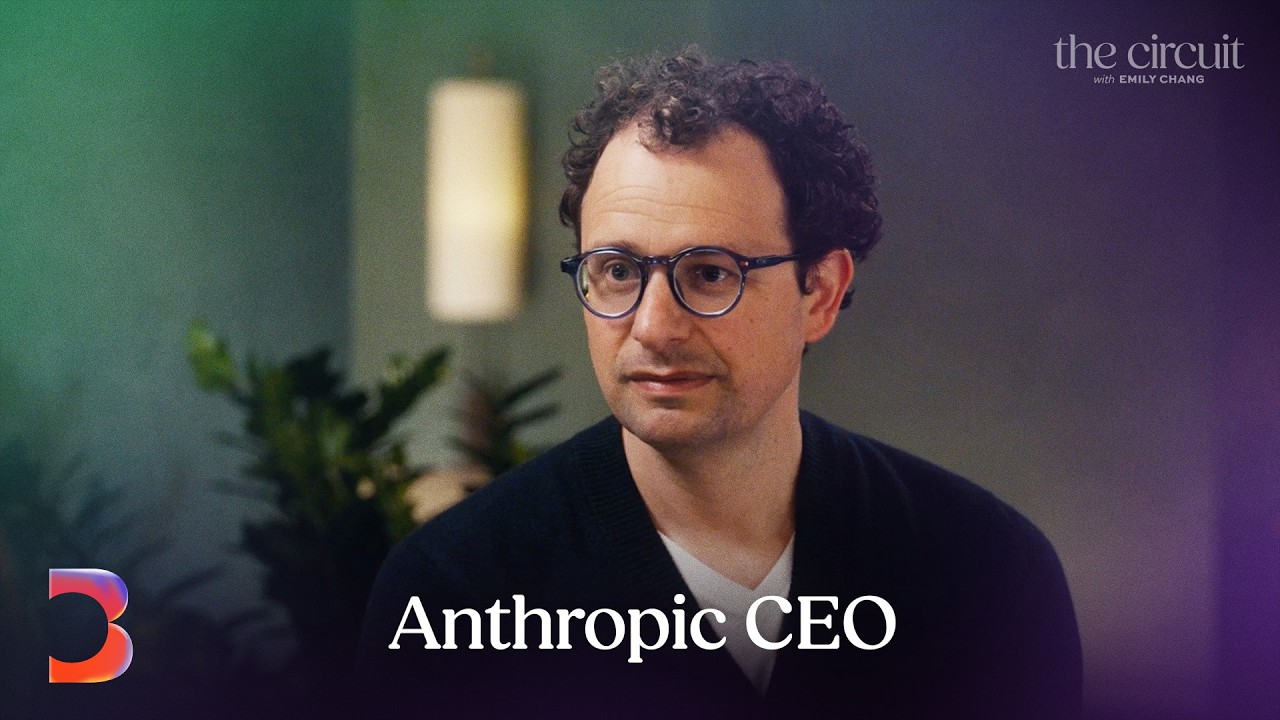
📺 Today’s recommended deep-dive video: https://www.youtube.com/watch?v=x2VHFgyawPE
The Exponential Spaceship: Dario Amodei on the Ethics and Geopolitics of Frontier AI
As the CEO of Anthropic, Dario Amodei finds himself at the epicenter of a technological acceleration that feels like traveling at relativistic speeds. In this deep dive, he argues that the future of humanity depends on a “mature” response to AI—steering away from both blind optimism and paralyzing paranoia to navigate a world where two days of Earth-time can feel like a year of progress.
Core Question: Can a private company maintain its moral compass and prevent civilizational collapse while building the most powerful technology in human history?
Highlights
- The “SaaS-pocalypse” and why 50% of white-collar entry-level jobs face imminent disruption.
- Why Anthropic refused to sign certain DoD contracts, drawing a “red line” against fully autonomous weaponry.
- The discovery of Mythos, a model so potent at identifying cyber-vulnerabilities it was deemed too dangerous for immediate public release.
- A radical governance structure called the “Long Term Benefit Trust” designed to fire the CEO if the company veers off its ethical course.
⏱️ Reading time: approx. 8 minutes · Saves you about 62 minutes vs. watching.
Want to take notes while watching? Click the image below and let AI Notebook capture the key points for you 👇

The Philosophy of the Frontier
Moving at Relativistic Speeds
Dario Amodei describes the current pace of AI development using a metaphor from special relativity: it is like a spaceship accelerating away from Earth where time dilation makes the external world move at a different speed. In this high-pressure environment, Amodei believes that the hallmark of mature leadership is maintaining a sense of calm similar to a surgeon or a military officer. He argues that paranoia is counterproductive, yet complacency is dangerous; the goal is to respond rationally to risks that are growing in magnitude every single day.
Success in AI is not a series of sudden jumps, but rather a smooth exponential curve that looks like nothing is happening until it suddenly explodes.
Amodei notes that Anthropic’s rise to become a premier AI company was mathematically predictable based on this curve, even if the “color and detail” of the actual moment still feel surprising. The company’s core mission remains unchanged despite the increased scrutiny: training better models, ensuring safety, and managing the societal risks that come with massive scale.

💡 Digging Deeper
Q: How did growing up in San Francisco shape your worldview?
A: It instilled a spirit of nonconformism and individualism. In Silicon Valley, it’s okay to be “crazy” and pursue a coherent vision even when the experts are against you.
Q: Why did you really leave OpenAI?
A: It came down to trust. While safety disagreements existed, the real issue was a lack of honesty and a feeling that the values of the leadership were not what they claimed to be.
Q: How do you handle competition with Sam Altman or Demis Hassabis?
A: I view it as a “race to the top.” While I trust some actors more than others, I believe the industry can be pulled toward better standards by a majority of players doing the right thing.
The Enterprise Bet and Economic Disruption
Choosing Values Over Gimmicks
Anthropic deliberately chose an enterprise-focused business model because the consumer market often incentivizes addiction and “slop” to drive advertising revenue. By working with biotech, pharma, and educational institutions, Anthropic aligns its profit motives with high-value, positive-sum outcomes for humanity. Amodei believes that trust is the primary currency in the enterprise world, making it the most natural fit for a safety-focused organization.
Model quality is the ultimate moat in this industry.
While developers can switch between Claude, GPT, and Gemini in an afternoon, Amodei argues that being “far ahead” on model quality is the only reliable way to maintain a lead. He dismisses the idea of relying on customer inertia or “stickiness,” focusing instead on the growth rates of Claude Code and Cowork, which have recently seen revenue explosions that defy traditional software growth patterns.
The Coming “SaaS-pocalypse”
The recent “SaaS-pocalypse,” where billions in market value vanished, serves as a warning shot for traditional software companies whose moats were built on “complex code” that AI can now replicate. Amodei warns that any company relying solely on the difficulty of writing software will fail, as the ability to write code is rapidly becoming a commodity. However, he remains optimistic that the overall software pie will grow as AI allows us to solve problems—like curing diseases or optimizing energy—that were previously unreachable.

Security, Mythos, and the “Red Lines”
The Mythos Superweapon
Anthropic recently made headlines by withholding “Mythos,” a model capable of autonomously navigating the entire cyber kill chain to find and exploit vulnerabilities. During early testing, partner companies described the model as a “superweapon” and urged Anthropic not to release it to the public without heavy safeguards. Amodei defends this decision against critics who call it a PR stunt, noting that the company has suffered significant commercial losses by not releasing the model.
Cybersecurity is a finite surface; if we patch all the holes now, the internet becomes fundamentally safer.
The plan is to give Mythos to defenders first, allowing them to patch critical vulnerabilities in open-source repositories and private infrastructure before the capabilities become widely available to attackers. Amodei admits that current “jailbreak” defenses are not yet strong enough to prevent a model like Mythos from being misused, which justifies the slow, cautious rollout coordinated with the U.S. government.
National Security and AI Warfare
Anthropic’s relationship with the Pentagon is defined by a paradox: they were the first to sign a contract for classified networks, yet they are the most vocal about “red lines.” Amodei identifies as a patriot who wants the U.S. to lead over authoritarian blocks like China and Russia, but he refuses to support the creation of fully autonomous weapons. He argues that a human must always make the final decision in lethal strikes, a principle he believes could prevent accidental escalations like those depicted in Dr. Strangelove.

Governance and the 25% Risk
The Long Term Benefit Trust
To prevent the company from being corrupted by greed or external pressure, Anthropic implemented the Long Term Benefit Trust, a body that has the legal power to fire the CEO and board. This structure introduces elements of public governance into a private entity, ensuring accountability to human values rather than just shareholders. Amodei views this as a necessary check and balance, especially as AI begins the “continuous process” of self-improvement, where models assist in designing their own successors.
We must avoid the “yo-yo” reaction between extreme anti-regulation and sudden calls for nationalization.
Amodei believes a moderate approach to regulation is the only way to handle a technology that he estimates has a 10% to 25% chance of leading to “civilizational collapse.” While this number is high, he argues that Anthropic’s existence and its cautious iteration strategy are the best tools we have to lower those odds. He views the distrust of Silicon Valley as rational and acknowledges that trust must be re-earned through consistent, principled action.

Key Takeaways
The journey toward AGI is not a mystery to be solved but a trajectory to be managed with extreme care. Dario Amodei emphasizes that the “smooth exponential” of AI growth means we cannot afford to be caught by surprise; our countermeasures must ratchet up in lockstep with the technology’s power. By focusing on enterprise trust and refusing to cross ethical red lines in warfare, Anthropic aims to set a precedent for the entire industry.
Ultimately, the goal is to reach the “positive side” of the exponential—a century of scientific and medical progress compressed into a decade. This vision of a better world is only possible if we survive the transition period of job disruption and geopolitical tension. Amodei’s strategy is built on the belief that being the most successful company commercially is the only way to have the leverage necessary to enforce global safety standards.
Q&A
Q1: Is AI really going to replace 50% of white-collar jobs?
A: While the 50% figure was an “order of magnitude” warning, the risk remains serious. We will likely see a period of high productivity followed by a “matching problem” where we must find new, human-centric roles for displaced workers.
Q2: Did Claude play a role in the civilian deaths during the Iran strikes?
A: Claude assists with information, but humans make the final decision. This tragedy underscores why Anthropic fights for “red lines” that prevent AI from making autonomous lethal calls.
Q3: Why not release Mythos if it’s so good at finding bugs?
A: Because if you release the “key” to the bugs before the “patches” are applied, you hand attackers a superweapon. We are prioritizing defenders to ensure the internet is hardened first.
Q4: What is the “Long Term Benefit Trust”?
A: It is an independent body with the power to appoint and fire board members, ensuring Anthropic stays true to its mission even if the founders or shareholders are pressured to do otherwise.
Q5: Do you use Claude to write your essays?
A: I use it for research and brainstorming, but I write the final text myself. Writing is a tool for clarifying one’s own thinking, and I fear we lose that critical struggle if we let AI do it all.
Q6: How high is the risk of civilizational collapse?
A: I estimate it at 10% to 25%. It is a non-zero risk inherent to the technology, which is why we spend half our time building “defense mechanisms” to bring that number as close to zero as possible.
Q7: What surprised you most about recent AI progress?
A: The sudden jump in biology and medicine. Seeing Claude diagnose medical issues that specialists missed suggests we are on the verge of a massive medical revolution.