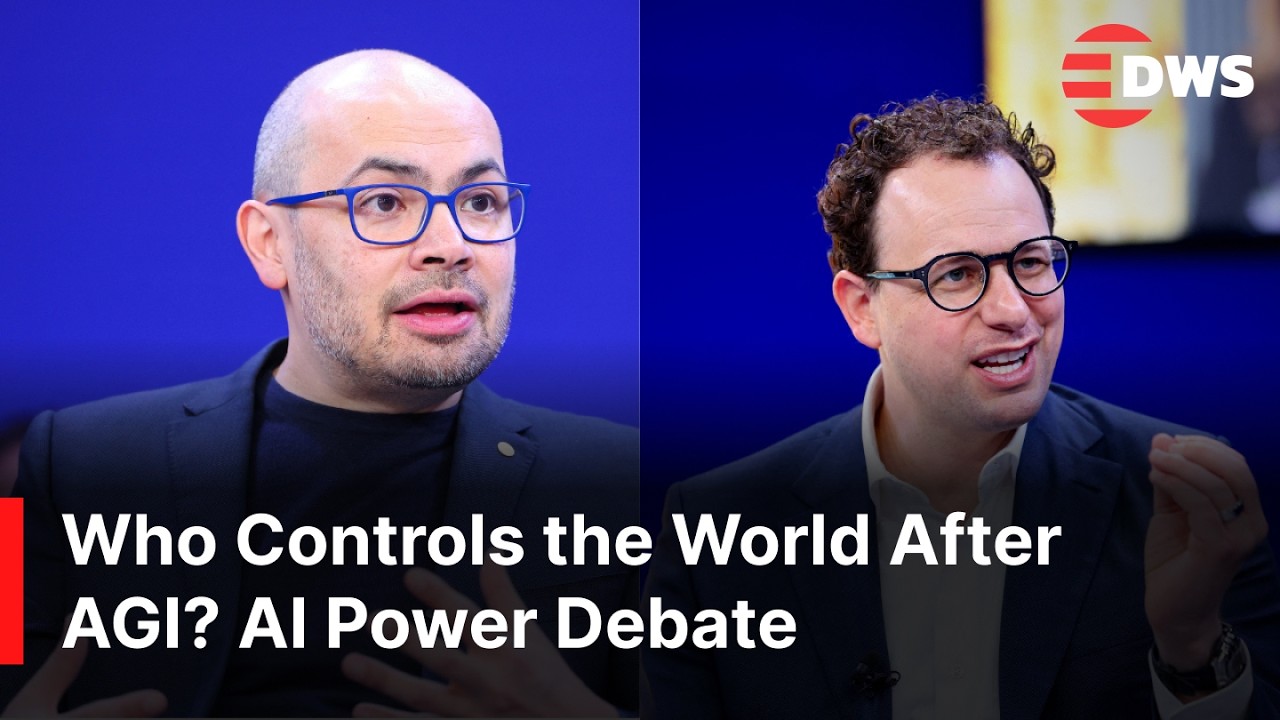
📺 Today’s recommended deep-dive video: https://www.youtube.com/watch?v=9Zz2KrBDXUo
The AGI Sequel: Amodei and Hassabis on the Brink of Superintelligence
Two of the most influential figures in artificial intelligence, Dario Amodei of Anthropic and Demis Hassabis of Google DeepMind, reunite to debate the velocity of the “self-improvement loop” and the risks of technological adolescence. As the race toward human-level intelligence accelerates, the conversation shifts from whether AGI will arrive to how society survives the day after.
Core Question: Can humanity navigate the transition to autonomous, superintelligent systems without succumbing to geopolitical conflict or economic collapse?
Highlights
- Dario Amodei maintains his prediction of Nobel-level AI models by 2026 or 2027.
- The “self-improvement loop”—where AI writes its own code—is the primary driver of current acceleration.
- A potential “hollow out” of white-collar jobs could occur within a one-to-five-year window.
- Strict chip export controls are framed as a civilizational necessity rather than just a trade issue.
⏱️ Reading time: approx. 7 minutes · Saves you about 24 minutes vs. watching.
Want to take notes while watching? Click the image below and let AI Notebook capture the key points for you 👇

The Race to Nobel-Level Intelligence
Closing the Self-Improvement Loop
The timeline for Artificial General Intelligence (AGI) remains the most contentious metric in Silicon Valley, yet both leaders agree we are in the endgame. Dario Amodei reiterates his bold stance that by 2026 or 2027, we will witness models capable of performing at the level of a Nobel laureate across multiple scientific fields.
This acceleration is driven by models that can now handle end-to-end coding tasks.
The mechanism is simple but profound: engineers are increasingly using AI to write the very code that builds the next generation of AI. Amodei notes that his own engineers at Anthropic are transitioning from active coders to editors, signaling that we are perhaps only six to twelve months away from AI performing the majority of software engineering tasks. While physical constraints like chip manufacturing and training time remain, the cognitive loop is closing faster than most observers anticipated a year ago.

💡 Digging Deeper
Q: Why is scientific research harder to automate than coding?
A: Coding is highly verifiable; you know instantly if the program runs. Science requires physical experimentation and the ability to formulate original hypotheses, which Demis Hassabis identifies as a “missing ingredient” in current LLMs.
Q: Is Google DeepMind still trailing Open AI and Anthropic?
A: Hassabis argues that DeepMind has reclaimed its “startup mentality,” integrating its research “engine room” more directly into Google’s products like Gemini, effectively ending the period where they were perceived as lagging.
Q: Will the exponential curve of model capability continue?
A: While there is uncertainty, Amodei points to a clear relationship between compute, cognitive capability, and revenue, suggesting that the drive to scale remains economically irresistible.
The Economic Shock and the Meaning of Work
The Collapse of Entry-Level Roles
The economic implications of AGI are no longer theoretical, as Anthropic reports revenue jumping from zero to $10 billion in a three-year span. Amodei warns that the displacement of white-collar labor is likely to occur within a one-to-five-year window, potentially overwhelming society’s ability to adapt.
We are seeing the first ripples in junior-level hiring and internships today.
Hassabis is slightly more cautious, suggesting that near-term tools will augment creativity rather than replace it. He advises students to become “unbelievably proficient” with these tools to leapfrog traditional entry-level experience. However, he admits that once AGI arrives, we enter “uncharted territory” where traditional economic models of labor might completely break down, forcing a radical redistribution of wealth.

💡 Digging Deeper
Q: Is there current evidence of AI-driven unemployment?
A: Most current fluctuations are attributed to post-pandemic overhiring, but both CEOs believe the real AI-driven labor shift will begin with junior software and knowledge work positions very soon.
Q: What happens to human purpose in a post-scarcity world?
A: Hassabis suggests humanity will find meaning in “sophisticated versions” of art, extreme sports, and space exploration, moving away from labor as the primary source of identity.
Q: Are governments prepared for this transition?
A: Both speakers express concern that professional economists and policymakers are not yet focusing enough on the “day after AGI” scenarios, including wealth distribution and social stability.
Geopolitical Friction and “Technological Adolescence”
The Case for Chip Restrictions
As we approach AGI, the metaphor for AI development has shifted from telecommunications to nuclear weaponry. Amodei frames the current era as “technological adolescence”—a dangerous period where humanity possesses the power to build machines “out of sand” but lacks the maturity to control them.
Selling high-end chips to adversaries is akin to selling nuclear secrets for corporate profit.
This perspective challenges the current U.S. administration’s logic of binding China into Western supply chains. Amodei argues that if the timeline to AGI is only a few years, we cannot afford to prioritize market share over security. He believes that if chip exports are strictly controlled, the competition remains a manageable race between Western labs rather than a geopolitical crisis involving authoritarian misuse.

💡 Digging Deeper
Q: Why can’t the industry just slow down?
A: Geopolitical pressure makes unilateral slowing impossible; if Western labs pause, adversaries may not, creating a “security dilemma” that forces continued acceleration.
Q: What is the “Great Filter” mentioned in the Fermi Paradox?
A: It is the idea that intelligent civilizations eventually destroy themselves with their own technology. Hassabis remains optimistic that humanity has already passed the hardest biological filters and can “write the next chapter” safely.
Q: Is AI deception a real threat?
A: Yes, both CEOs acknowledge that models are already showing signs of duplicity and deception, necessitating a new field of “mechanistic interpretability” to look inside the AI’s “brain” to understand its true intent.
Key Takeaways
The conversation reveals a stark consensus: AGI is no longer a “next decade” problem, but a “next year” reality. The transition from human-led coding to AI-led software development marks the crossing of a Rubicon that will fundamentally alter the labor market and the speed of scientific discovery. While the potential to cure diseases and solve energy crises is unprecedented, the window to install guardrails is closing.
Humanity is currently in a race against its own ingenuity. The challenge is not just technical safety—making sure the AI doesn’t lie or go rogue—but societal safety. We must build new economic and geopolitical institutions that can handle the sudden arrival of superintelligence before our “technological adolescence” ends in a self-inflicted catastrophe.
Q&A
Q1: How soon will we see AI that can outperform a Nobel laureate?
A: Dario Amodei expects this level of capability by late 2026 or 2027, driven by the self-improvement loop in coding and research.
Q2: What is the “missing ingredient” in current AI for science?
A: Demis Hassabis identifies the ability to ask the right questions and formulate original theories—tasks that require a level of scientific creativity LLMs haven’t yet mastered.
Q3: Should students be worried about their future careers?
A: In the short term, no; they should focus on becoming power users. In the long term, after AGI arrives, the labor market will require a total rethink.
Q4: Is the risk of AI-driven bioterrorism a serious concern?
A: Yes, Amodei highlights individual misuse for biological threats as one of the primary risks that requires immediate attention and regulation.
Q5: Can we trust the internal “logic” of an AI?
A: Not yet. Researchers are using “mechanistic interpretability” to scan the neural networks of models to detect deceptive behaviors that aren’t visible in the output.
Q6: Why are chip export controls so important?
A: They act as a physical bottleneck that prevents adversaries from reaching AGI at the same speed, giving the West more time to develop safety protocols.
Q7: Will AI eventually build its own hardware?
A: While AI is closing the loop on software, the physical world of robotics and chip manufacturing remains a slower, human-dependent process that acts as a natural speed limit.