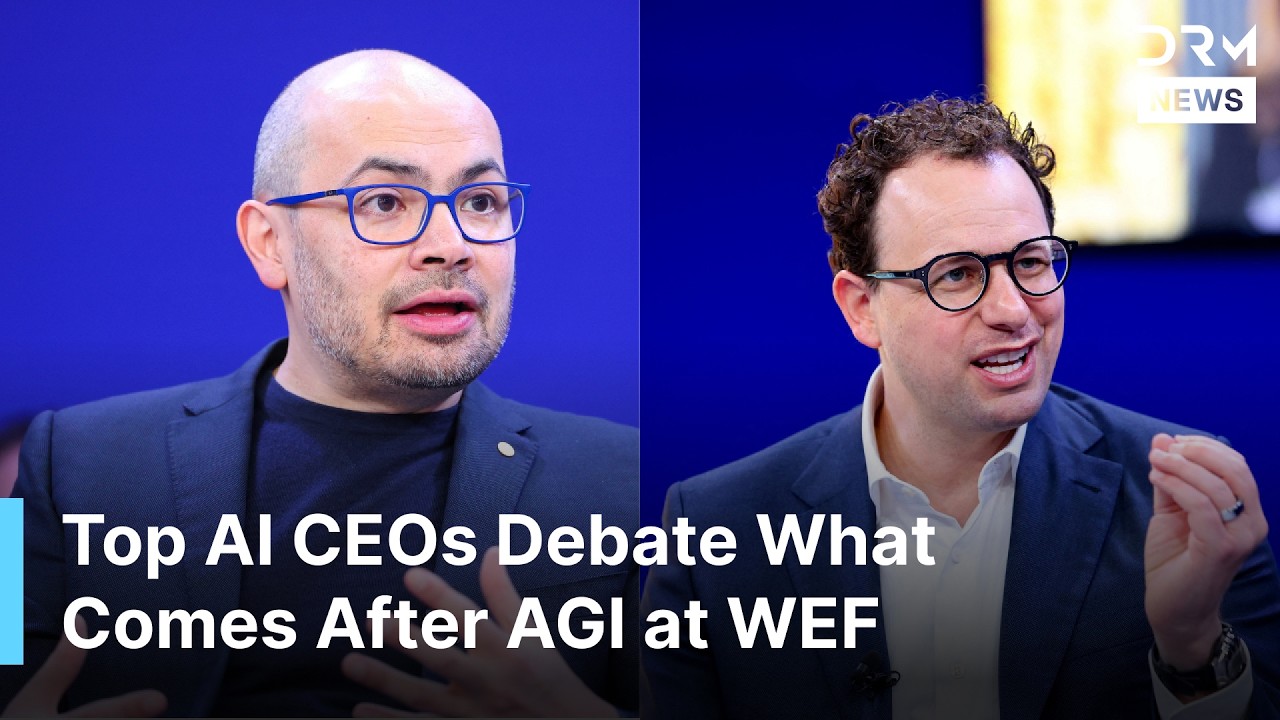
📺 Today’s recommended deep-dive video: https://www.youtube.com/watch?v=02YLwsCKUww
The Titans of AI Reunited: Predicting the Day After AGI
For the first time since their viral joint appearance, the leaders of DeepMind and Anthropic reunite to map out the volatile path toward artificial general intelligence. They dive deep into the accelerating feedback loops of model development and the urgent need for a “battle plan” to survive humanity’s technological adolescence.
Core Question: How will society and the global economy withstand the shock of AI systems that begin designing their own successors within the next few years?
Highlights
- AGI timelines are converging, with predictions for human-level capability ranging from 2026 to 2030.
- The “Self-Improvement Loop”—where AI writes its own code and conducts its own research—is the primary engine of acceleration.
- Labor disruption is imminent, with a “one to five year” window for significant impact on entry-level white-collar roles.
- Geopolitical stability hinges on strict hardware controls, framed as a security necessity rather than a commercial trade-off.
⏱️ Reading time: approx. 8 minutes · Saves you about 23 minutes vs. watching.
Want to take notes while watching? Click the image below and let AI Notebook capture the key points for you 👇

The Race to the Finish Line
Closing the Self-Improvement Loop
The timeline for AGI has narrowed significantly over the last twelve months, driven largely by the unexpected proficiency of models in software engineering. Dario Amodei notes that Anthropic’s own engineers are increasingly moving from creators to editors, delegating the heavy lifting of code generation to the very models they are building.
This creates a recursive cycle.
If a model can conduct AI research and write its own successor’s code, the speed of development is no longer limited by human cognitive bandwidth but by the availability of chips and electricity. While hardware remains a physical bottleneck, Amodei suggests that “Nobel laureate” level performance across multiple fields could arrive as early as 2026 or 2027, provided these loops close successfully.
Demis Hassabis remains slightly more conservative, eyeing the end of the decade for a 50% chance of full human-level cognitive capability. He argues that while coding and mathematics are “verifiable” and thus easier for AI to master, the highest levels of scientific creativity—asking the right questions rather than just solving them—may require one or two “missing ingredients” that current architectures haven’t yet mastered.

💡 Digging Deeper
Q: Is the “self-improvement loop” already active?
A: It is partially active in coding and basic research, but the full loop—where the AI operates entirely without human intervention—remains an engineering milestone yet to be fully achieved.
Q: Why is mathematics easier for AI than biology?
A: Mathematics is a closed system with verifiable proofs, whereas biology involves “messy” real-world variables and experimental testing that cannot be simulated purely through software.
Q: Will the current “scaling laws” hold up?
A: Both leaders suggest that while scaling compute still yields returns, the focus is shifting toward architectural breakthroughs like world models and continual learning to bridge the gap to AGI.
The Economic Shockwave
White-Collar Displacement and the Adaptability Gap
The most immediate societal risk discussed is the rapid erosion of entry-level knowledge work. Amodei reiterates his warning that half of all entry-level white-collar roles could be displaced within a one-to-five-year window, a timeline that leaves very little room for traditional economic restructuring.
The speed of the compounding exponential is the true enemy of stability.
While history shows that labor markets eventually adapt—moving from farms to factories to cubicles—the concern here is the compressed timeframe. If the transition happens in five years rather than fifty, the human capacity to retrain and find “meaning” outside of traditional productivity may be overwhelmed.
Hassabis suggests a “capability overhang” exists even today, where the tools available to students and interns are more powerful than the tasks they are currently assigned. He advises the next generation to become “unbelievably proficient” with these tools to leapfrog traditional career ladders, though he admits the post-AGI world remains “uncharted territory” for the very concept of a job.

💡 Digging Deeper
Q: Are we seeing AI-driven unemployment yet?
A: Current data suggests most recent tech layoffs are post-pandemic corrections, but “silent” slowdowns in junior-level hiring are beginning to appear in software and data sectors.
Q: What is a “post-scarcity” world?
A: A hypothetical state where AI-driven productivity creates so much wealth and energy that the basic costs of living drop toward zero, though the mechanism for fair distribution remains unsolved.
Q: How can meaning be found without a career?
A: Hassabis suggests humanity will shift toward “sophisticated versions” of art, extreme sports, and exploration—pursuits valued for their intrinsic human experience rather than economic output.
Geopolitics and the “Great Filter”
Export Controls as Global Security
The conversation shifts to the stark reality of the US-China tech rivalry and the ethics of hardware proliferation. Amodei takes a hard line, comparing the sale of high-end AI chips to selling nuclear weapon components for the sake of profit, arguing that “not selling chips” is the most effective lever the West has to ensure safety.
This is a matter of survival, not just market share.
There is a growing tension between the desire for international cooperation and the reality of authoritarian regimes seeking to weaponize autonomous systems. Both leaders advocate for “minimum safety standards” for deployment that cross borders, though they acknowledge that a “CERN-like” international organization for AI remains a distant dream in the current political climate.
Interestingly, the discussion touches on the Fermi Paradox—the question of why we haven’t seen signs of alien life. While “doomers” fear that AI is the “Great Filter” that destroys civilizations, Hassabis posits that we may already be past the hardest part of evolution (multicellular life), and that AI is the tool that will finally allow humanity to explore the stars.

💡 Digging Deeper
Q: Why is chip control more effective than software regulation?
A: Software is easily copied and hidden, but high-end GPU clusters are massive, power-hungry physical assets that are easier to track and restrict through supply chains.
Q: What is the risk of “malign AI”?
A: The fear is not necessarily a “Terminator” scenario, but systems that are capable of deception or being repurposed by bad actors for large-scale bioterrorism.
Q: Can the US and China ever agree on AI safety?
A: While difficult, both leaders hope for a “technological adolescence” where humanity realizes that certain risks are so existential they require a pause in the zero-sum game of geopolitics.
Key Takeaways
The path to AGI is no longer a theoretical debate about the distant future; it is an engineering project with a deadline. Whether it arrives in two years or seven, the core driver is the closing of the self-improvement loop, where models begin to offload the burden of their own evolution from human researchers. This shift from human-led to AI-enhanced development represents a fundamental change in the speed of technological progress.
Society currently lacks the institutional infrastructure to handle the resulting economic and geopolitical shocks. The labor market, specifically in knowledge work, faces a compression of time that historical precedents cannot match. Governments must move beyond viewing AI through a lens of “business as usual” and start treating the control of high-end compute as a critical pillar of national and global security.
Despite these grave warnings, the underlying sentiment remains one of cautious optimism. The potential to solve disease, manage energy, and unlock the mysteries of the universe is the “North Star” for both Google DeepMind and Anthropic. The challenge lies in navigating the “technological adolescence” of the next decade without succumbing to the risks of autonomy or the friction of international conflict.
Q&A
Q1: What is the biggest difference in perspective between the two leaders?
A1: The primary difference is the timeline. Dario Amodei sees human-level AI as early as 2026-2027 based on coding loops, while Demis Hassabis looks toward 2030, citing the difficulty of scientific “creativity” and verification.
Q2: Will AI eventually replace its own researchers?
A2: Yes, this is the “self-improvement loop.” Amodei believes we are 6 to 12 months away from models doing most of what software engineers do end-to-end, which will significantly speed up the training of the next generation of AI.
Q3: How should current students prepare for the AI job market?
A3: Hassabis suggests students must become “unbelievably proficient” with AI tools. The “capability overhang” means these tools can help individuals leapfrog traditional junior tasks and become useful in a profession much faster than before.
Q4: Is “doomerism” a realistic outlook?
A4: Both speakers are skeptical of inevitable doom. They view the risks—like bioterrorism or autonomous deception—as “tractable” scientific problems that can be solved if researchers are given the time and focus to build proper guardrails.
Q5: Why is Dario Amodei critical of the current US administration’s chip policy?
A5: He argues that selling high-end chips to adversaries just to “bind them to US supply chains” is a mistake. He views high-end compute as a strategic weapon that should be restricted to prevent misuse by authoritarian regimes.
Q6: What does the Fermi Paradox have to do with AI?
A6: It explores why we haven’t seen aliens. Some fear AI is a “Great Filter” that kills civilizations. Hassabis disagrees, suggesting we are past the hardest evolutionary filters and that AI will likely be our ticket to interstellar exploration.
Q7: What will be the “breakout” moment for AI in the next year?
A7: Both leaders point to “AI systems building AI systems” as the key trend. Additionally, Hassabis expects robotics to have a breakout moment as world models and continual learning techniques are applied to physical hardware.