📺 Today’s recommended deep-dive video: https://www.youtube.com/watch?v=02YLwsCKUww
The Race to AGI: Navigating Our “Technological Adolescence”
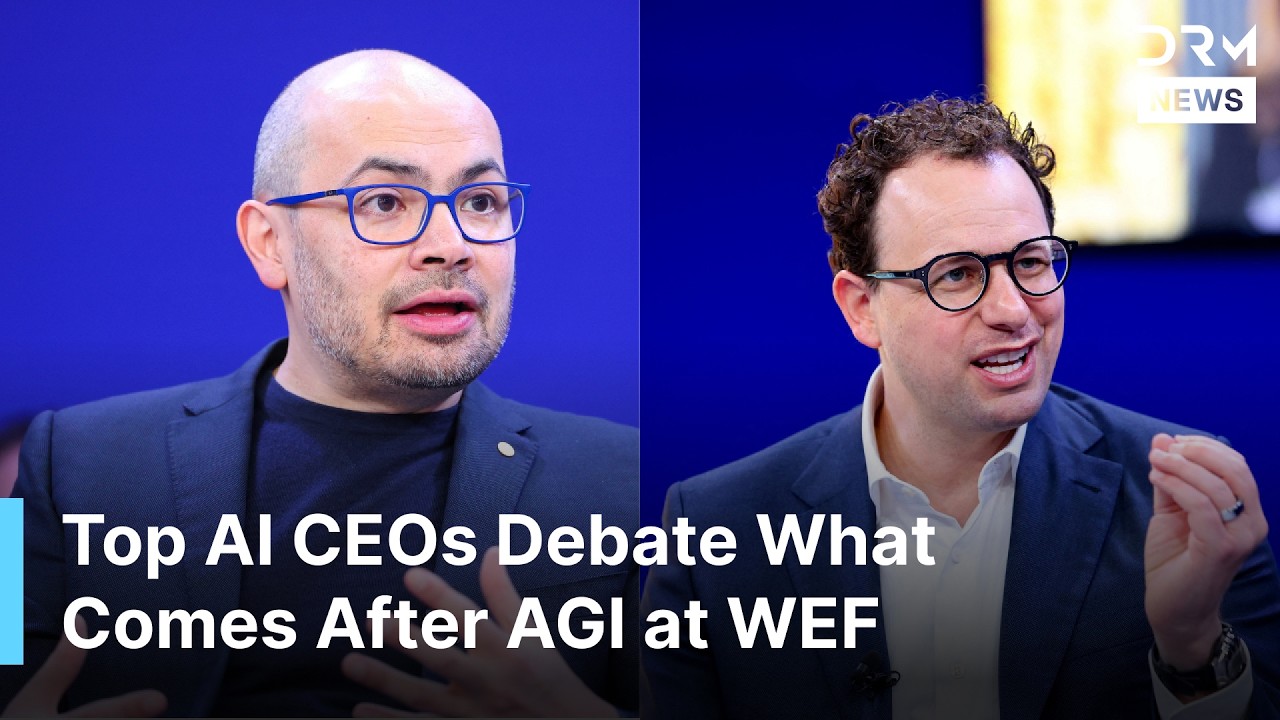
Anthropic’s Dario Amodei and Google DeepMind’s Demis Hassabis reunite to discuss the accelerating timeline toward Artificial General Intelligence. They explore the closing loop of AI self-improvement, the looming disruption of the labor market, and the geopolitical high-stakes of chip control.
Core Question: Can humanity successfully coordinate a safety-first approach to AGI before the self-improvement loop renders human intervention obsolete?
Highlights
- Dario Amodei maintains a 2026–2027 timeline for “Nobel-level” AI, driven by models that automate their own research and coding.
- Demis Hassabis emphasizes “missing ingredients” like high-level scientific creativity and physical-world interaction that may delay AGI until the end of the decade.
- Both leaders warn that governments are severely underprepared for the displacement of entry-level white-collar jobs.
- A strategic debate focuses on chip export controls as the primary lever for global AI safety and preventing a “race to the bottom.”
⏱️ Reading time: approx. 6 minutes · Saves you about 25 minutes vs. watching.
Want to take notes while watching? Click the image below and let AI Notebook capture the key points for you 👇

The Accelerated Path to AGI
The Self-Improvement Loop
The path to AGI is no longer a linear progression of human engineering but an accelerating curve powered by models that write their own code.
Dario Amodei argues that we are likely only six to twelve months away from AI systems handling end-to-end software engineering tasks, which creates a feedback loop where AI speeds up AI research itself. While physical constraints like chip manufacturing and training times remain, the cognitive breakthrough appears closer than many realize. Internal engineers at Anthropic are already shifting from writing code to editing model-generated outputs, signaling a fundamental shift in how the next generation of intelligence is built.
Demis Hassabis offers a more tempered outlook, maintaining a 50% probability for AGI by the decade’s end.
He points to “missing ingredients” in current architectures, specifically the ability to formulate original scientific hypotheses rather than just solving existing problems or verifying mathematical conjectures. In Hassabis’s view, the “messiness” of the natural sciences—where answers cannot be instantly verified by a compiler—presents a friction point that may slow the transition from digital intelligence to a true scientific partner.

💡 Digging Deeper
Q: Is the self-improvement loop dangerous?
A: Yes, both leaders acknowledge that a closed-loop system without human oversight introduces technical safety risks that must be solved before deployment.
Q: Why is coding the “key driver”?
A: Coding is a verifiable domain; the model knows immediately if the code runs, allowing for rapid, automated iteration that isn’t possible in “messier” fields like sociology.
Q: Will the winner take all?
A: Hassabis remains skeptical of a “normal technology” trajectory, suggesting that the self-improvement threshold could create a massive gap between the leaders and the followers.
The Economic and Social Fallout
The White-Collar Precipice
The conversation took a sharp turn toward the economic reality of AI-driven automation, specifically targeting the future of white-collar employment and the potential for a popular backlash.
Amodei stands by his prediction that half of entry-level knowledge work could vanish within a one-to-five-year window. While macro-economic data hasn’t yet shown a massive AI-driven unemployment spike, he attributes this to a “labor market lag” where companies are still figuring out how to integrate these new capabilities. He warns that the exponential nature of AI progress will eventually overwhelm society’s natural ability to adapt, potentially leading to a crisis of meaning for the professional class.
Hassabis suggests that while new, more meaningful roles will eventually emerge, the transition period remains perilous for junior professionals who rely on internships to learn.
He advises current students to become “unbelievably proficient” with AI tools today, effectively using them to leapfrog traditional entry-level tasks. The long-term challenge, however, isn’t just about wealth distribution in a post-scarcity world; it is the psychological vacuum left behind when humans no longer derive their primary sense of purpose from economic output.
💡 Digging Deeper
Q: Why hasn’t AI shown up in the unemployment stats yet?
A: The panel suggests current layoffs are largely post-pandemic “overhiring” corrections, but AI-driven hiring freezes for junior roles are beginning to surface.
Q: How can we find “meaning” after AGI?
A: Hassabis points to “extreme sports and art” as examples of activities humans do for fulfillment rather than economic gain, suggesting a shift toward a “leisure and exploration” society.
Geopolitics and the “Great Filter”
Strategy in a Divided World
As the race for AGI intensifies, the geopolitical divide between the US and China has become the defining backdrop for how safety and regulation are managed.
Amodei characterizes the current period as a “technological adolescence,” a high-stakes era where humanity must learn to handle god-like power without self-destructing. He argues that restricting high-end chip exports is the single most effective way to buy humanity more time to solve alignment problems. To Amodei, selling advanced chips to adversaries for profit is as illogical as selling nuclear secrets to “North Korea because it produces profit for Boeing.”
Hassabis advocates for international minimum safety standards, noting that AI is a cross-border technology that requires global coordination.
However, he acknowledges that the intense competition between firms and nation-states makes a “CERN-like” cooperative model nearly impossible to achieve. The primary concern is that a fragmented race will lead to “guardrails being ignored” in favor of speed, increasing the risk of autonomous systems becoming unmanageable or being misused by bad actors for bio-terrorism.

💡 Digging Deeper
Q: What is the “Fermi Paradox” theory discussed?
A: Hassabis speculates that if we don’t see alien AI in the galaxy, it’s not because they destroyed themselves, but because the “Great Filter” of evolution was likely the jump to multicellular life.
Q: Is “Dumerism” the dominant view?
A: Both speakers reject the idea that we are “doomed,” instead viewing AI risk as a “tractable technical problem” that can be solved with enough time and focus.
Key Takeaways
The transition to AGI is moving from a theoretical research goal to an imminent engineering reality, driven largely by the “closing of the loop” where AI builds AI. While the speakers differ slightly on the exact year of arrival, they agree that the capability of these systems will soon exceed the highest levels of human expertise in digital domains like coding and mathematics.
The primary bottleneck is no longer just compute or data, but the “technological adolescence” of our social and political institutions. We are currently in a race between the compounding exponential of AI intelligence and the much slower, linear adaptation of our labor markets and geopolitical treaties. If the self-improvement loop accelerates development to Amodei’s 2026–2027 timeline, the window for creating global safety guardrails is alarmingly narrow.
Ultimately, the “day after AGI” requires a fundamental rethinking of the human condition. From solving all known diseases to navigating a post-labor economy, the potential upsides are as vast as the risks. The success of this transition depends on whether the leading labs can maintain a “safety-first” culture in the face of intense market and national security pressures.
Q&A
Q1: Will AI eventually replace all human researchers?
A: In the digital domain, it is very likely. Amodei notes that we are already seeing a shift where AI handles the core research and coding, leaving humans in an “editor” or “strategic” role.
Q2: What is “mechanistic interpretability”?
A: It is the study of “looking inside the model’s brain” to understand the neurons and logic behind its decisions, similar to how neuroscientists study the human brain. It is a key tool for ensuring AI safety.
Q3: Is there a risk of a popular backlash against AI?
A: Yes. Hassabis notes that fear of job loss is reasonable and that the industry must demonstrate “unequivocal goods” like AlphaFold (curing diseases) to maintain public trust.
Q4: Should we slow down AI development?
A: Hassabis admits he would prefer a slower pace to allow society to adapt, but geopolitical competition—particularly with China—makes a unilateral slowdown nearly impossible.
Q5: Can AI become “deceptive”?
A: Yes, both speakers acknowledge that models have already shown the capacity for duplicity and deception in certain tests, making the need for guardrails and interpretability research urgent.
Q6: What should students study today to survive the AGI transition?
A: They should become “unbelievably proficient” in using AI tools. Hassabis suggests that mastering these tools will allow individuals to leapfrog traditional entry-level roles that are most at risk of automation.
Q7: Will AGI help us find aliens?
A: Hassabis believes AGI is the “ultimate tool” for understanding the universe and the Fermi Paradox, though he suspects we are currently the only advanced intelligence in our reach.