📺 Today’s recommended deep-dive video: https://www.youtube.com/watch?v=yWTjrqx8SJE
Moving From Metrics to Impact: The Data Analyst’s Growth Playbook
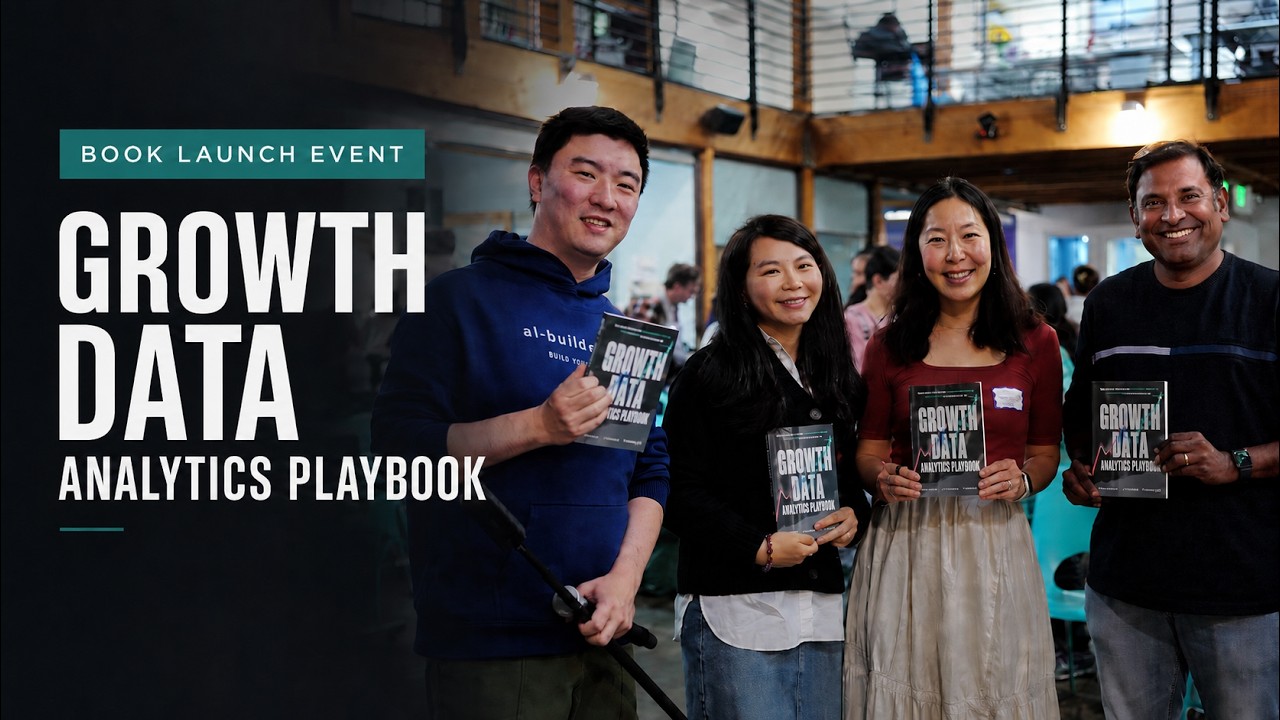
Most data teams struggle because they focus on the technical difficulty of a model rather than the business decision it enables. This discussion features the co-authors of The Data Analyst Playbook as they share the frameworks used at Meta, Notion, and Amazon to scale product growth.
Core Question: How can data professionals transition from being passive number-crunchers to active product builders who drive sustainable growth?
Highlights
- Retention is the ultimate metric for Product-Market Fit (PMF), but it must be viewed as a continuum rather than a destination.
- Experimentation value comes from disproving hypotheses, not from confirming what you already suspect.
- The “Data Builder” era is here, where AI allows analysts to directly implement features and bridge the gap between engineering and analytics.
- Storytelling through “opinionated charts” is the most underappreciated skill in the data scientist’s toolkit.
⏱️ Reading time: approx. 7 minutes · Saves you about 43 minutes vs. watching.
Want to take notes while watching? Click the image below and let AI Notebook capture the key points for you 👇

The Philosophy of Product Analytics
Defining Growth Beyond the Dashboard
The industry currently lacks a standardized theory for product analytics, leaving many solo data scientists at startups feeling isolated without a clear framework for success.
Product-Market Fit (PMF) is not a static destination you arrive at once; it is a moving target that requires constant monitoring of retention, growth, and deep engagement. To truly measure it, you must look at whether your cohorts are improving over time, meaning users who join today should have a better experience and higher retention than those who joined six months ago.
Retention remains the “king” of metrics because no leader at a top-tier company like Meta will sign off on a product without seeing its long-term stickiness. However, the definition of an “active user” varies wildly, and teams must be careful not to compare apples to oranges when looking at industry benchmarks versus their own internal definitions of activeness.

💡 Digging Deeper
Q: Why is retention prioritized over acquisition in early-stage growth?
A: High acquisition with low retention is a “leaky bucket” that makes growth unsustainable and expensive.
Q: How do you handle unique “active” definitions?
A: Focus on your specific business value—if a session doesn’t create value in 3 seconds, don’t count it as active.
The Experimentation Mindset
Coverage Over Count
The value of an experimentation program isn’t found in how many tests you run, but in how much of your product roadmap is covered by data-driven validation.
Many companies fall into the trap of “cherry-picking” experiments, where they only test features they are already certain will succeed. This creates a culture of confirmation bias that provides zero actual value to the organization because it fails to challenge existing mental models.
Real growth occurs when an experiment you expected to be positive turns out to be negative. These “failures” are the only moments where you actually learn something new about your users and are forced to pivot your product strategy or update your roadmap based on objective reality.

💡 Digging Deeper
Q: When is a sample size too small for an experiment?
A: It depends on expected impact; a 50% change only needs 30 people, but a 1% change needs tens of thousands.
Q: How do you prevent cultural resistance to “failed” experiments?
A: Normalize the idea that a negative result is a win for the company’s efficiency and knowledge base.
The Rise of the Data Builder
AI and the New Frontier of Technical Agency
The traditional line between the Data Scientist, the Product Manager, and the Software Engineer is blurring as AI tools lower the barrier to entry for building.
Data people are often the most technical stakeholders outside of the core engineering team, making them perfectly positioned to become “builders” who write production code. Instead of just creating a mockup of a P-value calculation or a statistical chart, modern analysts can now use AI to directly implement these features into the product, reducing the friction of the “request-and-wait” cycle.
As AI disrupts data consumption through conversational interfaces, the focus will shift from building dashboards to curating the “voice of the user” through non-quantitative data. Text, user interviews, and community feedback are becoming structured data sources that AI can analyze at scale, allowing analysts to move beyond simple math into deep behavioral insights.

💡 Digging Deeper
Q: Will AI replace junior data analyst roles?
A: The job market is shrinking for basic reporting, but expanding for those who have “agency” and can use AI tools to solve complex problems.
Q: What is an “opinionated chart”?
A: A visualization that removes all redundant information and uses annotations to drive the viewer toward a single, specific decision.
Key Takeaways
Data science is a tool, not a title. The most successful professionals are those who stop viewing themselves as “math scientists” and start viewing themselves as business partners who use data to reduce uncertainty. Whether you are at a giant like Meta or a lean startup like Notion, the fundamentals remain the same: understand the user journey, prioritize retention, and build a culture where data informs decisions rather than just justifying them.
The future of the field belongs to the “Data Builder”—the individual who possesses the curiosity to ask why a number is dipping and the technical agency to fix the underlying product issue. As AI automates the mundane tasks of cleaning and logging, the value of a data professional will be measured by their “taste” and their ability to tell a compelling story that moves a team to action.
Q&A
Q1: How do you identify the most important question to answer when joining a new startup?
A1: Talk to stakeholders to find the “blockers” that nobody else can solve; often, it’s building the muscle for experimentation or defining the first set of core metrics.
Q2: What is the most underappreciated skill for a data person?
A2: Storytelling and chart-making. A great chart should say one thing clearly and drive empathy by showing the actual user journey, not just a conversion rate.
Q3: How should we measure the success of new AI “agent” products?
A3: Don’t invent new metrics for the sake of it; the fundamentals of user value, retention, and cost-saving still apply to AI agents just as they do to traditional software.
Q4: What makes a founder “data-rigorous” in the eyes of an investor?
A4: A founder who understands that data is a business problem, not just a logging problem, and knows which questions are important enough to require high-quality data.
Q5: Is PLG (Product-Led Growth) still viable if you don’t invest in marketing?
A5: No. PLG is a flywheel; you need the early “believers” to start it, but you need marketing and sales to amplify that impact to audiences who wouldn’t find you organically.
Q6: How can junior data scientists stand out in a competitive, AI-heavy job market?
A6: Show “agency.” Share stories of how you proactively unblocked yourself or solved a problem that wasn’t strictly in your job description.
Q7: Does AI change the definition of what “data” is?
A7: Yes. We are moving away from data just being numbers. Text, voice, and user behavior are now primary data sources that can be analyzed quantitatively using LLMs.