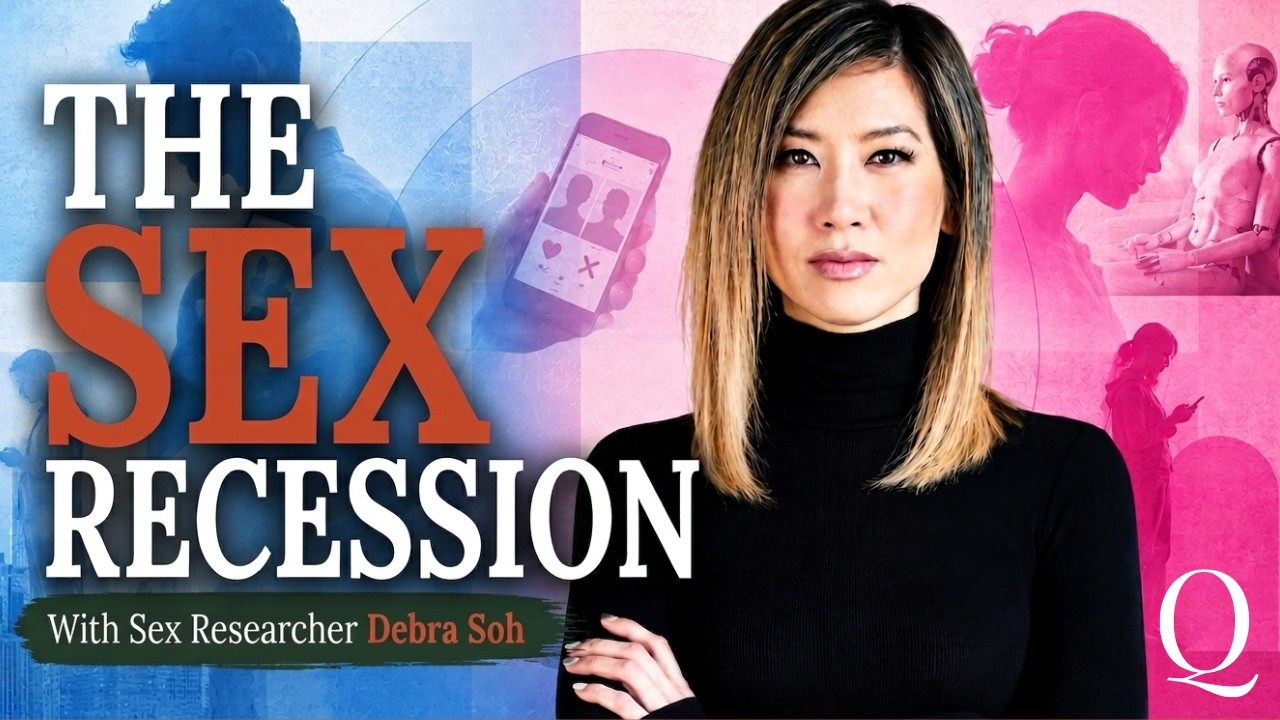
📺 Today’s recommended deep-dive video: https://www.youtube.com/watch?v=lsz20QLbg3c
The Modern Mating Crisis: Why Biology and Technology are at War
Dr. Deborah So, a neuroscientist and sex researcher, explores the “sex recession” and the growing alienation between the sexes in her new book, Sexinction. She argues that the collision of digital distractions, ideological science denial, and the mismatch between our evolutionary wiring and modern social structures is destroying human intimacy.
Core Question: How have technological shifts and “sex-positive” ideologies created a global decline in sexual activity and emotional connection?
Highlights
- The “sex recession” is a verified global trend affecting all developed nations, particularly hitting Gen Z and Millennials.
- Evolutionary hypergamy—the female preference for higher-status mates—is clashing with a reality where women now dominate higher education and the workforce.
- Digital “fubbing” (phone snubbing) and the rise of AI surrogates are replacing high-quality human interactions with low-stakes digital validation.
- Academic “sex-positivity” often ignores the biological differences between men and women, leading to exploitative dynamics in polyamory and kink culture.
⏱️ Reading time: approx. 8 minutes · Saves you about 52 minutes vs. watching.
Want to take notes while watching? Click the image below and let AI Notebook capture the key points for you 👇

The Neuroscience of the Sex Recession
Beyond the Moral Panic
Dr. Deborah So approaches the current decline in human intimacy not as a social critic, but as a neuroscientist trained to analyze the biological mechanisms of arousal.
During her time in academia, So utilized functional MRI technology to map the human brain’s response to sexual stimuli, managing a $1.2 million grant aimed at uncovering the structural connective tissues involved in desire. This rigorous scientific background allows her to look past the hyperbolic moral panics of the past and identify a genuine, data-driven trend: a global “sex recession” that is hitting younger generations and developed nations the hardest.
While many initially dismissed the idea of a sex recession as a statistical blip, data sets since 2016 show a persistent downward trend in sexual activity. This decline is particularly pronounced among young men, reflecting a broader withdrawal from the emotional risks associated with physical intimacy and real-world vulnerability.
The data reveals that we are trading genuine connection for cheap dopamine loops.

💡 Digging Deeper
Q: How did you transition from brain scans to writing about social trends?
A: The transition was logical; I began by questioning gender ideology in my first book and realized that the “sex recession” was the next myth that required a rigorous, science-based investigation.
Q: Is this decline just a Western phenomenon?
A: No, it is happening in both the West and the East; any developed country with high technological penetration is seeing a marked decrease in sexual activity among youth.
Q: Why focus specifically on young men?
A: Young men are disproportionately opting out of the mating market entirely, often replacing real-world pursuit with pornography, gaming, and online betting.
The Hypergamy Gap and the Mating Market
The Evolutionary Mismatch
We are currently living through a massive experiment where our ancient biological wiring is forced to navigate a sociopolitical environment it was never designed for.
Evolutionary psychology suggests that women generally exhibit a preference for hypergamy, which is the tendency to seek partners of equal or higher socioeconomic status to ensure resource security for offspring. However, as women now dominate university campuses and high-earning professional sectors, the pool of “high-status” men has shriveled, creating a brutal bottleneck in the dating market.
This leaves successful women with few attractive options and a small percentage of high-tier men enjoying a “sellers market” where they have little incentive to commit.
Intimacy is being priced out by an arithmetical impossibility.

💡 Digging Deeper
Q: What are the “Three Sixes” in modern dating lore?
A: They refer to a man who is over six feet tall, earns over six figures, and possesses a six-pack (with a fourth ‘six’ sometimes referring to anatomical measurements).
Q: Does hypergamy vanish if a woman becomes a millionaire?
A: Usually, it intensifies; highly successful women often still desire a partner who matches or exceeds their own level of provisionary status and ambition.
Q: Why do you advise women against pursuing men?
A: Biologically, sex carries a higher investment and risk for women; when men are not required to exert effort in the pursuit, they often view the partner as an afterthought rather than a priority.
The Ideological Distortion of Intimacy
The Myth of Sex-Positivity
Academic “sex-positivity” has become a shield for behaviors that are often psychologically damaging or exploitative, particularly for those who have experienced past trauma.
In many progressive circles, there is a total reluctance to judge any form of kink or “consensual abuse,” despite evidence that these communities can be hotbeds for genuine mistreatment. Dr. So argues that the push to normalize polyamory often ignores the reality of human jealousy and the fact that these arrangements frequently favor high-status men while leaving women to compete for scraps of attention.
She highlights the “Cowgirling” phenomenon—where one woman in a polyamorous group subtly pushes others out to achieve a monogamous outcome—as evidence that our drive for exclusive pair-bonding remains potent.
Ideology cannot rewrite the neurochemical reality of human attachment.

💡 Digging Deeper
Q: What is “fubbing”?
A: It is a portmanteau of “phone” and “snubbing,” describing the act of ignoring a physical partner in favor of a smartphone, which research links to lower sexual frequency.
Q: Why are academics reluctant to criticize BDSM or porn?
A: There is an “allyship” culture in academia where questioning the health of “consensual” kinks is viewed as a form of colonial or regressive judgment.
Q: Can people truly separate sex from emotion?
A: Generally, men can do this more easily than women due to hormonal differences, but for most people, the commodification of sex leads to an emotionally barren existence.
Key Takeaways
The decline of sex is not merely a matter of “puritanism” returning to the West; it is a symptom of a society that has optimized for digital convenience at the expense of biological fulfillment. We are witnessing a divergence where technology provides a “good enough” surrogate for the difficult work of building a relationship, leading to a generation that is increasingly “sexinct.”
We must acknowledge that biology is not a social construct. Until we address the mismatch between our high-status expectations and the reality of a struggling male population, the resentment between the sexes will likely continue to grow. True intimacy requires vulnerability, the setting aside of the smartphone, and a rejection of the idea that human beings are disposable commodities to be swiped away.
Q&A
Q1: Is the rise of sex dolls and AI chatbots a legitimate threat to human relationships?
A: Yes, particularly for young men who feel demoralized by the dating market. These surrogates provide a risk-free alternative to the complexities of real women, further entrenching social isolation.
Q2: Why do you criticize the “house husband” narrative?
A: The data shows that marriages where the woman is the primary breadwinner are at higher risk for divorce and domestic tension. Evolutionarily, women often feel resentment when they take on both the financial burden and the majority of the domestic labor.
Q3: What is the primary cause of the “Sex Recession” in Gen Z?
A: It is a confluence of factors, but “fubbing,” early exposure to pornography, and a lack of real-world social interaction are the primary drivers of this disinterested generation.
Q4: Is polyamory actually a progressive advancement for women?
A: Not usually. In many cases, it functions as a modern harem where a high-status man avoids commitment while women compete for his resources, often under the guise of “enlightened” openness.
Q5: Can reproductive technology solve the “mismatch” problem?
A: Technology like egg freezing is often oversold to young women. While it offers some flexibility, it doesn’t change the biological reality of a woman’s fertility window or the psychological desire for a stable partner.
Q6: What is the impact of childhood porn exposure?
A: It is highly damaging, as it creates unrealistic expectations and can lead to a disinterest in the slower, more nuanced process of real-world dating and intimacy.
Q7: How can couples fight “Sexinction” in their own lives?
A: The first step is awareness of “fubbing” and digital distractions. Prioritizing physical presence over digital validation is essential for maintaining a healthy, functional relationship.