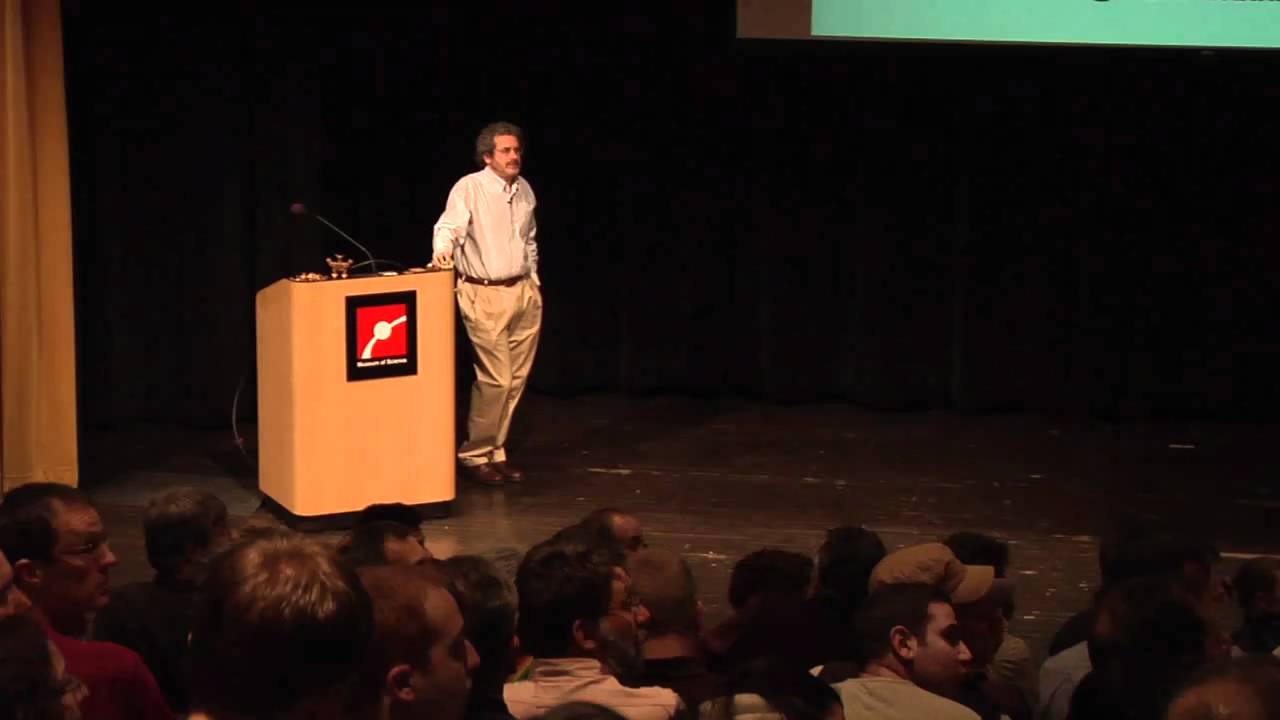
📺 Today’s recommended deep-dive video: https://www.youtube.com/watch?v=aPbJmYCSCgA
The Bits-to-Atoms Revolution: Programming the Physical World
The boundary between digital information and physical reality is dissolving, sparking a revolution in how we design, manufacture, and distribute everything. Dr. Neil Gershenfeld explores the rise of “Fab Labs”—distributed community centers that empower anyone to build customized technology, from solar-powered houses to specialized medical tools.
Core Question: How does merging the logic of computer science with physical manufacturing create a “market of one” that bypasses traditional mass production?
Highlights
- The transition from industrial “mainframes” to personal fabricators that produce objects on demand.
- Why “personal fabrication” mirrors the historical shift from institutional computing to the PC.
- Global impact case studies: Mesh networks in Afghanistan, micro-fluidics in Ghana, and nomadic labs in Norway.
- A 20-year roadmap toward molecular assemblers—the real-life “Star Trek replicator.”
⏱️ Reading time: approx. 7 minutes · Saves you about 63 minutes vs. watching.
Want to take notes while watching? Click the image below and let AI Notebook capture the key points for you 👇

The End of Analog Manufacturing
From Analog Gears to Digital Atoms
For decades, we have maintained a strict philosophical and industrial divide between the world of digital bits and the world of physical atoms. Academia separates computer science from physical science, and industry separates hardware from software, yet nature makes no such distinction. In a living cell, information and physical properties exist simultaneously; the DNA code isn’t just a description of a person, it is the fundamental blueprint that physically constructs the organism through molecular machinery.
The digital revolution in communication and computation is effectively over because we have already won; the next frontier is the digitization of fabrication itself.
We are moving away from the era where computers merely control tools to an era where the program is the thing itself. By treating physical matter like digital information, we can apply error correction and perfect reproducibility to the way we assemble the world. This represents a fundamental shift from the “analog” style of Boeing or Intel—where material is melted or etched—to a truly digital assembly where atoms are placed according to a code.
💡 Digging Deeper
Q: What does “digital” mean in the context of fabrication?
A: It means adding information to materials so that errors can be corrected. Just as digital data can be sent across the world perfectly, digital fabrication seeks to place physical “bits” (atoms or parts) in a way that allows for perfect, complex assembly.
Q: Why does Gershenfeld compare Fab Labs to early mainframes?
A: Because current Fab Labs cost thousands of dollars and fill a room, much like early computers. We are in the “PDP-11 era” of making things—it’s accessible to workgroups now, but it will eventually shrink to the size of a home appliance.
Q: How does nature demonstrate this concept?
A: Through the ribosome. The ribosome is a machine that reads a digital code (mRNA) and assembles physical parts (amino acids) to create complex, functional structures (proteins) that act as sensors, motors, and processors.
The “Market of One” and Global Empowerment
Designing for Individual Needs
The killer app of digital fabrication is not making what you can buy at a big-box retailer; it is making the things that retailers would never sell. When the cost of customization drops to zero, we enter the era of the “market of one,” where a student creates a “Scream Buddy” to record frustrated yells, or an architect develops a web browser specifically for parrots. These inventions aren’t meant for mass-market profit but for personal, expressive, or niche community utility that traditional industry ignores.
This democratization of technology shifts the focus from “top-down” billion-dollar mega-projects to “bottom-up” grassroots innovation.
In rural Afghanistan, Fab Labs have been used to build high-gain antennas to create local mesh networks where no IT infrastructure existed. Instead of parachuting in finished products like $100 laptops, these labs provide the means to create local solutions. This creates a cycle where local residents are not just consumers of technology, but the engineers, maintainers, and owners of their own technological infrastructure.

💡 Digging Deeper
Q: Are Fab Labs just a form of “outreach” for MIT?
A: No, they have become a “tail wagging the dog.” While they started as a way to show social impact, they have evolved into a global research network where inventions from the field often surpass the designs created on the MIT campus.
Q: How does fabrication impact education in developing nations?
A: It allows for “just-in-time” learning. An eight-year-old girl in Ghana can learn surface-mount soldering and microcontroller programming because she has an immediate, functional goal—like building a sensor—rather than following a dry, abstract curriculum.
Q: What is the “micro-VC” model mentioned?
A: It is a financial model where global capital can support local inventors. Instead of shipping finished goods, the model ships data, allowing local producers to manufacture and sell products on-demand within their own markets.
Redefining Institutions and Education
Is the Traditional Campus Obsolete?
The success of the Fab Lab network raises a provocative question: does a central university campus still serve a purpose in a connected world? When libraries are online and specialized tools are available in local labs, the traditional “pilgrimage” to an elite institution like MIT becomes less necessary for many students. We are seeing the emergence of a “global campus” where students in Nairobi, Iceland, and Boston collaborate in real-time within a peer-to-peer network that values “doing” over “sitting in a room.”
This shift requires us to rethink the very concept of literacy and the liberal arts.
In the Renaissance, a split occurred between “thinking” (the liberal arts) and “making” (the illiberal arts). Today’s inventors are proving that 3D machining and microcontroller programming are as expressive as painting a sonnet. We are moving toward a new kind of “technical literacy” where the ability to shape the physical world is a fundamental right, much like the ability to read or write.

💡 Digging Deeper
Q: What is the Fab Academy?
A: It is a distributed degree program where the “campus” is the entire planet. Students work in local labs but participate in global lectures and critiques, moving faster than traditional accreditation bodies can keep up with.
Q: How are Fab Labs like Carnegie Libraries?
A: Just as Andrew Carnegie funded town libraries to provide access to the “technology” of books, Fab Labs serve as town-based resources for the “technology” of production, ensuring that the means of creation are a public good.
Q: What is a “National Fab Lab Network”?
A: It is a proposed infrastructure where a “national lab” isn’t a single high-security building far away, but a distributed network of labs in every community, linked together to solve energy, education, and manufacturing challenges.
Key Takeaways
The transition from analog to digital fabrication is the third great digital revolution, following communication and computation. By treating physical assembly as a code-driven process, we enable a world where “making almost anything” is a local, personal capability rather than a centralized, industrial one.
This revolution is not just about tools; it is about human agency. It challenges the “Renaissance mistake” of separating intellectual labor from physical craft, suggesting that the future of education and industry lies in their reunion. As we move toward the “Star Trek replicator” 20 years from now, the infrastructure we build today—the Fab Labs—serves as the training ground for a planet of inventors.
Ultimately, the goal is to shift the global population from being passive consumers of technology to active creators. Whether it is a herder in the Arctic Circle tracking reindeer or a student in a Boston public school building a robot, the power to program the physical world is becoming a universal language that transcends borders and economic status.
Q&A
Q1: Will Fab Labs replace mass production for common items like nuts and bolts?
A1: No. You volume-produce the least interesting things and custom-produce the most interesting things. Nuts and bolts will remain mass-produced, but the specialized tools and “market of one” products will be made locally.
Q2: How do you handle the language barrier in a global network of 3,000+ languages?
A2: Technology itself becomes a shared language. When there is a strong incentive to communicate a design or a solution, people quickly pick up the necessary technical terms and “talk” through the shared medium of the machines and code.
Q3: Can these labs be used for “bad” purposes, like making weapons?
A3: All technology is a double-edged sword. However, Gershenfeld argues that “bad guys” already have access to weapons like AK-47s; providing these tools to “everyone else” addresses the root causes of conflict by empowering communities to solve their own resource and infrastructure problems.
Q4: How does a Fab Lab differ from a traditional school shop class?
A4: In a Fab Lab, the computer lab and the machine shop are the same thing. It’s not just about welding or woodworking; it’s about integrating logic, sensors, and computation directly into the physical object being created.
Q5: What is the current cost of starting a Fab Lab?
A5: It typically costs about $50,000 in equipment and $10,000 to $20,000 in materials and site preparation. While the cost stays steady, the capability of what that money buys increases every year as the tools become more advanced.
Q6: What is the timeline for a “home” personal fabricator?
A6: We are currently in the “mainframe” era. In 20 years, we expect to have molecular assemblers—machines that can reproduce themselves and build items atom-by-atom—effectively bringing the factory into the home.
Q7: Is MIT becoming obsolete because of this network?
A7: Only partially. MIT remains vital for research that requires incredibly rare, expensive tools or the concentration of unique specialists. However, for general advanced technical education and common fabrication, the distributed network is often more efficient and accessible.