📺 Today’s recommended deep-dive video: https://www.youtube.com/watch?v=wqii_iX0RTs
From Lawrence to Lanyard: The “Build Cool Stuff” Ethos of Django
A look back at how a tiny newspaper in Kansas birthed a world-changing web framework, driven by a philosophy of rapid shipping and creative joy. Simon Willison revisits the milestones of his career, from geocoding radical political lists to mapping every llama in England.
Core Question: How does the “build cool stuff” mentality shape the evolution of a web framework and the career of its creator?
Highlights
- The transition from clunky PHP to elegant Python at the Lawrence Journal-World.
- How a Little League baseball site proved Django’s power by being built in just 72 hours.
- The birth of data journalism at The Guardian using Django to analyze 450,000 pages of government documents.
- The “Devfort” concept: Renting a Napoleonic fortress to ship collaborative side projects.
⏱️ Reading time: approx. 8 minutes · Saves you about 28 minutes vs. watching.
Want to take notes while watching? Click the image below and let AI Notebook capture the key points for you 👇

The Kansas Incubation: Birth of the CMS
In 2003, the web development landscape was dominated by PHP and MySQL, a combination that worked until it didn’t. At the Lawrence Journal-World, Adrian Holovaty and Simon Willison realized they were hitting the ceiling of what PHP could maintain. They wanted clean code, meaningful URL design, and proper CSS layouts—things the existing Python frameworks of the era simply didn’t prioritize.
This wasn’t just a technical shift; it was a cultural one driven by the newspaper’s management.
Rob Curley, the legendary local media innovator, set a mission statement that would eventually define Django: “We build cool stuff.” He was a showman who didn’t care about the backend implementation as long as the results were spectacular and immediate. This pressure to ship high-quality, feature-rich sites on impossible deadlines—like a comprehensive Little League portal built in just three days—is what forged Django’s primitives.
The framework wasn’t “extracted” from a product like Ruby on Rails was from Basecamp; rather, it was built up to meet the existing, complex requirements of Lawrence.com. Because the destination was already known, the path to building the “CMS” (as they called it then) was focused entirely on utility and developer speed.

💡 Digging Deeper
Q: Why was the name “Tornado” rejected for the framework?
A: While Simon loved the idea for the “TPS reports” joke from Office Space, the team realized that in Kansas, tornadoes carry a very negative, destructive connotation that wasn’t ideal for a new brand.
Q: What was the first actual site to run on the Django code?
A: The weather page for 6 News Lawrence, featuring custom illustrations by Dan Cox that changed based on local conditions.
Data Journalism and the Power of Crowdsourcing
After Kansas, Simon moved to The Guardian, where he encountered a newsroom full of hidden data. Simon Rogers, a journalist who specialized in infographics, had hundreds of meticulously researched spreadsheets sitting on his hard drive that the engineering department didn’t even know existed. By connecting these raw data sources to Django, they pioneered a new form of digital storytelling.
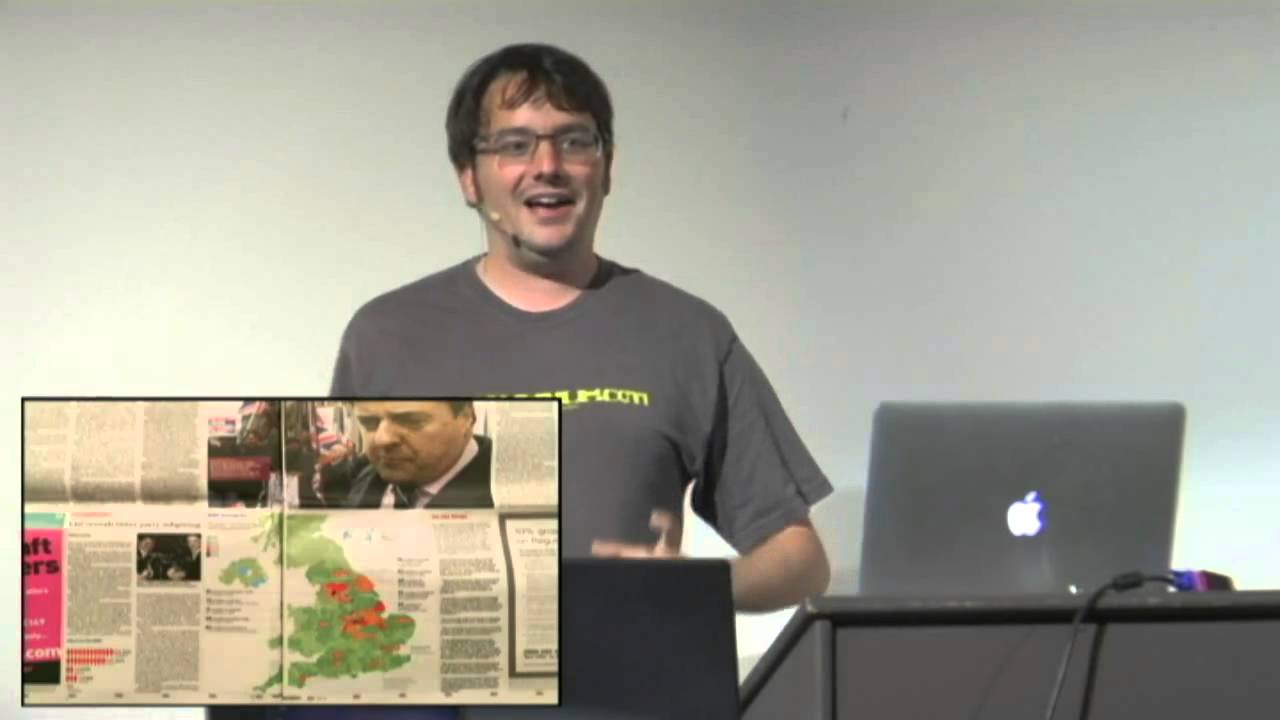
When the British National Party’s membership list was leaked, the team faced an ethical dilemma: how to report on it without violating individual privacy. The solution was a Django-powered heat map using SVG. By geocoding the addresses and mapping them to parliamentary constituencies, they turned a list of names into a visual story about political geography that could be exported directly to the printing press.
Speed was the ultimate currency in this environment.
When the UK Parliament expenses scandal broke, The Guardian had to analyze 450,000 pages of documents to catch up with a rival paper’s 30-day lead. They built a crowdsourcing platform in five days. By showing readers the “smug press photos” of their local MPs alongside their dubious expense claims, they gamified investigative journalism, allowing the public to process hundreds of thousands of pages in less than a day.

💡 Digging Deeper
Q: How did Simon handle the deployment of his internal tools at The Guardian?
A: He famously ran a self-service mapping tool on a Linux desktop under his desk, which the company eventually had to turn into a VMware instance because it became too critical to shut down after he left.
Q: Why were Google Spreadsheets used for the Data Blog?
A: Simplicity. Instead of building a complex database UI, they realized that just publishing Simon Rogers’ Excel files as Google Sheets allowed data nerds to build their own visualizations immediately.
The “Devfort” Era and Startup Reality
One of the most creative periods of Simon’s career involved renting a Napoleonic sea fortress called Fort Clon. The goal was simple: get a dozen hackers together in a defensive structure for a week and see what they could ship. This experiment birthed Wildlife Near You, a site designed to answer the question, “Where is my nearest llama?”
Collaborative side projects are notoriously difficult to maintain long-term.
While Wildlife Near You was a joy to build, it taught Simon that user accounts and moderation are the silent killers of side projects. Later iterations of “Devfort” focused on shipping tools that didn’t require permanent maintenance. One such project, Bugle, was essentially a local Twitter clone for groups without an internet connection—a precursor to the team-chat revolution that eventually led to apps like Slack.
The transition from “building cool stuff” to “running a business” came with Lanyard. What started as a honeymoon project in Morocco turned into a Y Combinator-backed startup. While successful, Simon is candid about the “misery, pain, and stress” hidden behind the glossy exterior of startup life, eventually leading to Lanyard’s acquisition by Eventbrite.

💡 Digging Deeper
Q: What is the “Tiki Bar” tool?
A: An internal Eventbrite tool similar to the Django Debug Toolbar, but optimized for production use to trace SQL queries and service calls without significant overhead.
Q: What was the most viral feature of the wildlife site?
A: A “Hot or Not” style comparison tool for animal photos, which allowed users to vote on which picture best represented a specific species.
Key Takeaways
The history of Django is inextricably linked to the fast-paced world of local journalism. Because the framework was born in a newsroom, it prioritizes the ability to move from a “wouldn’t it be cool if” idea to a live, functional website in a matter of hours. This legacy of pragmatism over perfectionism is what allowed it to scale from a small Kansas newspaper to massive platforms like The Guardian and Eventbrite.
Building for the web is most rewarding when it serves a human purpose, whether that’s holding politicians accountable or finding the nearest red panda. The “Build Cool Stuff” philosophy isn’t just about technical vanity; it’s about reducing the friction between a creative impulse and a shipped product. Simon’s career serves as a roadmap for how to maintain that sense of play and utility across different scales of engineering.
Ultimately, the longevity of these projects often comes down to the community. While many of the sites Simon built now only exist in the Internet Archive, the framework itself survives because it solved real problems for real developers. The goal shouldn’t just be to write code, but to build tools that empower others to ship their own “cool stuff” before the next news cycle begins.
Q&A
Q1: How did the Lawrence Journal-World afford to hire full-time developers?
The organization was unique; despite its small circulation, it funneled significant resources into a world-class newsroom and tech team, viewing digital innovation as a core survival strategy.
Q2: What was the “Wouldn’t it be cool if…” philosophy?
It was an informal development process where the team would brainstorm features in the basement and, if they liked them, build and ship them the very same day without formal specs.
Q3: How did the team handle the launch delay of 6 News Lawrence?
The launch was delayed by a week not because of a bug, but because the on-air news talent didn’t like their hairdos in the website headshots and insisted on new photos.
Q4: What was the original purpose of the Lanyard project?
It was meant to help Twitter users find which conferences their friends were attending, solving the discovery problem for professional events.
Q5: Is Django People still active today?
Yes, it is one of the few projects Simon mentioned that is still live, now hosted as part of the official Django Project website thanks to community maintenance.
Q6: What is the main danger of R&D positions according to Simon?
The risk is that you never actually ship anything to real users; he spent a year and a half at Yahoo R&D building prototypes that mostly never saw the light of day.
Q7: Can you really rent a missile silo for a “Devfort” in Kansas?
According to the audience at the talk, there are several decommissioned missile silos in Kansas that are indeed available for rent.