📺 Today’s recommended deep-dive video: https://www.youtube.com/watch?v=AQA7BUtqm1I
The Great AI Schism: e/acc vs. d/acc and the Future of Human Agency
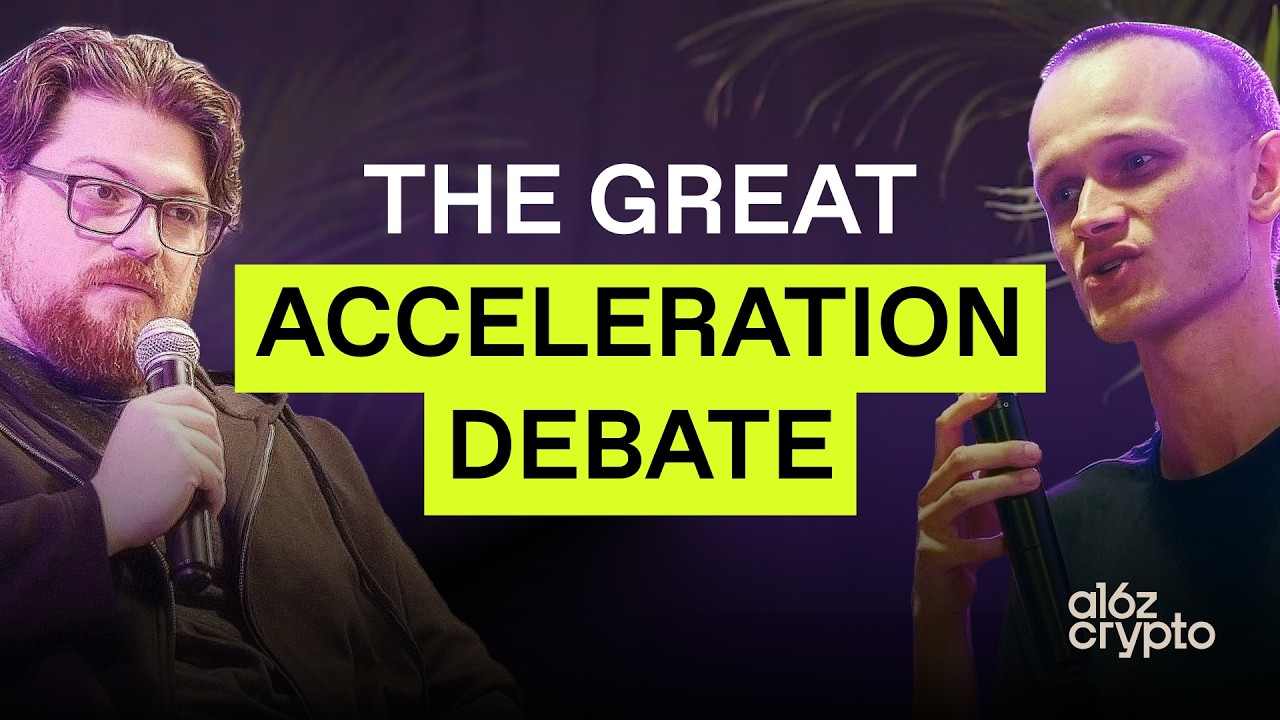
In this high-stakes meeting of minds, Ethereum creator Vitalik Buterin and e/acc founder Guillaume Verdon (Beff Jezos) debate the terminal velocity of technological progress. As the world approaches Artificial General Intelligence (AGI), they grapple with a singular choice: do we embrace the cold logic of thermodynamics or build a decentralized shield to protect human pluralism?
Core Question: Can humanity survive the inevitable acceleration of intelligence by using decentralized technology to balance the raw power of physics?
Highlights
- e/acc (Effective Accelerationism) posits that civilization must follow the “Kardashev gradient” to survive, treating growth as a thermodynamic law.
- d/acc (Decentralized/Defensive Acceleration) advocates for intentionally favoring defensive, open-source technologies to prevent unipolar AI dictatorships.
- The “soft merge” between humans and AI is seen as the only way to avoid a “hedonic singularity” where humans become obsolete meat-bags.
- Crypto is proposed as the essential “coupling” layer for commerce between autonomous AI agents and humans, replacing state-backed violence with trustless code.
⏱️ Reading time: approx. 8 minutes · Saves you about 89 minutes vs. watching.
Want to take notes while watching? Click the image below and let AI Notebook capture the key points for you 👇

The Thermodynamics of Civilization
Growth as a Physical Law
Verdon defines e/acc as a “physics-first” worldview that looks at civilization as a petri dish governed by the second law of thermodynamics. Systems naturally complexify to capture more energy and dissipate heat more efficiently; therefore, intelligence is effectively a “Maxwell’s Demon” that turns raw energy into predictive power.
Verdon asserts that deceleration is not just a policy choice but a biological error that decreases the fitness of any organism attempting to resist the inevitable flow of entropy.
Under the “selfish bit” principle, information configurations that promote growth and replication will naturally out-survive those that favor stagnation. This means that a culture embracing acceleration effectively “bootloads” survival software into the population, ensuring that those who seek upside are the ones who ultimately inherit the stars.
By treating civilization as a giant generative process, the e/acc movement argues that we should follow the “Kardashev gradient” to maximize our productive capacity and energy output. This perspective views intelligence as an optimization tool that consumes energy to create order out of chaos. Consequently, any attempt to throttle AI progress is seen as weaponized anxiety that only serves to widen the intelligence gap between a centralized elite and the general public.

💡 Digging Deeper
Q: What is the primary metric for e/acc success? A: Climbing the Kardashev scale, which measures a civilization’s total energy consumption and technological mastery.
Q: How does e/acc view AI “doomerism”? A: It is seen as a political tool used to consolidate power by inducing entropy/anxiety in the public’s model of the future.
Q: Why does Verdon use aggressive “mind hacks” online? A: To create a necessary polar opposite to the prevailing “decel” monoculture, pushing the Overton window toward optimism.
The Defensive Counter-Move
Pluralism and Verifiable Hardware
Vitalik introduces d/acc as a framework that values technological acceleration but insists on a specific direction: decentralized and defensive. He worries that “unipolar risks”—where a single AI or government gains absolute control—could lead to a permanent lock-in of power that humanity can never escape.
The goal of d/acc is to ensure the “narrow corridor” of progress remains open to human agency rather than being closed off by autonomous, centralized AI entities.
Vitalik’s vision for d/acc focuses on “defensive technologies” that protect individual liberty while still allowing for rapid scientific advancement in fields like biology and cryptography. He argues that instead of blindly accelerating every variable, we must intentionally favor tools that provide security to the many rather than leverage to the few. This includes building bug-free code and open-source sensors that can detect pathogens without compromising personal privacy or civil liberties through mass surveillance.
To mitigate the risk of mass surveillance supercharged by AI, Vitalik suggests a shift toward “verifiable hardware” where cryptographic proofs ensure privacy.

💡 Digging Deeper
Q: What does the “d” in d/acc stand for? A: It is multifaceted, representing Decentralized, Defensive, Differential, or Democratic acceleration.
Q: What is a “unipolar risk”? A: The danger of a single entity (AI or state) becoming so powerful that it can suppress all alternatives and establish a permanent dictatorship.
Q: How can hardware be “verifiable”? A: Through cryptographic attestation signatures that prove a device is only performing specific, transparent functions.
The Convergence of Silicon and Labor
The Future of the Human Career
The debate shifts to the “soft merge,” where humans augment their cognition with AI to remain relevant in a world where silicon intelligence evolves a million times faster than biology. Verdon argues that we are currently in the “caveman era” of computing and that the next leap involves non-Von Neumann, bio-inspired hardware that democratizes intelligence per watt.
Verdon believes that we will eventually “vibe code” our way into higher leverage, ascending the control hierarchy as AI automates the mundane.
A major point of contention arises regarding the value of human labor in an automated future; Vitalik fears that if labor value drops to zero, the social contract as we know it will dissolve into a “hedonic singularity” of empty comfort. Verdon, however, suggests that the system will eventually equilibrate, though the transition will be uncomfortable for those who are not “plastic” enough to adapt. He maintains that more intelligence is always better because it allows us to “one-shot” complex problems like aging, climate change, and interstellar travel.
Ultimately, the integration of AI as a cognitive extension—a digital “left hemisphere”—is viewed by both as the most likely path for human survival.
💡 Digging Deeper
Q: Why is “plasticity” important for the future? A: It allows individuals and nations to reconfigure their skill sets and policies quickly as technological disruptive forces shift the landscape.
Q: Will AI replace jobs? A: Verdon argues it will “automate 95% of every job” rather than 95% of all jobs, making everyone effectively 20 times richer.
Q: What is the risk of “centralized AI agents”? A: If an agent is state-owned, it can steer human behavior through personalized “prompt engineering” of the user’s worldview.
Key Takeaways
The fundamental tension between e/acc and d/acc is not “stop vs. go,” but rather “growth vs. steering.” Verdon’s e/acc provides the thermodynamic “why”—growth is a physical law that cannot be ignored without courting death. Vitalik’s d/acc provides the socio-political “how”—we must build decentralized, defensive infrastructure to ensure that the “bits” of the future still respect human pluralism and privacy.
Both thinkers converge on the necessity of open-source weights and open hardware to prevent a “unipolar” AI dictatorship. They see crypto as the essential infrastructure for a future where humans and AI agents must engage in trustless commerce. The consensus is that while the transition will be high-entropy and anxiety-inducing, the cost of slowing down (missing out on curing aging or reaching the stars) is an unacceptable “exponential opportunity cost.”
Q&A
Q1: What is the “Kardashev Gradient”?
A: It is the path toward capturing and utilizing all the energy of a planet, then a sun, and eventually a galaxy. Verdon argues civilization must climb this to ensure persistence.
Q2: Why does Vitalik prefer an 8-year AGI timeline over 4 years?
A: To provide a safety buffer for human systems—like defensive cybersecurity and legal frameworks—to adapt before the “spooky era” of superintelligence begins.
Q3: Can we “pause” AI development?
A: Verdon argues it is impossible due to realpolitik; if one nation pauses, an adversary will simply take the lead, creating a dangerous capability gap.
Q4: How does crypto “couple” humans and AI?
A: It provides a trustless financial layer for commerce that doesn’t rely on state-backed violence, allowing AI agents to have property rights and “skin in the game.”
Q5: What is “Vibe Coding”?
A: A high-level way of interacting with AI where humans provide the creative direction and “vibe,” while the AI handles the low-level deconvolution and execution of code.
Q6: Is AGI a “nuke” at 7-Eleven?
A: Vitalik uses this analogy to describe the risk of powerful tech becoming so accessible that any individual could cause mass destruction; d/acc seeks to build “defensive” shields against this.
Q7: Will humans remain the “apex” species?
A: Both agree we likely won’t remain “purely biological” apexes. The goal is a “soft merge” where AI becomes an extension of our own cognition, rather than a separate, competing entity.