📺 Today’s recommended deep-dive video: https://www.youtube.com/watch?v=hse8miXdksE
Earth’s Iron Heart: The Mystery of the Core’s Shifting Spin
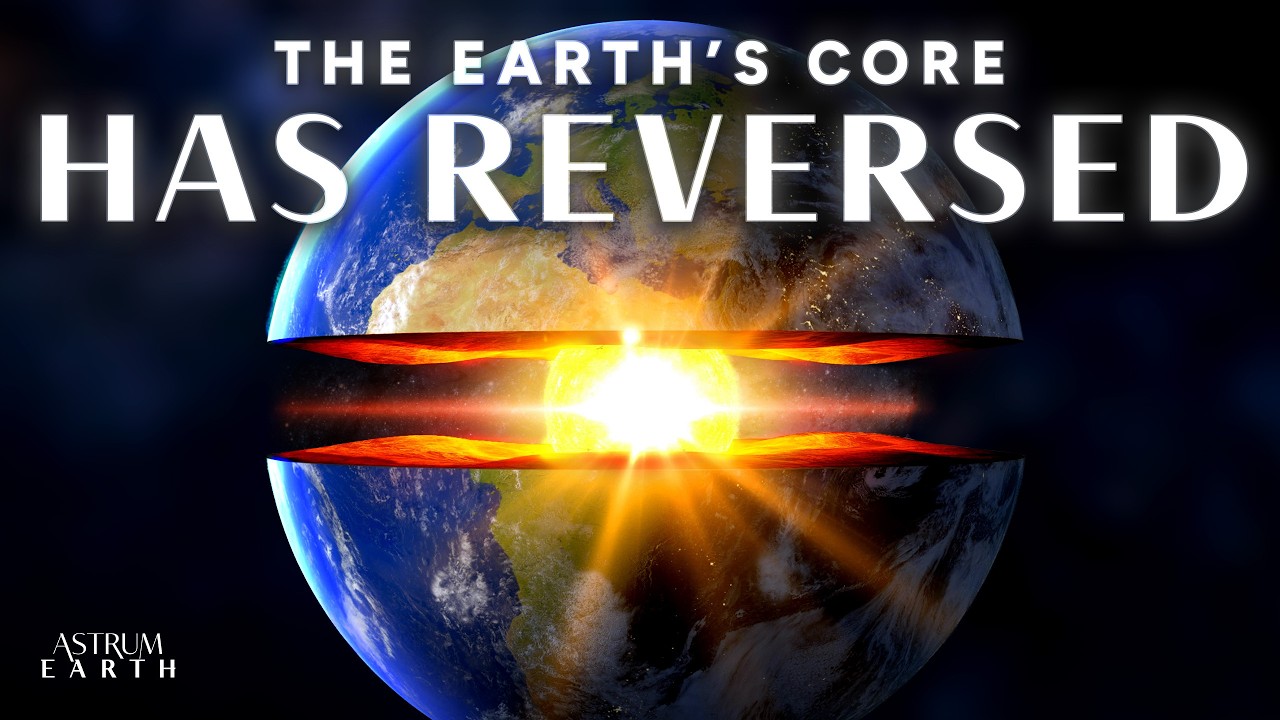
Deep beneath our feet, a solid iron sphere the size of the moon maintains a fiery temperature rivaling the surface of the sun. Recent scientific breakthroughs suggest this massive engine has not only slowed its rotation but may actually be drifting backward relative to the crust.
Core Question: Does the periodic oscillation of Earth’s inner core pose a threat to surface life, or is it merely a natural planetary heartbeat we are finally learning to monitor?
Highlights
- The Earth’s inner core is a solid iron spheroid suspended within a liquid outer shell.
- Recent data suggests the core follows a 70-year oscillation cycle, currently rotating “backwards” relative to the mantle.
- Cold War-era nuclear detection technology provided the seismic data necessary to map the core’s behavior.
- While the core influences day length and magnetic fields, the changes are too microscopic to impact daily human life.
⏱️ Reading time: approx. 6 minutes · Saves you about 17 minutes vs. watching.
Want to take notes while watching? Click the image below and let AI Notebook capture the key points for you 👇

The Architecture of the Abyss
A Layered World
Earth is not a static rock but a complex machine powered by a 6,000°C furnace at its center. This heat drives the entire planetary system, from the shifting of continents to the generation of the magnetic field that keeps our atmosphere from stripping away into space.
The crust we inhabit is merely a brittle shell floating atop the mantle, which flows like thick honey at just a few centimeters per year. This movement is fueled by the heat radiating from the core, driving the tectonic plates that reshape our geography through earthquakes and volcanic eruptions.
Deepest of all is the core, split into two distinct realms: a churning liquid outer layer and a solid inner spheroid. The motion of the liquid iron generates the invisible magnetic shield protecting us from solar radiation, while the solid inner core acts as the planet’s anchor. It is a world of impossible pressure where metal remains solid despite temperatures that should melt it instantly.
💡 Digging Deeper
Q: Why is the inner core solid if it is hotter than the liquid outer core?
A: Immense gravitational pressure at the center of the Earth forces the iron atoms together so tightly that they cannot melt, despite the 6,000°C temperature.
Q: How deep have humans actually gone?
A: The Kola Superdeep Borehole reached about 12 kilometers, which is only 0.2% of the way to the center.
Decoding the Deep with Seismic Echoes
The Pioneers of Inner Space
In 1896, Emil Wiechert proposed that Earth must contain a dense iron heart to account for the planet’s overall mass. He realized that surface rocks were far too light compared to the Earth’s calculated density, and by studying iron meteorites, he correctly theorized that the missing mass lay buried in a metallic core thousands of miles below.
We cannot drill to the center, so we use earthquakes as a form of natural ultrasound for the entire planet.
Richard Dixon Oldham later discovered that seismic waves slowed down when passing through the center, proving a core existed. However, it was Inge Lehmann who noticed P-waves appearing in “shadow zones” where they shouldn’t be. Her 1936 discovery concluded that the core wasn’t just a liquid blob, but contained a solid inner center that reflected waves back toward the surface.

💡 Digging Deeper
Q: What is the “Shadow Zone”?
A: It is an area on Earth’s surface where seismographs cannot detect waves from a specific earthquake because the liquid core has refracted or blocked them.
Q: Who was Inge Lehmann?
A: She was a Danish seismologist who discovered the inner core; she lived to be 104 and fought for recognition in a male-dominated field.
The Great Rotation Debate
From Cold War Secrets to Core Science
During the Cold War, the hunt for underground nuclear tests accidentally provided seismologists with the most sophisticated data network in history. By distinguishing man-made blasts from natural tremors, researchers gained a high-resolution view of how waves travel through the core’s crystalline structure. This revealed that the inner core has a “grain” like wood, allowing waves to travel faster north-to-south than east-to-west.
By comparing “earthquake doublets”—identical tremors occurring in the same spot decades apart—scientists discovered the core rotates independently.
Recent studies from Peking University and USC suggest that this rotation follows a 70-year oscillation cycle. Data shows the core slowed to a near-halt around 2009 and is currently moving slightly backward relative to the surface. This is not a catastrophic reversal but a gentle drift, likely caused by the magnetic tug-of-war between the liquid outer core and the gravitational pull of the deep mantle.

Key Takeaways
The realization that Earth’s inner core rotates at its own pace marks a turning point in geophysics. While the idea of the core “spinning backward” sounds like a premise for a disaster movie, it is actually a subtle, periodic shift. This oscillation is part of a complex feedback loop involving the Earth’s magnetic field and gravitational forces that scientists are only just beginning to map with precision.
Ultimately, these deep-earth shifts correlate with minor changes in the length of a day and the strength of the magnetic field. However, these variations are measured in milliseconds and fractions of degrees. They serve as a reminder that our planet is a living, breathing system with cycles that span decades, most of which occur far beneath the reach of human influence.
Q&A
Q1: Is the Earth’s core actually spinning in the opposite direction of the planet?
A1: No. It is still spinning in the same direction as the rest of Earth, but it has slowed down so much that, relative to the mantle, it appears to be drifting backward.
Q2: Will this cause the magnetic poles to flip?
A2: There is no evidence that this 70-year oscillation causes a full magnetic pole reversal, though it does cause slight fluctuations in the magnetic field’s strength.
Q3: Does this core shift cause global warming?
A3: While some studies suggest a link to very minor climate fluctuations, the impact is negligible compared to atmospheric and human-driven factors.
Q4: How does this affect the length of our days?
A4: The shift can change the length of a day by about a thousandth of a second—far too small for humans to perceive without atomic clocks.
Q5: What causes the core to change its speed?
A5: It is a tug-of-war between the electromagnetic forces of the liquid outer core (which speed it up) and the gravitational pull of the mantle (which slows it down).
Q6: How do scientists see something 3,000 miles deep?
A6: They use “earthquake doublets,” which are two earthquakes that happen in the exact same location years apart; changes in how the waves pass through the core reveal its movement.
Q7: Should we be worried about the core “stopping”?
A7: Not at all. The “pause” in 2009 was a relative point in a natural cycle, and data suggests it is already beginning its next phase of movement.