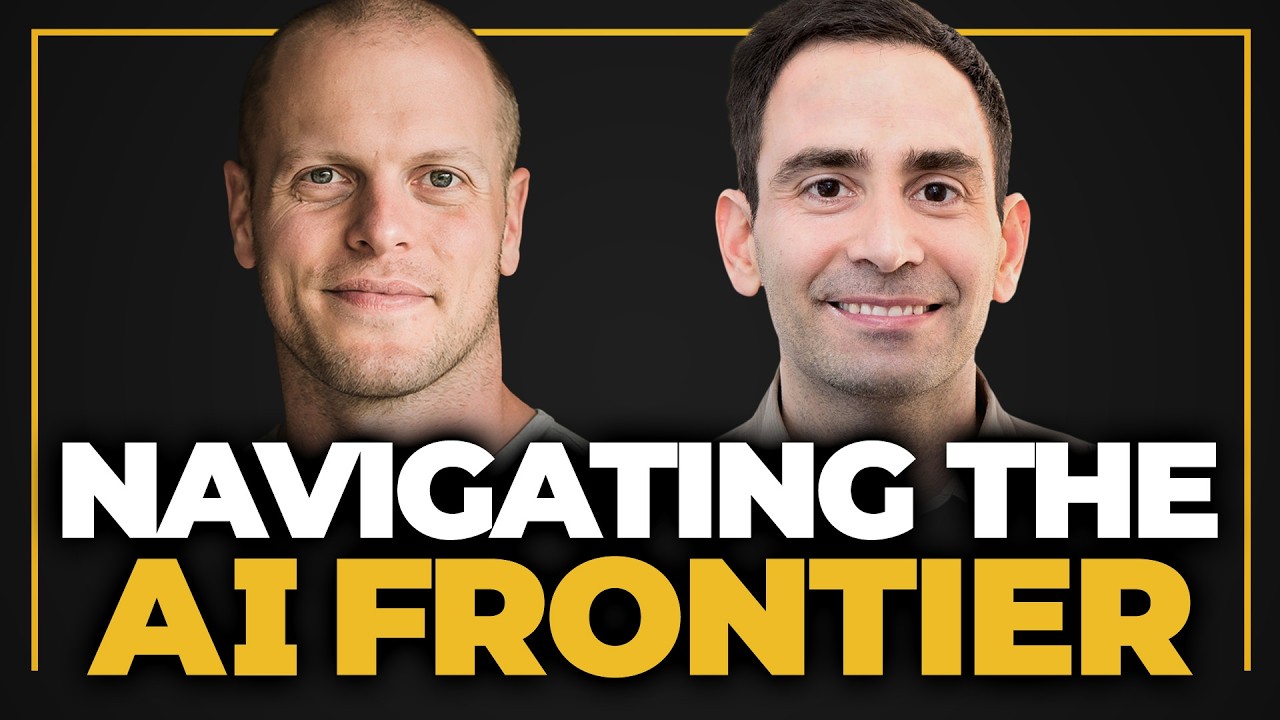
📺 Today’s recommended deep-dive video: https://www.youtube.com/watch?v=HutNi2cNsCg
The AI Personal IPO and the 12-Month Exit Window
Silicon Valley legendary investor Elad Gil joins Tim Ferriss to discuss the unprecedented “Personal IPO” phenomenon currently enriching top AI researchers. He provides a tactical look at why the next 18 months may be the ultimate exit window for startups and how a global memory shortage is keeping the top AI labs in a temporary dead heat.
Core Question: How can founders and investors navigate an AI landscape defined by extreme talent wars, temporary compute ceilings, and the inevitable consolidation of a crowded market?
Highlights
- The “Personal IPO” has created a class of researchers worth hundreds of millions without them ever starting a company.
- High-bandwidth memory (HBM) shortages act as an artificial ceiling, preventing any single AI lab from pulling ahead for the next two years.
- Most AI startups should consider exiting within 12–18 months to maximize valuation before the “commoditization headwind” hits.
- Meaningful “data moats” are often overstated; long-term durability in AI comes from workflow integration and becoming a system of record.
⏱️ Reading time: approx. 9 minutes · Saves you about 92 minutes vs. watching.
Want to take notes while watching? Click the image below and let AI Notebook capture the key points for you 👇

The Rise of the Researcher Class
Understanding the “Personal IPO”
Normally, wealth in tech is created through a single company going public, but we are seeing a strange shift where talent is enriched as a class. Meta’s aggressive bidding for top-tier researchers has fundamentally shifted the labor market for artificial intelligence, forcing every other major player to match.
By offering compensation packages ranging from tens to hundreds of millions of dollars, the industry has effectively triggered a “personal IPO” for a select group of technical talent, long before these individuals ever consider founding their own firms.
This shift has profound implications for how science is conducted, as these newly wealthy individuals may soon pivot toward “passion projects” or big-science endeavors rather than traditional corporate ladders.

💡 Digging Deeper
Q: Why is Meta bidding so aggressively on talent now?
A: It is a rational strategy; if you are spending tens of billions on compute, it makes sense to have the world’s best people ensuring that investment isn’t wasted.
Q: How many people have actually experienced this personal IPO?
A: It is a small but influential group, likely between fifty and a few hundred people across the entire Silicon Valley ecosystem.
Q: Will this wealth lead to “quiet quitting”?
A: While some may chase vices, many are likely to pivot toward AI for science or other humanity-scale projects that require significant personal capital.
The Great Compute Ceiling
Why No One Can Pull Ahead
There is a common belief that one AI lab will suddenly achieve a “God-like” advantage over the others, but physical supply chain constraints make this unlikely in the short term. Every lab—OpenAI, Anthropic, Google, and xAI—is currently hitting the same wall: a global shortage of specialized memory.
This memory constraint, largely driven by Korean manufacturers, is expected to persist for roughly two years, creating an artificial ceiling on model scale.
Because no single lab can buy ten times more compute than its rivals right now, the major models will likely remain neck-and-neck in capabilities for the foreseeable future.

💡 Digging Deeper
Q: What is the output of months of training on a massive cluster?
A: It is effectively a “flat file,” a relatively small document that encapsulates human knowledge and reasoning logic.
Q: Is Google also constrained by these memory issues?
A: Yes, despite having their own TPU chips, they are still limited by the same global supply of memory components as everyone else.
Q: What happens when the constraint is eventually lifted?
A: There is a scenario where the lab with the most capital could finally pull far ahead once the hardware supply becomes elastic again.
The Founder’s Exit Strategy
Navigating the 12-to-18-Month Window
When we look at the history of technology cycles, from the automotive collapse in Detroit to the dot-com crash of 2000, the pattern remains strikingly consistent. While hundreds of companies reach multi-billion dollar valuations during the hype phase, only a tiny fraction possess the durability to survive a decade of consolidation.
For most AI startups today, the next year represents a unique value-maximizing window where incumbents are desperate to buy talent and market share before commoditization sets in.
Being consensus is often framed as a failure of imagination, but in the current AI cycle, betting against the obvious trajectory of the technology is a recipe for irrelevance.

💡 Digging Deeper
Q: Why do 95% of companies in a tech cycle go bust?
A: Markets eventually collapse into oligopolies; the hundreds of car companies in the early 1900s eventually became just a few major players.
Q: What defines a “durable” AI company?
A: It isn’t just the technology; it’s about how deeply the product is embedded into a customer’s daily workflow and change management processes.
Q: Is now the time to be a contrarian?
A: No. There are moments to be contrarian, but right now, being “consensus”—buying more AI and following the scaling laws—is the smartest move.
Information Literacy and “Truth-Seeking”
The Polymath’s Research Stack
Finding an informational advantage in a crowded market requires moving beyond the “talk of the town” and engaging directly with technical literature and truth-seeking individuals. Elad Gil relies on a mix of X (formerly Twitter), technical papers, and a network of polymaths who are willing to question their own assumptions.
He has also integrated AI models into his research workflow, using Gemini for travel and rankings, while leveraging Claude and GPT for deep-dives into clinical data and primary literature.
Talking to a truly smart person for twenty minutes often provides more signal than weeks of independent research, provided you know who to call for which specific topic.

💡 Digging Deeper
Q: Why does Gil use Gemini specifically for travel?
A: The Google corpus and the historical data they have built around locations and rankings often provide more accurate travel scoring than other models.
Q: How does he vet a new area like longevity?
A: He looks for “literacies”—not just people talking about biohacking, but researchers like Kristen Fortney who have deep bioinformatics backgrounds.
Q: Does a math background help with investing?
A: It provides a fluency in “nerd language” and a framework for logical proofs that can be applied to business models and market dynamics.
Key Takeaways
The AI boom is not just a software revolution; it is a fundamental restructuring of how labor and capital are allocated. The “Personal IPO” represents the first time in history where the mere potential for invention has been capitalized at such a massive scale for individuals. This creates a high-stakes environment where talent is mobile, highly liquid, and increasingly focused on humanity-scale science rather than just incremental product updates.
For founders, the message is one of cautious urgency. The current market is wide open, with CEOs everywhere looking for an “AI story,” but this openness will not last forever. Those who do not have a clear path to becoming a “system of record” should look at the current multi-trillion dollar market caps of incumbents as an unprecedented opportunity for high-value exits.
Finally, the hardware bottleneck is the most underrated factor in the current AI race. We are in a state of “forced parity” because of memory shortages. This two-year window is a gift for trailing labs to catch up, but once the supply chain matures, we may finally see the “breakout” moment where one lab’s scale truly dwarfs the rest.
Q&A
Q1: What is the “Personal IPO”?
A: It is a phenomenon where top AI researchers receive pay packages in the tens or hundreds of millions, granting them “public-company wealth” based on their individual value to a project rather than a company’s stock market debut.
Q2: What is the biggest constraint on AI growth right now?
A: It is high-bandwidth memory (HBM). This hardware bottleneck creates a “ceiling” that limits how much compute any one lab can effectively deploy, keeping the major models in a close competitive range.
Q3: Should founders sell their companies in the next 18 months?
A: If the company isn’t one of the dozen that will be “durable” over the next decade, Elad suggests now is likely the value-maximizing moment to exit before market headwinds and commoditization arrive.
Q4: How does Elad Gil evaluate a market?
A: He looks for “market first, team second.” He identifies markets that are undergoing regulatory, technological, or competitive shifts—like Google shutting down a project—which creates an opening for a startup to move in.
Q5: What are the “Scaling Laws” in AI?
A: These are empirical observations that as you increase the amount of compute, data, and parameters used to train a model, its performance and reasoning capabilities increase in a predictable, linear fashion.
Q6: Why is the Bay Area still the center of AI?
A: According to Gil’s team’s analysis, 91% of the private technology market cap in AI is concentrated in the Bay Area. Despite remote work trends, these high-stakes industries still rely on dense physical clusters of talent.
Q7: What is the shift from SaaS to “Labor Units”?
A: Generative AI is shifting the business model from selling software “seats” to selling “work product.” Companies are now effectively selling hours of cognition rather than just tools to help humans work.