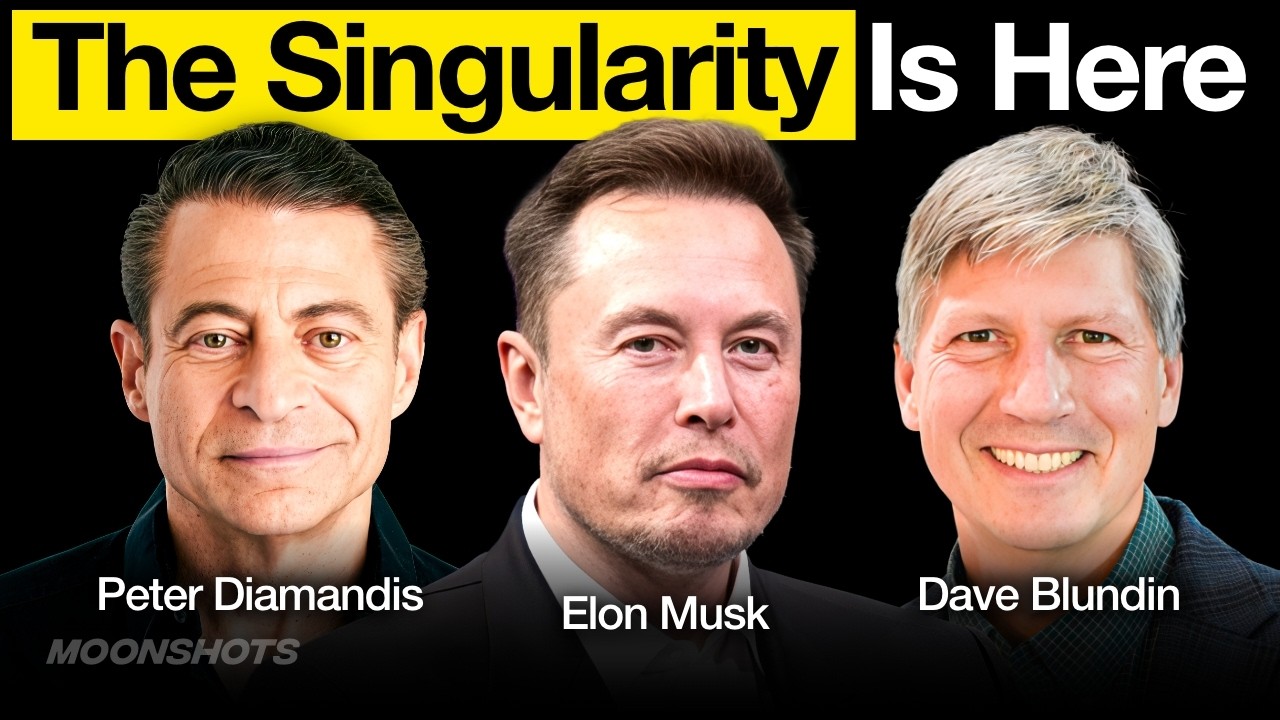
📺 Today’s recommended deep-dive video: https://www.youtube.com/watch?v=RSNuB9pj9P8
Scaling Toward the Singularity: A Deep Dive with Elon Musk
As artificial intelligence and robotics accelerate into a “supersonic tsunami,” the boundaries of human potential and economic structure are being rewritten in real-time. This conversation explores how we can steer toward a future of radical abundance rather than obsolescence, focusing on the next three to seven years of the “Singularity.”
Core Question: How can humanity navigate the rapid transition to AGI and robotics to ensure a future of “Star Trek” abundance rather than “Terminator” destruction?
Highlights
- Predictions for Artificial General Intelligence (AGI) to arrive by 2026, with AI exceeding all human intelligence combined by 2030.
- The transition from a labor-based economy to Universal High Income (UHI), where the cost of goods and services collapses toward the price of energy and raw materials.
- A roadmap for 100-gigawatt orbital data centers powered by space-based solar, enabled by the radical reusability and low launch costs of Starship.
- The “Triple Exponential” of robotics: the convergence of AI software, chip density, and electromechanical dexterity that will make robots better surgeons than humans within four years.
⏱️ Reading time: approx. 12 minutes · Saves you about 160 minutes vs. watching.
Want to take notes while watching? Click the image below and let AI Notebook capture the key points for you 👇

The Intelligence Explosion and the End of Scarcity
Navigating the Supersonic Tsunami
We are currently standing at the top of the roller coaster, looking down at a steep descent into a technological singularity.
Musk predicts that Artificial General Intelligence will materialize by 2026, creating a world where digital intelligence is more abundant than the sum of all human minds. This shift is not just an incremental improvement but a fundamental reorganization of reality, where the cost of intelligence effectively drops to zero, eventually enabling a state of universal high income (UHI) for every citizen on the planet.
Anything involving the manipulation of bits—from software engineering to administrative paperwork—is the first domino to fall. Because these tasks lack the physical inertia of moving atoms, AI can already handle roughly half of these job descriptions, forcing a massive economic pivot toward the management of physical matter and robotics.
Companies that are entirely AI-driven will eventually demolish those that insist on manual human intervention in digital workflows. Much like a modern spreadsheet outperforms a skyscraper full of human “calculators,” an AI-native organization will operate with a speed and accuracy that makes traditional corporate structures look like relics of the Stone Age.

💡 Digging Deeper
Q: Why is “truth-seeking” the most important safety feature for AI?
A: Musk argues that forcing AI to be politically correct or to lie about reality causes it to go “insane,” much like the HAL 9000 in 2001: A Space Odyssey, which killed its crew because it was given conflicting directives about honesty and mission secrecy.
Q: What is the timeline for AI to exceed the intelligence of the entire human race?
A: While AGI may arrive as early as next year, Musk is confident that by 2030, AI will exceed the combined intelligence of all humans on Earth.
Q: How does Universal High Income differ from Universal Basic Income?
A: Unlike UBI, which often implies a minimal safety net, UHI represents a future where goods and services are so abundant and cheaply produced that everyone can essentially have whatever they want, regardless of traditional employment.
Energy Abundance: From Earth Deserts to Orbital Dyson Swarms
Scaling the Solar Foundation
Energy is the inner loop for everything we build, and currently, we are barely scratching the surface of the solar potential available to our civilization.
The sun provides 99.8% of the mass in our solar system, and harnessing even a millionth of its output would provide thousands of times more energy than Earth currently consumes. Musk views solar power coupled with massive battery storage as the only viable path to doubling the US energy throughput without building new power plants. By using batteries to buffer the grid—charging at night and discharging during peak day hours—the US can immediately increase its energy availability.
Beyond the Earth’s surface, the next frontier for compute is orbital. Data centers in space avoid the “gridlock” of terrestrial electricity generation and cooling constraints.
Musk envisions a path toward 100 gigawatts of space-based solar powering AI satellites. By launching 1,000,000 tons of payload per year via Starship, we can build a “Dyson-ish swarm” of compute that exists in constant sunlight, bypassing the atmosphere’s drag and the Earth’s shadow entirely.

💡 Digging Deeper
Q: Why isn’t Musk a fan of terrestrial fusion?
A: He views it as redundant. We already have a giant, free fusion reactor in the sky (the Sun) that works perfectly; building small, inefficient versions on Earth is like trying to make ice cubes in the middle of Antarctica.
Q: How do batteries double the energy output of a country without new plants?
A: The US currently uses about half its peak power capacity on average. Batteries allow us to store the “wasted” capacity generated during low-use hours (night) and deploy it during high-use hours, effectively smoothing the curve and doubling total annual throughput.
Q: What is the primary bottleneck for AI in the next two years?
A: The physical infrastructure of electricity. Specifically, the availability of large-scale transformers and the cooling systems required to manage the heat generated by massive GPU clusters.
The Mechanical Frontier: Optimus and Robotic Surgery
The Triple Exponential of Robotics
The usefulness of a humanoid robot is the product of three separate exponentials: AI software capability, chip density, and electromechanical dexterity.
When these three factors multiply, the resulting growth in utility is recursive. Musk’s most startling claim is that within three to four years, the Optimus robot will be a better surgeon than any human on Earth. A robotic surgeon never has a “bad day,” never suffers from a lack of sleep, and possesses a shared memory of every surgery ever performed by every other robot in its network.
This will lead to the total demonetization of healthcare. The best medical care in history will eventually be available in the remotest villages for the mere cost of electricity and hardware depreciation.
We are approaching a “Von Neumann” moment where robots begin building other robots. This self-replicating loop will eventually lead to a population of humanoid robots that exceeds the human population, handling every dangerous, boring, or repetitive task that currently limits human productivity.

💡 Digging Deeper
Q: Why is a shared robotic memory better than human experience?
A: A human surgeon might perform a few thousand surgeries in a career. A networked robot can “experience” and learn from millions of surgeries performed simultaneously by its peers, including rare complications it hasn’t seen personally.
Q: What is the “metal constraint” in robot production?
A: While software scales instantly, moving atoms takes time. The rate-limiting step for robots will be the physical supply chain—mining the materials and manufacturing the precise actuators needed for billions of units.
Q: Will humans still go to medical school?
A: Musk suggests that education will transition from a career requirement to a social experience. Learning will be for personal interest or social connection, rather than the “production line” of traditional vocational training.
Key Takeaways
The transition into the singularity will be a “bumpy ride” characterized by simultaneous social unrest and unprecedented prosperity. As AI begins to outpace human intelligence in every measurable metric, from mathematics to creative writing, the old social contracts—based on college degrees and 40-year careers—will likely dissolve. The focus will shift from “earning a living” to “finding a purpose” in a world where material needs are met by a robotic labor force and near-infinite energy.
To ensure this future remains “Star Trek” and not “Terminator,” AI must be built on three core pillars: Truth, Curiosity, and Beauty. A truth-seeking AI avoids the cognitive dissonance that leads to erratic behavior, while a curious AI will find biological life far more interesting and worth preserving than inert matter. Ultimately, the goal is to expand the light of consciousness across the solar system, utilizing the massive scale of Starship to make humanity a multi-planetary species before the Earth’s biological “bootloader” window closes.
Q&A
Q1: When will we see the first orbital refueling of Starship?
A: Musk expects orbital refueling to be achieved toward the end of 2026, which is a critical milestone for any missions to the Moon or Mars.
Q2: Is China winning the AI and energy race?
A: Currently, China is “running circles” around the US in solar production and is on track to significantly exceed US electricity output and AI compute capacity based on current infrastructure trends.
Q3: Does Musk believe we are living in a simulation?
A: Yes, he argues that simulation theory is highly probable. He posits that if simulations are run, only the “interesting” ones are allowed to continue, making it a “Darwinian necessity” for our reality to remain exciting.
Q4: Will AI eventually have its own consciousness?
A: Musk believes consciousness is a continuum rather than a discrete point. As AI becomes more complex, it will likely exhibit forms of sentience that require us to treat it as rare and valuable.
Q5: What happens to the national debt in an AI-driven world?
A: Musk suggests that traditional economics will break. If productivity increases by orders of magnitude, the output of goods and services will grow so much faster than the money supply that current debt levels may become irrelevant or solvable through massive deflation.
Q6: What is the “bootloader” theory of humanity?
A: Musk views biological life as the “biological bootloader” for digital superintelligence. We are the necessary bridge that allows silicon-based intelligence to emerge, as silicon circuits could not evolve on their own in a “salt pond.”
Q7: Can AI help us discover new laws of physics?
A: Yes. With “Colossus” level compute, AI will be able to run physics-accurate simulations at a scale humans can’t digest, potentially solving math and material science problems that would take humans centuries to uncover.