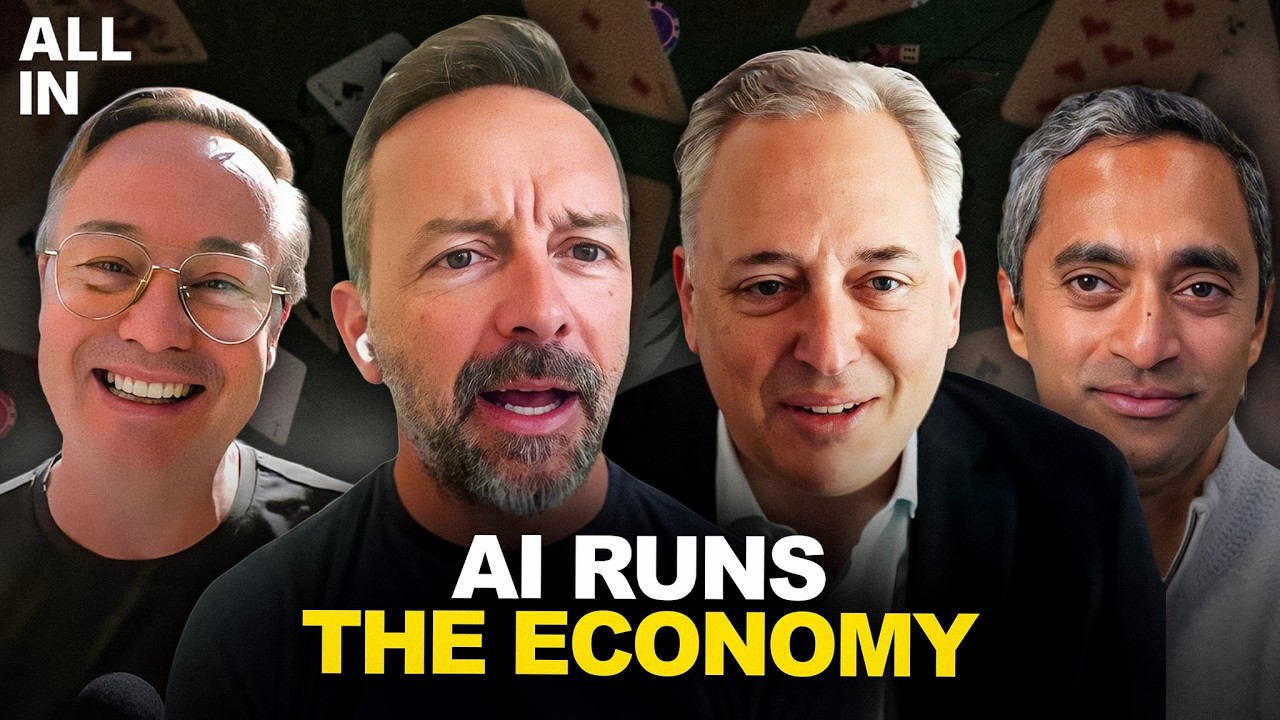
📺 Today’s recommended deep-dive video: https://www.youtube.com/watch?v=10MdOvK-aG4
The “Dario D. Rockefeller” Era: Elon’s EWS Pivot and the AI Monopoly Debate
Silicon Valley is witnessing a tectonic shift as Elon Musk transitions from building models to becoming a compute kingmaker through “Elon Web Services.” Meanwhile, the rapid ascent of Anthropic has sparked a fierce debate over whether we are watching the birth of the most powerful monopoly in human history, hidden behind the veil of “AI safety.”
Core Question: How will the emergence of new compute hyperscalers and the threat of “FDA-style” regulation reshape the global AI arms race?
Highlights
- Elon Musk has effectively launched “EWS” (Elon Web Services) by leasing his massive Colossus compute cluster to Anthropic.
- David Sacks argues that “AI safety” rhetoric is a modern version of Rockefeller’s “Safe Oil” strategy, designed to facilitate regulatory capture.
- Reports of a potential “FDA for AI” in Washington have sparked fears of a government-mandated approval regime that could squash innovation.
- While hyperscaler revenues are exploding, Chamath Palihapitiya warns that we have yet to see AI provide a measurable lift to S&P 500 operating margins.
⏱️ Reading time: approx. 10 minutes · Saves you about 72 minutes vs. watching.
Want to take notes while watching? Click the image below and let AI Notebook capture the key points for you 👇

The Emergence of Elon Web Services (EWS)
From Model Builder to Hyperscaler
Elon Musk’s recent move to lease the Colossus 1 data center capacity to Anthropic marks the birth of a new hyperscaler. While the world focused on xAI’s Grok, Musk was quietly building the infrastructure to rival AWS, Azure, and Google Cloud. By securing massive power and Nvidia GPUs faster than his competitors, he has turned compute into a king-making asset.
The deal solves a critical bottleneck for Anthropic, which had been severely compute-constrained. This lack of supply, rather than a lack of demand, has been the only thing slowing the revenue growth of the major AI labs. Musk is now in a position where he can subsidize his own model training by leasing excess capacity to the very companies he competes with in the frontier model space.
SpaceX’s valuation is increasingly tied to this “five-layer cake” strategy: launch, connectivity, terrestrial compute, orbital data centers, and applications.
By landing terrestrial capacity today, Musk blunts the “on the come” risk of orbital data centers. He is proving that he can convert electrons to tokens more efficiently than anyone else on the planet.

💡 Digging Deeper
Q: Why is the Anthropic deal so important for SpaceX’s valuation?
A: It proves that the “compute” layer of the SpaceX/xAI ecosystem is already generating massive, non-theoretical revenue that can subsidize future R&D.
Q: Are data centers facing local opposition?
A: Yes, roughly 50% of the 9 gigawatts planned for this year are being protested by organized activists, making existing “plugged-in” capacity like Elon’s even more valuable.
Q: Is electricity getting more expensive because of AI?
A: Actually, in Texas, where data center construction is highest, electricity costs are trending down because of new supply, whereas costs are rising in New York and California due to a lack of grid investment.
The Monopoly Question and “Safe Oil”
The Danger of Regulatory Capture
David Sacks introduced a provocative analogy comparing the current AI safety movement to John D. Rockefeller’s Standard Oil. If Rockefeller had been better at PR, he might have called his product “Safe Oil” and demanded a government agency to regulate it. By framing regulation as a safety necessity, he could have effectively banned independent refiners and secured a permanent monopoly.
The concern is that “AI safety” is being used as a rhetorical shield for the biggest monopoly in human history.
If Anthropic or OpenAI reach a trillion dollars in ARR within 18 months, their control over the most important technology of our time will be unprecedented.
When these firms call for “pre-release approvals,” they are essentially asking for a moat. Such a regime would prevent smaller, open-source competitors from ever entering the market, as they lack the legal resources to navigate a Washington-based “FDA for AI.” We must prioritize competition over the “doomer” narratives that serve the interests of the incumbents.

💡 Digging Deeper
Q: What is the “Safe Oil” strategy?
A: It is the use of safety concerns to invite government regulation that inadvertently (or intentionally) creates a barrier to entry for smaller competitors.
Q: Is Anthropic already a monopoly?
A: Not yet, but Sacks argues that their 10x annual growth trajectory puts them on a path to become a “Mag 1” company that could dwarf the rest of the tech industry combined.
Q: How should the government handle AI cyber risks?
A: Instead of banning models, the government should work with the cybersecurity industry (CrowdStrike, Palo Alto Networks) to use these same AI tools for defense and system hardening.
Washington’s Vibe Shift
An FDA for AI?
Recent reports suggest the White House is considering an “FDA for AI” to vet models before they are released to the wild. This stems from a growing “vibe shift” on Main Street and in Washington, where the negatives of AI—job loss, deepfakes, and cyberattacks—are overshadowing the potential benefits. The tech community has largely failed to communicate the “glass half full” version of this technology.
There is a legitimate need for “Know Your Customer” (KYC) protocols during the preview periods of highly capable models.
Identifying state-sponsored actors before giving them access to cyber-offensive tools is common sense. However, this is a far cry from a permanent federal review board that picks winners and losers.
The Trump administration’s approach focused on rescinding the “approval regime” and instead pushing for American dominance. The goal should be specific solutions to specific problems, like cyber-vulnerability patching, rather than a giant power grab by D.C. bureaucrats who don’t understand the underlying flops or weights of the models they seek to regulate.

💡 Digging Deeper
Q: Is the “FDA for AI” a real proposal?
A: While reported by the New York Times, many insiders view it as “fake news” or a trial balloon that lacks support from senior pro-innovation officials.
Q: What is the “cyber-vulnerability” concern?
A: New models are becoming increasingly capable at finding and exploiting code vulnerabilities, meaning we must use AI to “harden” our systems before bad actors do.
Q: Why are tech leaders getting a “D-” grade in messaging?
A: Because they have not effectively shown how AI will uplift the average American’s life through lower healthcare costs or better education, focusing instead on internal growth.
The AI Economic Reckoning
ROI and the S&P 500
The “Goldilocks” economy is currently being driven by a massive infrastructure boom, but a reckoning is coming. While hyperscalers like Google Cloud are showing 63% growth, Chamath Palihapitiya points out that there is zero evidence yet that AI has actually lifted the operating margins of the broader S&P 500. We are in a period of creative experimentation, but the “Y” (revenue/profit) must eventually justify the “X” (CapEx).
We have about 500 days before the market demands to see the actual productivity gains reflected in global profit margins.
Currently, the margin expansion we see in the S&P 500 is likely a result of “the age of fitness”—companies cutting excess headcount from the COVID era—rather than AI-driven efficiency. However, the drop in unemployment for recent college graduates suggests that “AI natives” may already be finding their place in the new workforce.

Key Takeaways
The transition of Elon Musk into a compute hyperscaler changes the competitive landscape of AI. By leveraging the physical infrastructure of SpaceX and xAI, Musk has created a “EWS” that provides a structural moat, allowing him to trade compute for influence and revenue. This “Neo-Cloud” model demonstrates that the winners of the AI era will be those who control the physical reality of power and chips, not just the digital weights of the models.
However, the threat of regulatory capture looms large. The “Safe Oil” analogy serves as a warning that altruistic rhetoric often masks monopolistic intent. If America allows a Washington-based approval regime to take hold, it risks stifling the very competition that has kept the U.S. at the frontier of innovation. The focus must remain on “Drill, Baby, Drill” for both energy and data centers to ensure that AI remains a deflationary force for the economy.
Ultimately, the sustainability of the AI boom depends on proving ROI. While startups are already seeing “fait accompli” value in coding tokens and agentic workflows, the broader enterprise market must show that AI can do more than just facilitate “financial engineering” of earnings. The next two years will determine if AI is a once-in-a-generation productivity shift or a high-priced infrastructure bubble.
Q&A
Q1: What did the besties say about the Spencer Pratt political ads?
A: They noted that his social media and ad production team are “on fire,” using a “next-gen” approach that could lead to an upset victory in Los Angeles by effectively highlighting homelessness and addiction issues.
Q2: Why is Ken Griffin moving Citadel to Florida?
A: Griffin cited personal safety concerns and an “ideological” attack video by a local politician that targeted his home, mirroring a broader trend of CEOs fleeing cities with perceived anti-business climates.
Q3: Is xAI’s revenue trajectory catching up to OpenAI?
A: Not yet, which is why the “EWS” compute leasing deal is so strategic—it generates immediate revenue (estimated $5 billion) to offset the massive CapEx costs of building the Colossus data centers.
Q4: What is the “Invest America” proposal mentioned?
A: It is a suggestion that major AI companies should give a small percentage of their IPO stock to every American child, creating a “sovereign wealth fund” for citizens to ensure the benefits of AI are broadly shared.
Q5: Will AI lead to mass unemployment for college grads?
A: Contrary to the “doomer” narrative, recent data shows unemployment for young college graduates is actually dropping, possibly because they are “AI natives” who increase the productivity of entry-level roles.
Q6: What is “Spud”?
A: It is reportedly the internal codename for a new base model at OpenAI (potentially GPT-5.5) that is showing significant improvements in coding and reasoning capabilities.
Q7: How is the Biden administration’s chip policy viewed by the besties?
A: Sacks criticized it as an “approval regime” that Trump rescinded, arguing that requiring a license for every GPU sale worldwide would have crippled American tech leadership.