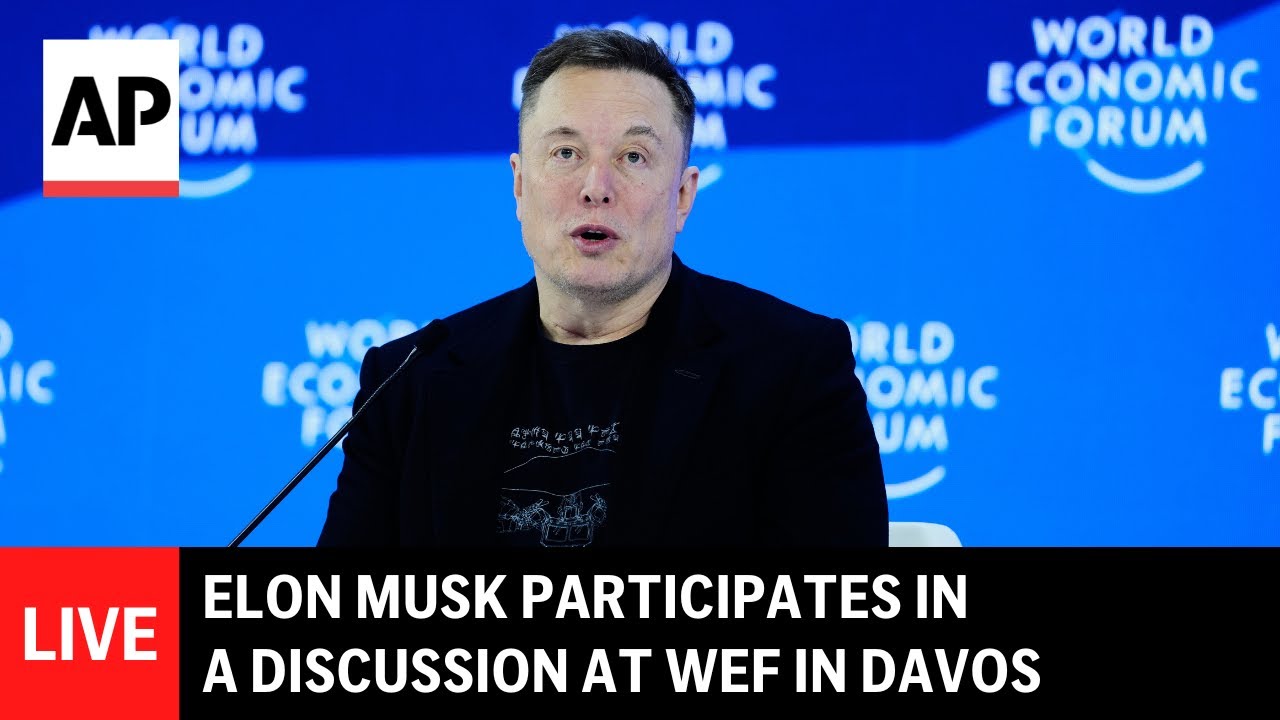
📺 Today’s recommended deep-dive video: https://www.youtube.com/watch?v=SQJIyR5uoZY
Engineering the Infinite: Musk on AI, Energy, and the Future of Abundance
In a wide-ranging dialogue at Davos, Elon Musk outlines a future where humanoid robots saturate human needs and Starships make orbital access cheaper than air freight. By focusing on fundamental engineering bottlenecks like energy and reusability, he argues that humanity is on the verge of either radical prosperity or civilizational obsolescence.
Core Question: How can we leverage robotics, space-based solar, and artificial intelligence to transition from a world of scarcity to one of universal abundance?
Highlights
- Humanoid robots (Tesla Optimus) could soon outnumber humans, potentially automating all labor and creating an explosion in global economic output.
- Electrical power is the primary bottleneck for AI deployment, leading to a future where solar-powered AI data centers operate more efficiently in orbit.
- Achieving full rocket reusability with Starship is expected to drop the cost of space access by a factor of 100, making multiplanetary life economically viable.
- Artificial Intelligence is predicted to surpass individual human intelligence within a year and collective human intelligence within the next five years.
⏱️ Reading time: approx. 8 minutes · Saves you about 24 minutes vs. watching.
Want to take notes while watching? Click the image below and let AI Notebook capture the key points for you 👇

The Economics of Robotics and Abundance
Automating the Foundation of Society
Humanoid robotics represent a fundamental shift in how we calculate economic output, moving away from the biological limits of human labor.
Musk predicts a future where billions of robots handle everything from industrial manufacturing to personal tasks like childcare and elderly support. If productivity is no longer tied to human hours but to the number of robots multiplied by their average output, the global economy could expand at a rate that is truly beyond any historical precedent. This transition necessitates a shift in how we perceive work and human purpose in a post-scarcity world, where the primary challenge becomes finding meaning rather than survival.
While the “Terminator” scenario remains a cautionary tale for the industry, the benign path leads to a world where goods and services are virtually free. This transition could solve global poverty by providing a standard of living currently reserved for the ultra-wealthy to every person on Earth.
The saturation of human needs via robotics is a necessary step toward universal prosperity.

💡 Digging Deeper
Q: How soon will robots be functional in the real world?
A: Optimus is already doing simple tasks in factories; Musk expects industrial deployment by the end of this year and public sales by the end of next year.
Q: Will this technology be limited to a few wealthy nations?
A: Musk argues that AI companies will seek the broadest possible customer base, plummeting costs month-to-month and ensuring global access.
Q: What happens to human purpose if robots do everything?
A: It is a difficult trade-off; you cannot have both mandatory labor and total abundance. Society will have to redefine purpose through curiosity and exploration.
Solving the Energy Bottleneck
The Solar Solution and Space-Based Compute
We are rapidly approaching a ceiling where chip production outpaces our ability to provide them with the necessary electrical power.
While AI efficiency is increasing, the demand for steady-state electricity is growing at a rate the current US grid simply cannot match without radical changes. Currently, US power growth is stagnant at a few percent per year, while China is aggressively deploying over 1,000 gigawatts of solar annually to meet the rising demand of the digital age.
Musk highlights a surprising geographic reality: a 100-mile by 100-mile solar field in a desert like Nevada could power the entire United States. The primary obstacles are not technological but political, involving high tariff barriers and a lack of manufacturing scale for solar cells within the West. By moving AI data centers to space, we can bypass atmospheric attenuation and weather, gaining five times the efficiency of ground-based panels while utilizing the natural cooling of the cosmic void.
The sun is the only energy source that truly matters for a Type I civilization.

💡 Digging Deeper
Q: Why aren’t we building the 100×100 mile solar farm now?
A: High tariffs on low-cost Chinese solar cells make the economics artificially difficult in the US and Europe, though SpaceX and Tesla are scaling their own production.
Q: Is space-based AI realistic?
A: It is a “no-brainer” because space provides constant solar energy and 3-degree Kelvin temperatures for efficient cooling of massive data centers.
Q: What is the primary limiting factor for AI today?
A: Electrical power. We will soon have more chips than we can actually turn on.
The Frontier of Multiplanetary Life
Starship and the Philosophy of Curiosity
Full reusability is the “Holy Grail” of rocket engineering, potentially lowering the cost of space access by two orders of magnitude.
SpaceX’s Starship is designed to make life multiplanetary, acting as a safeguard for the “candle of consciousness” against natural or man-made disasters. By landing both the booster and the upper stage, space travel moves from the economics of disposable aircraft—where you throw the plane away after one flight—to the economics of commercial refueling and rapid turnaround.
Musk views consciousness as a rare and delicate flame in a vast, dark universe, noting that despite 9,000 satellites, he has seen zero evidence of aliens. This scarcity makes the mission to Mars not just an engineering challenge, but a moral imperative to preserve the only known life in the cosmos. Achieving this requires turning science fiction into science fact through rigorous iterative testing and the mass production of interplanetary hardware.
We must protect the light of consciousness from being extinguished.

Key Takeaways
The transition to a post-scarcity economy is driven by the convergence of humanoid robotics and artificial intelligence. By decoupling labor from human biology, the global economy can shift from a linear growth model to an exponential one. However, this future depends entirely on solving the massive energy deficit, likely through a combination of large-scale terrestrial solar and orbital data centers.
Space exploration serves as the ultimate insurance policy for human consciousness. The development of Starship represents a paradigm shift in physics and economics, aiming to reduce the cost of reaching other planets to the point where a self-sustaining city on Mars becomes viable. Without full reusability, humanity remains tethered to a single, precarious planet.
Ultimately, Musk advocates for a “philosophy of curiosity.” By seeking to understand the fundamental laws of the universe and the meaning of life, technology becomes a tool for expanding our reach rather than just solving immediate problems. Choosing optimism, even if occasionally wrong, provides a higher quality of life and a better foundation for civilizational progress.
Q&A
Q1: What is the timeline for AI to surpass human intelligence?
A1: Musk predicts AI will be smarter than any individual human by the end of this year or next, and smarter than all of humanity combined within five years.
Q2: How does Musk view the process of human aging?
A2: He believes aging is a solvable biological “clock” problem that synchronizes across 35 trillion cells, though he notes that death is necessary to prevent society from becoming stagnant and ossified.
Q3: What is the status of Tesla’s Full Self-Driving (FSD) technology?
A3: FSD is essentially a solved problem, with updates occurring as often as once a week. It is already significantly safer than human driving, leading some insurers to offer half-price premiums for users.
Q4: Why does Musk focus so heavily on solar energy?
A4: The sun represents 99.8% of the mass in the solar system; even burning every other planet for fuel wouldn’t equal its output. It is the only scalable energy source for the future.
Q5: Does Musk believe there are aliens among us?
A5: Despite SpaceX having 9,000 satellites in orbit, they have never had to maneuver around an alien craft. He concludes that life and consciousness are likely extremely rare.
Q6: What is the goal of the Starship rocket?
A6: To achieve 100% reusability, dropping the cost of space freight below $100 per pound and enabling the colonization of Mars and the moon.
Q7: What inspired Elon Musk’s career path?
A7: A childhood spent reading science fiction and comic books led to a desire to turn “science fiction into science fact” and a personal philosophy centered on curiosity about the universe.