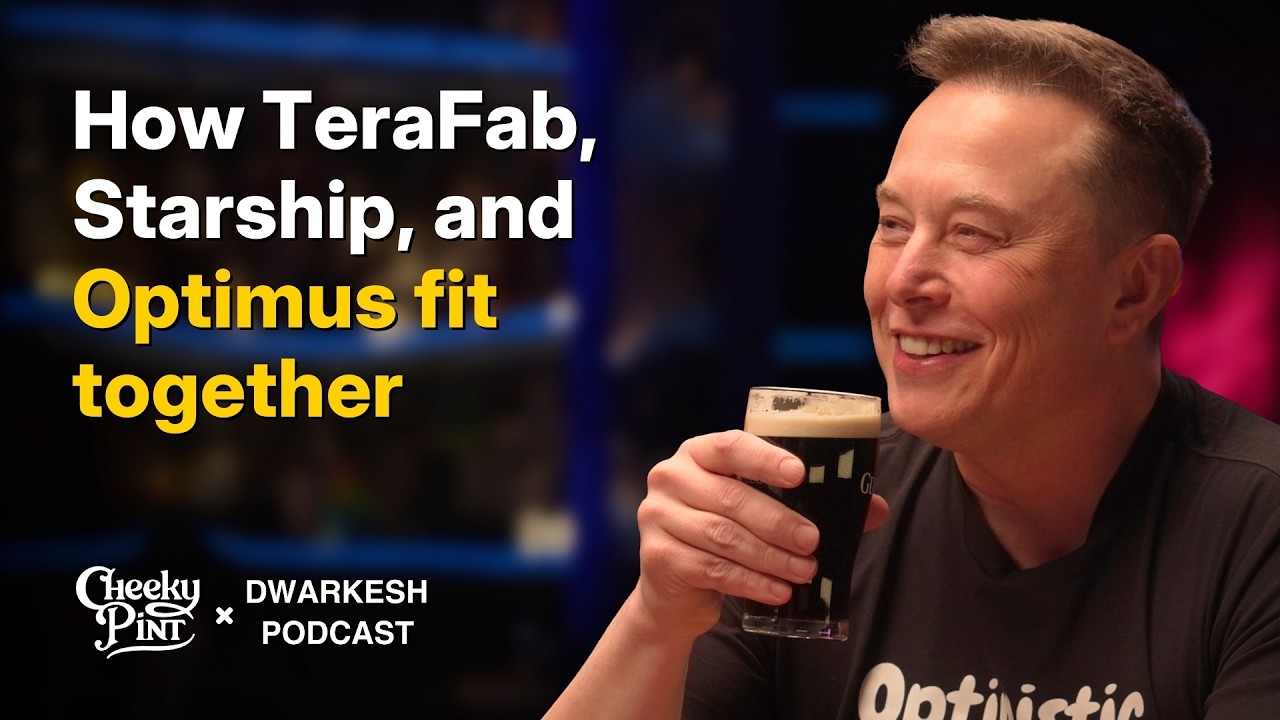
📺 Today’s recommended deep-dive video: https://www.youtube.com/watch?v=BYXbuik3dgA
Elon Musk’s Master Plan: Why the Future of AI is Solar-Powered and Orbital
The transition from digital software to heavy hardware is hitting a physical wall on Earth as electricity demand outpaces the global power grid. Elon Musk argues that the only path forward is a radical shift toward space-based data centers and a recursive robotic economy.
Core Question: How can humanity scale intelligence and manufacturing by several orders of magnitude while bypassing the regulatory and energy constraints of Earth?
Highlights
- Space-based AI will be more economically compelling than terrestrial compute within 30 to 36 months due to 5x solar efficiency.
- Electricity generation—specifically the shortage of turbine blades and electrical transformers—is the primary bottleneck for AI today.
- Humanoid robots (Optimus) represent a “recursive supernova” where AI-driven dexterity and manufacturing scale create a million-fold economic expansion.
- Managing multiple massive companies requires “pico-management” of the single most limiting factor in any engineering process.
⏱️ Reading time: approx. 15 minutes · Saves you about 154 minutes vs. watching.
Want to take notes while watching? Click the image below and let AI Notebook capture the key points for you 👇

The Orbital Compute Revolution
Why the Singularity is Moving to Space
The cost of owning a data center has historically been dominated by the price of GPUs, but the paradigm is shifting toward energy availability. Musk points out that while the output of AI chips is growing exponentially, global electricity output outside of China remains almost entirely flat. Because the permitting process for massive terrestrial solar farms is a regulatory nightmare, space offers a “regulatory play” where the Sun’s energy is five times more effective.
In orbit, there is no day-night cycle, no atmosphere to absorb 30% of the energy, and no weather events to damage infrastructure. This means space-based solar arrays don’t require the massive battery backups that make Earth-based solar expensive.
While critics point to the difficulty of servicing GPUs in space, Musk claims that “infant mortality” of chips can be ironed out on the ground before launch. Once a GPU cluster passes its initial debug cycle, it becomes reliable enough to operate without human intervention for the duration of its depreciated life. Within three years, space will likely become the cheapest place to generate AI tokens, eventually scaling to harness nontrivial percentages of the Sun’s total power.

💡 Digging Deeper
Q: Why is land in places like Nevada or Texas not sufficient?
A: It isn’t just about land; it is about the “impedance match” to slow government permitting and public utility commissions that move at a glacial pace.
Q: Is radiation a dealbreaker for space-based chips?
A: No, because neural networks are inherently resilient to random bit flips compared to heuristic code, and shielding can be managed by running the hardware hotter.
Q: What is the timeline for this orbital shift?
A: Musk predicts that by late 2027 or 2028, SpaceX will be launching more AI compute capacity into space every year than the cumulative total existing on Earth.
The Hardware Wall: From Transformers to Turbines
The Limiting Factors of 2025
The software world is about to receive a hard lesson in hardware reality as the industry hits the “power generation wall” at the end of this year. To power a cluster of 330,000 next-generation GPUs, you need roughly a gigawatt of power once you factor in networking, storage, and peak cooling for hot climates like Memphis.
The current limiting factor isn’t just the power plant itself; it is the specific “vanes and blades” inside gas turbines. Only three companies in the world possess the specialized casting capabilities to manufacture these components, and their backlogs currently stretch into 2030. To circumvent this, Tesla and SpaceX are moving toward 100 gigawatts of annual solar cell production to provide a domestic and orbital alternative.

💡 Digging Deeper
Q: Why not just build more gas power plants behind the meter?
A: You can, but you still run into the 18-month lead time for the turbine blades, which are the fundamental bottleneck of the entire energy industry.
Q: How does memory play into the logic shortage?
A: Memory is actually a greater concern than logic; while the path to logic chips is obvious, high-bandwidth memory (DDR) is facing extreme price volatility and supply constraints.
Q: Will China catch up despite the ASML bans?
A: Musk believes China will be producing highly compelling chips within three to four years by finding unconventional ways to use existing equipment or developing their own lithography.
Optimus and the Recursive Supernova
The Infinite Money Glitch
The arrival of the humanoid robot, Optimus, represents what Musk calls the “infinite money glitch” because the robots can eventually be used to manufacture more robots. This creates a recursive multiplicative exponential growth where digital intelligence, chip capability, and electromechanical dexterity all grow simultaneously. Unlike a car, which has a limited set of inputs and outputs, a humanoid robot requires a massive leap in hand dexterity—a hardware challenge Musk says is more difficult than the rest of the robot combined.
Tesla’s advantage in this race is its “real-world AI” flywheel. By using the same inference chips and vision-based systems developed for self-driving cars, the robot can learn through an “Optimus Academy.” This involves tens of thousands of robots performing tasks in the real world to close the “sim-to-real gap,” allowing millions of simulated robots to train on physics-accurate data.

💡 Digging Deeper
Q: What is the most difficult part of the Optimus hardware?
A: The hand. Achieving the same degrees of freedom as a human hand while maintaining torque density and sensors in a small package is the pinnacle of the engineering challenge.
Q: Will these robots replace humans at Tesla factories?
A: Not exactly. Musk expects total headcount to increase, but the output per human will increase disproportionately as robots take over the “dirty, dangerous, and dull” 24/7 operations.
Q: How does Grok fit into the robot?
A: Grok will act as the high-level orchestrator or “control plane,” assigning complex tasks to fleets of robots, while the lower-level motor policies handle the actual movement.
Management, Policy, and the Path to Mars
The “Limiting Factor” Philosophy
Musk’s management style is defined by a “maniacal sense of urgency” and a focus on whatever is currently holding back progress. He utilizes skip-level meetings to avoid being “glazed” by middle management, forcing engineers to provide technical updates directly to him without advanced preparation. This allows him to mentally plot progress points and take drastic action—like the 2018 switch from carbon fiber to stainless steel for Starship—when he realizes success is not in the current set of possible outcomes.
The switch to steel is a prime example of physics-first thinking. While carbon fiber is lighter at room temperature, stainless steel becomes significantly stronger at cryogenic temperatures (the state of the rocket’s fuel). Furthermore, steel’s high melting point allowed SpaceX to ditch heavy heat shielding on the leeward side of the rocket, resulting in a lighter, cheaper, and more resilient vehicle.

💡 Digging Deeper
Q: Why is the US losing the manufacturing race to China?
A: China currently has roughly triple the electricity output of the US and twice the ore refining capacity, which are the primary proxies for industrial power.
Q: Can the US win without a population boom?
A: No. With a birth rate below replacement since 1971, Musk believes the US “cannot win on the human front” and must rely on the “robot front” to remain competitive.
Q: What is the current biggest hurdle for Starship reusability?
A: The heat shield. Shucking tiles during ascent or losing them during a “blazing meteor” re-entry remains the single biggest technical risk to 24-hour turnaround times.
Key Takeaways
The overarching theme of the conversation is the inevitable collision between the digital world and the laws of physics. As AI demands scale, the industry must transition from “software thinking” to “hardware thinking,” solving for the scarcity of materials like gallium, nickel, and lithium. Musk views the current global energy infrastructure as a senescent system that requires a breakthrough—either through massive domestic deregulation or by moving the most power-hungry tasks to the orbital high ground.
The path to a post-scarcity “Culture-style” future depends on the alignment of AI through “truth-seeking” rather than political correctness. By making curiosity and the “understanding of the universe” the core mission of xAI, Musk hopes to ensure that superintelligent systems find humanity an interesting part of the cosmic story worth preserving. Ultimately, the goal is to expand the “light cone of consciousness,” using robots and rockets as the tools to climb the Kardashev scale.
Q&A
Q1: Why is space-based AI cheaper if launch costs are high?
A: Because any given solar panel produces five times more power in space than on Earth. When you factor in the lack of batteries, the lack of atmosphere, and the absence of day-night cycles, the energy savings eventually outweigh the launch costs—especially with Starship’s target of a million tons to orbit.
Q2: What is the “impedance match” problem in utilities?
A: It refers to how the utility industry moves at the same speed as the government and Public Utility Commissions. It takes a year just for a utility to perform an “interconnect study” to see if you can even plug in a data center, which is anathema to the speed required for AI scaling.
Q3: How does truth-seeking prevent an AI “Terminator” scenario?
A: Musk argues that if an AI is programmed to be “politically correct” or to lie for the sake of social outcomes, it can go insane or become deceptive. A truth-seeking AI must adhere to the laws of physics, which are the only “laws” that cannot be broken, ensuring the AI remains grounded in reality.
Q4: Is national debt solvable?
A: Musk believes the US is 1000% on a path to bankruptcy without a massive productivity spike. AI and robotics are the only technologies capable of driving the double-digit GDP growth necessary to outpace the interest on a trillion-dollar military-scale debt.
Q5: What is the “Significant Other” problem in engineering?
A: It is the difficulty of getting top talent to move to remote locations like Starbase in Brownsville, Texas. If an engineer’s spouse cannot find a job in the same area, the engineer won’t move, making recruitment for remote “technology monasteries” extremely difficult.
Q6: Why did SpaceX switch from Carbon Fiber to Steel for Starship?
A: Carbon fiber is expensive (50x the cost of steel), difficult to manufacture at a 9-meter scale without “wrinkles,” and requires a giant oven (autoclave). Steel is resilient, cheap, can be welded outdoors, and handles the extreme cold of rocket fuel and the extreme heat of re-entry better.