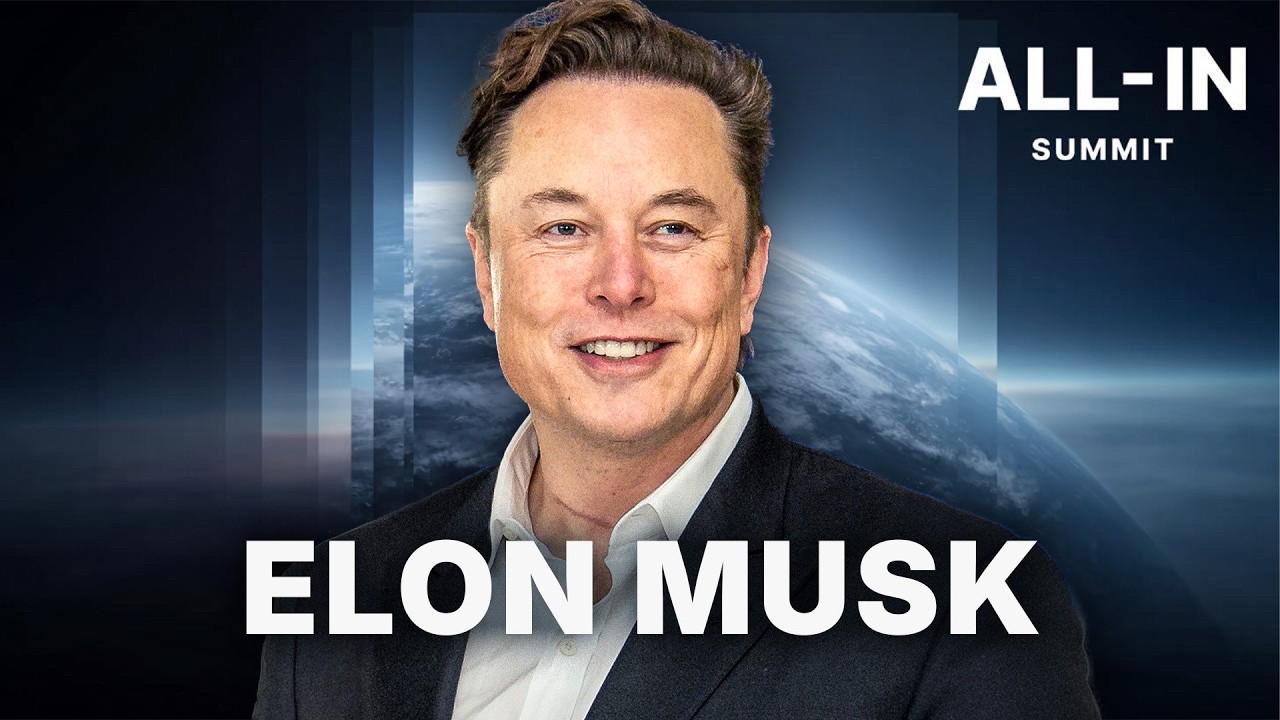
📺 Today’s recommended deep-dive video: https://www.youtube.com/watch?v=qeZqZBRA-6Q
The Engineering of Consciousness: Musk’s Blueprint for Optimus and Mars
Elon Musk is pivoting from “government side quests” back to the core engineering challenges that define our future. From humanoid robots with human-level dexterity to a self-sustaining city on Mars, the mission remains the radical expansion of human consciousness.
Core Question: Can vertical integration and a philosophy of curiosity overcome the technical and civilizational hurdles threatening the West?
Highlights
- Optimus Version 3 aims for human-level manual dexterity with 28 degrees of freedom in the hand alone.
- Tesla’s AI5 chip promises a 40x performance jump over AI4 by co-designing hardware and software for specific operations.
- SpaceX expects to achieve full Starship reusability next year, including catching both the booster and the ship.
- xAI is developing “Grokipedia” to scrub the corpus of human knowledge of bias, falsehoods, and partisan hallucinations.
⏱️ Reading time: approx. 7 minutes · Saves you about 38 minutes vs. watching.
Want to take notes while watching? Click the image below and let AI Notebook capture the key points for you 👇

The Robotic Frontier: Optimus and the Dexterity Challenge
Engineering the Human Form
The human hand represents an evolutionary peak in mechanical versatility, possessing the unique ability to both swing a heavy baseball bat and thread a microscopic needle. To replicate this in the Optimus robot, Tesla has had to abandon existing supply chains entirely, as no off-the-shelf actuators or motors could provide the necessary power-to-weight ratio. Musk emphasizes that the forearm remains the most critical engineering zone because it houses the complex web of tendons that drive the hand’s 28 degrees of freedom.
Building a robot that can navigate reality requires three missing components: manual dexterity, a real-world AI mind, and the capacity for high-volume manufacturing. While other companies focus on subsets of these problems, Tesla is vertically integrating the entire stack, from the physics-first design of the electric motors to the controlling electronics. This approach is harder than building a Model X but sits just below the complexity of a Starship, representing one of the most difficult engineering projects in human history.
At scale, the goal is to drive the marginal cost of production down to approximately $20,000 per unit once manufacturing reaches a million robots annually. The AI chip alone accounts for a significant portion of the bill of materials, potentially costing upwards of $6,000. However, Musk believes that the price will ultimately be a function of demand, with the robot eventually becoming the most successful product ever created due to its “backwards compatibility” with a world built by and for humans.

💡 Digging Deeper
Q: Why stick to the humanoid form factor?
A: Because humans have designed the entire physical world for our specific shape; a humanoid robot is immediately compatible with all existing infrastructure.
Q: What is the most difficult part of the hardware?
A: The hands and forearms represent the majority of the engineering difficulty because of the intricate tendon-based mechanics required for generalized tasks.
Q: How does the AI learn to move?
A: It uses real-world AI and reinforcement learning, leveraging the same computer vision foundation developed for Tesla’s Full Self-Driving (FSD) systems.
Silicon Evolution and the Starlink Global Network
The 40x Leap in AI5
Tesla is currently finalizing the design of its AI5 chip, which Musk describes as an immense jump that will make cars feel truly sentient by the end of the year. While the raw compute is roughly eight times that of AI4, the actual performance increase for specific operations like “softmax” is closer to 40x. This is achieved through a “fine-grained” co-design process where the software and hardware teams work together to eliminate emulated steps in favor of native silicon execution.
This massive increase in compute power allows for much larger parameter counts and more complex reinforcement learning models. By reducing the “lossiness” of reality compression, the FSD software will reach safety levels two to ten times better than the average human driver. This isn’t just a marginal improvement; it is a fundamental shift in how the vehicle comprehends and interacts with its environment in real-time.
Connectivity Without Borders
SpaceX recently invested $17 billion in wireless spectrum to enable Starlink satellites to communicate directly with standard mobile phones without the need for additional hardware. This “direct-to-cell” technology will effectively turn Starlink into a global carrier, providing high-bandwidth connectivity even in remote areas or inside typical homes. While it won’t immediately replace regional carriers like Verizon or AT&T, it offers a comprehensive alternative for high-speed internet and cellular service anywhere on Earth.
Musk envisions a world where a single Starlink account provides seamless transitions between home Wi-Fi and global mobile data. The hardware changes required in handsets to support these new frequencies will likely take two years to filter through the market. Once the constellation and the phone chipsets are synchronized, the concept of “dead zones” or expensive international roaming will become a relic of the past, marking a new era of planetary communication.

Starship: The Multi-Planetary Lifeboat
Solving the Heat Shield Problem
The primary hurdle for Starship’s full reusability is the creation of a “refurbishment-free” orbital heat shield, a feat never before achieved in aerospace history. Unlike the Space Shuttle, which required months of tile repair after every flight, Starship needs tiles that can withstand the heat of reentry and remain flight-ready immediately upon landing. This is a material science challenge of the highest order, requiring tiles that are lightweight, durable, and resistant to environmental factors like rain.
SpaceX intends to demonstrate full reusability next year by catching both the booster and the ship back at the launch site. Version 3 of Starship, powered by the new Raptor 3 engine, will be a radical redesign capable of carrying over 100 tons to orbit. This scale is necessary to move from “flags and footprints” to the massive tonnage required for a self-sustaining city on Mars.
The 30-Year Countdown
The ultimate test for human survival is “planetary redundancy,” or the ability for a Mars colony to survive if resupply ships from Earth stop arriving. Musk estimates that with exponential increases in tonnage during every two-year launch window, a self-sustaining civilization could be established within 25 to 30 years. This window of opportunity is a rare moment in Earth’s four-billion-year history and must be seized before civilizational decline closes it.

Key Takeaways
The overarching theme of Musk’s current work is a race against time and civilizational entropy. He views the declining birth rates and “suicidal” cultural trends of the West as a direct threat to the window of opportunity for space exploration. By focusing on “Optimus” as a tool for economic abundance and “Starship” as a lifeboat for consciousness, he is attempting to engineer a future that is inherently optimistic and driven by curiosity.
The development of “Grokipedia” at xAI represents an attempt to salvage the “corpus of human knowledge” from partisan bias and digital decay. If AI is to become smarter than the sum of all humans by 2030, Musk argues it must be grounded in a philosophy that seeks truth rather than political correctness. Ultimately, the goal is to expand the scope and scale of human consciousness so that we might finally understand the questions the universe is trying to answer.
Q&A
Q1: What is “Grokipedia”?
A1: It is a project by xAI to use inference compute to rewrite and correct the corpus of human knowledge, such as Wikipedia, by removing bias and falsehoods.
Q2: When will AI be smarter than humans?
A2: Musk predicts AI will be smarter than any individual human by next year and smarter than the collective sum of humanity by 2030.
Q3: How much will the Optimus robot cost?
A3: The target marginal cost at a production volume of one million units per year is approximately $20,000 to $25,000.
Q4: Will Starlink replace traditional cell phone carriers?
A4: It will offer a global alternative, but Musk expects traditional carriers to remain relevant because they own significant amounts of terrestrial spectrum.
Q5: What is the most significant upgrade in Starship Version 3?
A5: It features the Raptor 3 engine and a radical redesign aimed at full reusability and the capacity to carry 100 tons of cargo.
Q6: Why is Musk worried about the “suicide of the West”?
A6: He cites declining birth rates, open borders without assimilation, and a lack of optimism as symptoms of a civilization that has lost its will to propagate.
Q7: What is the “test” for a successful Mars colony?
A7: The colony is only truly successful when it no longer relies on resupply ships from Earth to survive and grow.