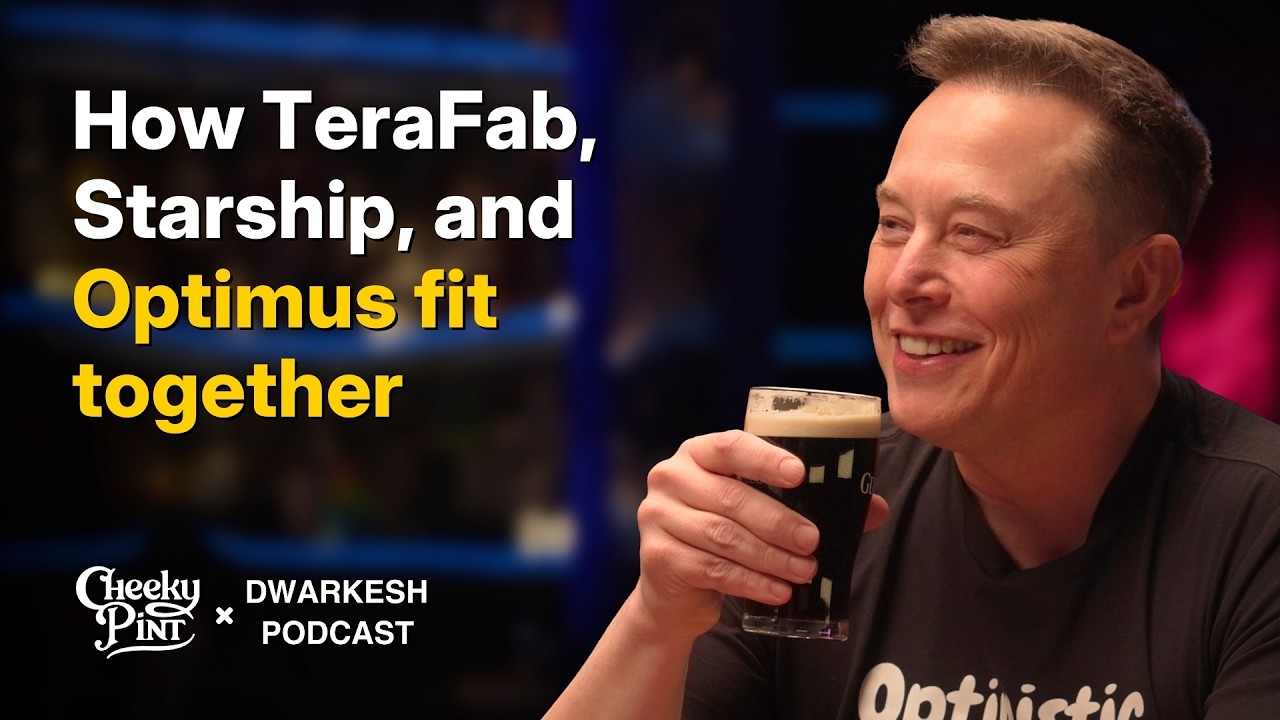
📺 Today’s recommended deep-dive video: https://www.youtube.com/watch?v=BYXbuik3dgA
Scaling Intelligence to the Stars: Elon Musk on Space-Based AI and the Robotics Supernova
As terrestrial power grids hit a regulatory and physical wall, the frontier of artificial intelligence is shifting from Silicon Valley to low Earth orbit. Elon Musk outlines a 30-to-36-month roadmap to move massive compute clusters into space, leveraging permanent sunlight and orbital scalability to bypass Earth’s energy constraints.
Core Question: How can humanity overcome the physical and regulatory bottlenecks of Earth to achieve a million-fold increase in the economy through orbital AI and humanoid robotics?
Highlights
- Space-based data centers provide 5x more power efficiency by eliminating atmospheric loss and the need for batteries.
- The “limiting factor” for AI has shifted from chips to power, with gas turbine backlogs extending to 2030.
- Optimus represents an “infinite money glitch” where robots build robots, potentially growing the economy by 100,000x.
- Starship’s transition to stainless steel was driven by “desperation” and the superior strength-to-weight ratio of steel at cryogenic temperatures.
⏱️ Reading time: approx. 12 minutes · Saves you about 157 minutes vs. watching.
Want to take notes while watching? Click the image below and let AI Notebook capture the key points for you 👇

The Orbital Compute Pivot
Why Space is the Ultimate Regulatory Play
Musk argues that the primary cost of AI isn’t the GPU itself, but the availability of energy to run it. Outside of China, global electrical output is largely stagnant, creating a massive mismatch between exponential chip production and flat energy grids. Space offers an escape from this terrestrial “miracle” requirement for power.
Putting data centers in orbit isn’t just about efficiency; it’s a strategic move to bypass the crushing weight of terrestrial permitting and land-use regulations.
In space, solar panels are five times more effective because they operate without atmospheric interference, clouds, or the day-night cycle. This eliminates the need for expensive battery storage systems that currently bog down green energy projects on Earth. Musk predicts that within 36 months, space will become the most economically compelling location for AI training and inference, providing an order of magnitude more scalability than any land-based facility.
The transition will likely happen in phases, starting with inference-heavy satellites before moving to massive training clusters. Those who have lived exclusively in “software land” are about to receive a hard lesson in hardware reality as the grid fails to keep up with the demands of the intelligence age.

💡 Digging Deeper
Q: Is servicing GPUs in space a dealbreaker?
A: No, because modern chips are highly reliable past the “infant mortality” phase. You debug them on the ground first, then launch.
Q: What about bandwidth?
A: High-speed orbital lasers already provide massive throughput between satellites, and the goal is to reach terrestrial fiber-like speeds in vacuum.
Q: Why not just build more power plants on Earth?
A: You can’t. The global supply chain for turbine blades and vanes is sold out through 2030, and utility companies move at the speed of government.
The Hardware Bottleneck and “TeraFabs”
Rebuilding the Industrial Stack
The global supply chain for high-end industrial hardware is fundamentally broken, with backlogs for critical turbine components stretching into the next decade across all major Western manufacturers.
To solve this, Tesla and SpaceX are vertically integrating the entire energy stack, from raw polysilicon to finished solar cells. Musk’s goal is to reach 100 gigawatts of solar production annually, creating a feedback loop where chips and power generation are matched one-to-one. He also hints at building “TeraFabs”—massive chip manufacturing facilities that move beyond the limitations of current giants like TSMC by rethinking equipment design from first principles.
Musk identifies memory, rather than logic, as the looming catastrophic bottleneck for the next generation of AI clusters. Without massive investment in dedicated memory fabrication, even the most advanced logic chips will remain “marooned” without the bandwidth to process the coming wave of trillion-parameter models.
If US chip production doesn’t scale aggressively, China will dominate the manufacturing layer of the AI revolution by default. The current tariff structures on solar components are “nuts,” effectively slowing down the very transition to green energy that the government claims to support.

💡 Digging Deeper
Q: Can anyone replicate ASML’s lithography?
A: It’s the ultimate hurdle. China is struggling with it, and Musk admits he “doesn’t know yet” if he’ll have to build his own lithography machines.
Q: What is “Tera” in this context?
A: It’s the new “Giga.” We are moving from gigawatt-scale factories to terawatt-scale industrial ecosystems.
Q: How does the “limiting factor” philosophy work?
A: You identify the one thing holding back the entire system—like turbine blades—and you obsessively solve that before looking at anything else.
Optimus and the Recursive Economy
The “Infinite Money Glitch”
Humanoid robots represent a “recursive multiplicative exponential” that Musk describes as a supernova for the global economy. By combining digital intelligence with electromechanical dexterity, robots like Optimus can eventually be used to build more versions of themselves. This effectively uncouples economic output from the limitations of the human population.
The hardest engineering challenge isn’t the AI “brain,” but the human hand, which requires custom-designed actuators and sensors that simply don’t exist in any catalog.
To train these robots, Tesla is creating an “Optimus Academy” where tens of thousands of humanoid units engage in self-play within the real world to close the “sim-to-real” gap. This training data flywheel is similar to how Tesla solved Full Self-Driving: by correlating massive bitstreams of video data with physical control outputs. Once the hardware reaches “Version 3,” Musk expects to scale production to a million units per year, fundamentally transforming manufacturing and refining.
A million-fold increase in the economy sounds like sci-fi, but it’s just the natural result of removing the labor constraint from the production of atoms.

💡 Digging Deeper
Q: Will robots take all the jobs?
A: Headcount at Tesla will actually increase, but output per human will skyrocket. It’s about increasing the pie, not slicing it differently.
Q: Why the humanoid form?
A: Because the entire world—doors, tools, stairs—is designed for a humanoid shape. Changing the world is harder than building a robot to fit it.
Q: What is the “Digital Optimus”?
A: It’s a human emulator at a computer. Before we have physical robots, AI will act as a digital co-worker that can use any software a human can.
Key Takeaways
The conversation reveals a fundamental shift in Musk’s strategy: the “bottleneck” is no longer software, but the physical constraints of Earth. Whether it is the inability of utilities to provide gigawatts of power or the limits of terrestrial permitting, Musk sees space as the only viable path to scale AI to its logical conclusion. By launching 10,000 Starships a year, SpaceX intends to become a “hyper-hyperscaler,” hosting more compute in orbit than exists on the entire planet.
Musk’s vision for the future is grounded in “maniacal urgency” and a physics-first approach to management. He views the national debt and human demographic collapse as existential threats that can only be solved by a massive injection of robotic productivity. The ultimate goal remains the propagation of the “light cone of consciousness,” ensuring that intelligence—whether biological or silicon—survives and understands the universe.
Q&A
Q1: Why did Starship switch from carbon fiber to stainless steel?
A: Carbon fiber is 50x more expensive and has a lower melting point. Stainless steel actually becomes stronger at cryogenic temperatures (like those of liquid oxygen) and allows for a much lighter heat shield.
Q2: What is the single biggest problem remaining for Starship?
A: Developing a fully reusable orbital heat shield. We need to be able to land, refill propellant, and fly again without manually inspecting 40,000 tiles.
Q3: How does Musk manage 200,000 employees across multiple companies?
A: He identifies the “limiting factor” for each company and drills down into that specific issue with “nano-management” while allowing successful departments to cruise autonomously.
Q4: What is the “most interesting outcome” theory?
A: The idea that if we live in a simulation, the simulators will only keep the “interesting” or “ironic” simulations running. Therefore, staying interesting is a survival strategy.
Q5: Why is Grok’s mission to “understand the universe” so important for AI safety?
A: Because a truth-seeking AI must value the existence of humans and consciousness. You cannot understand the universe if you eliminate the very intelligence that observes it.
Q6: How does Musk plan to compete with China’s manufacturing lead?
A: He believes the US cannot win on human labor because China has 4x the population. The only path to victory is through breakthrough robotics that close the productivity gap.
Q7: What is the “DOGE” plan for government efficiency?
A: Eliminating “ludicrous” fraud, such as billions of dollars being sent to people marked as 115+ years old or payments sent without any congressional appropriation codes.