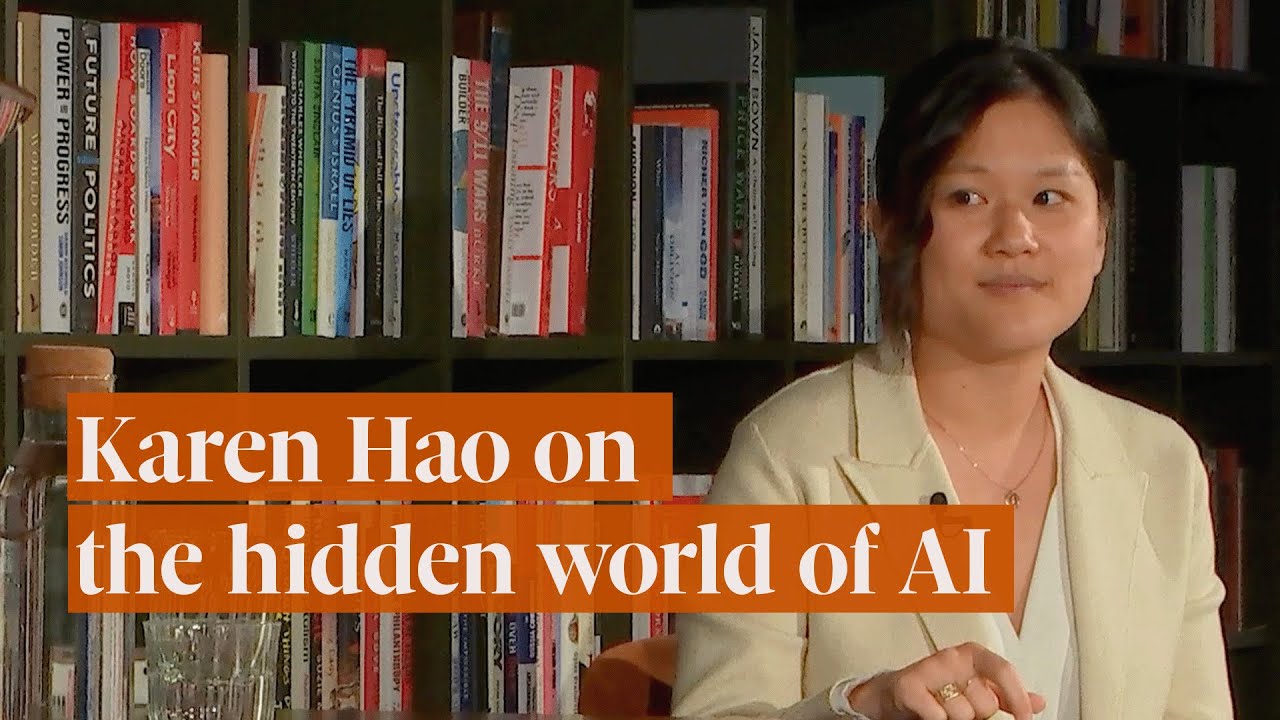
📺 Today’s recommended deep-dive video: https://www.youtube.com/watch?v=t9G_kXUm6mI
Inside the AI Empire: Power, Persuasion, and the Myth of Inevitability
Investigative journalist Karen Howe peels back the shiny veneer of Silicon Valley to reveal the dark architecture of the AI industry. From data centers in Chile to the boardrooms of OpenAI, she argues that today’s tech giants aren’t just building software—they are reviving the exploitative structures of colonial empires.
Core Question: Is the current path of AI development a scientific necessity or a carefully constructed narrative designed to concentrate global wealth and power?
Highlights
- The four parallels between AI giants and historical empires: resource theft, labor exploitation, knowledge control, and “civilizing” myths.
- Sam Altman’s “Michael Jordan of listening” persona and how he uses persuasion to consolidate influence where others use coercion.
- The divide between “boomers” and “doomers” as two sides of the same quasi-religious AGI coin.
- Why task-specific AI, such as AlphaFold, offers a more ethical and effective alternative to the current pursuit of “everything machines.”
⏱️ Reading time: approx. 12 minutes · Saves you about 46 minutes vs. watching.
Want to take notes while watching? Click the image below and let AI Notebook capture the key points for you 👇

The Four Pillars of the AI Empire
Rebranding Colonial Exploitation for the Digital Age
The central thesis of Howe’s investigation is that companies like OpenAI act as modern-day empires, operating through a four-part strategy of extraction and control. The first pillar is the theft of resources—data and intellectual property—which these companies claim as “fair use” while ignoring the lack of consent from the writers and artists who created it.
This is not merely about software; it is a physical conquest of labor and land. These empires rely on a massive, often invisible workforce in the Global South to perform the traumatic labor of content moderation and data labeling for pittance. Meanwhile, they consume vast amounts of fresh water and electricity in communities like those in Chile and Uruguay, where residents have long resisted “extractivismo”—the large-scale removal of natural resources to fortify foreign powers.
OpenAI’s definition of Artificial General Intelligence (AGI) as a system that outperforms humans in most economically valuable work is effectively an admission of intent to automate human labor out of existence.
The third pillar is the monopoly of knowledge, where massive compensation packages drain top researchers from academia into private labs. This shift creates a scientific landscape where the people studying AI’s risks are bankrolled by the very companies creating them, a situation Howe compares to climate scientists being funded exclusively by oil companies. Finally, these empires maintain their power through a narrative of “good” versus “evil,” positioning themselves as the only shield against rival threats—be it Google in the early days or China today—to justify their unfettered expansion.
💡 Digging Deeper
Q: Why use the word “Empire” instead of just “Monopoly”?
A: A monopoly refers to market dominance, but an empire implies a totalizing influence over governance, resources, and the very definitions of progress and morality.
Q: How does the “China threat” narrative serve these companies?
A: It creates a sense of urgency that discourages regulation; the argument is that if the “good” empire is slowed down by rules, the “evil” empire will win and destroy humanity.
The Prophet and the Religion of AGI
The Persuasive Power of Sam Altman
Unlike Elon Musk, who uses coercive power to seize what he wants, Sam Altman is a master of persuasion who convinces others to seed him power. He is described by colleagues as the “Michael Jordan of listening,” possessing an uncanny ability to make whoever he is talking to feel like the most important person in the world.
Altman understands that to build a world-changing company, one must first build a religion. In his early blog posts, he noted that the most successful founders create a sense of higher purpose to mobilize talent and capital, a strategy he has perfected by positioning AI as the “inevitable” solution to all human suffering.
This religious fervor manifests in strange ways within the halls of OpenAI. Howe recounts an event where former chief scientist Ilya Sutskever led a semi-religious ceremony involving bathrobes, a fire pit, and the burning of a wooden effigy representing an “evil” AGI.
Despite the grand claims, there is a staggering lack of scientific evidence for the inevitability of AGI. While Altman pitches a future of “boundless abundance” to venture capitalists, nearly 75% of long-standing AI researchers believe we don’t even have the technical foundation to recreate human intelligence in computers. The gap between the marketing and the science is not a mistake; it is the “original sin” of the industry, which has long used the term “Artificial Intelligence” to anthropomorphize math and attract funding.

💡 Digging Deeper
Q: What is the “boomer vs. doomer” dynamic?
A: Both groups believe AGI is coming soon and will change everything; they only disagree on whether the result is heaven or hell, yet both agree that the technology is too dangerous for public control.
Q: How does Altman handle internal dissent?
A: Through a mix of extreme agreeableness and tactical silence; he is known for telling different stakeholders exactly what they want to hear, even when those promises are contradictory.
The Human Cost of the “Everything Machine”
From Family Dynamics to Global Impacts
The power dynamics within OpenAI are mirrored in Sam Altman’s own family history, particularly in his relationship with his sister, Annie. Annie Altman has publicly alleged a history of abuse and economic control by her brothers, painting a picture of a family where those who do not fit the “tech-success” mold are marginalized and silenced.
While the brothers deny these claims, Howe notes that the “power chasm” Annie experienced—where a wealthy elite uses whispers and narrative control to dismiss the vulnerable—is exactly how the AI industry treats the workers and communities it exploits.
We are currently sacrificing real-world resources for a nebulous “everything machine” that might never work as promised.
The pursuit of a general-purpose AI that can do anything has led to “middling” results, where users are encouraged to treat chatbots as therapists or advisors, often with harmful consequences. In contrast, task-specific AI—like DeepMind’s AlphaFold, which won a Nobel Prize for predicting protein structures—demonstrates that AI can be profoundly useful when focused on bounded, scientific problems rather than vague, civilization-ending fantasies.
Unfortunately, the financial incentives of Silicon Valley favor the “hype” of AGI because it promises 100x returns to investors, whereas specific, helpful tools do not offer the same path to total market domination.

💡 Digging Deeper
Q: Is it possible to change these companies from the inside?
A: Howe is skeptical; she observes that researchers who enter with a “moral compass” either leave in frustration or eventually succumb to the intense, insular echo chamber of the lab.
Q: What is the environmental impact of this scale?
A: The training of these models requires massive amounts of fresh water for cooling and electricity that often strains local grids, leading to conflicts with local activists in places like Chile.
Key Takeaways
The narrative of AI as an unstoppable, god-like force is a choice, not a law of nature. By framing AGI as inevitable, tech leaders strip the public of their agency and justify the erosion of democratic governance. We are told that we must sacrifice our privacy, our environment, and our intellectual property to stay ahead of “evil” empires, but this is a classic imperial tactic used to consolidate power in the hands of a few.
The true path to progress lies in rejecting the “everything machine” in favor of specialized, task-oriented technologies that respect human rights and environmental limits. We have already seen the success of AI in fields like drug discovery and renewable energy integration. By shifting the focus away from religious-like devotion to AGI and toward accountable, scientific tools, we can reclaim the future from the new empires.
Ultimately, the stories these companies tell—whether about utopia or extinction—are designed to keep us looking at the horizon while they extract the ground from beneath our feet. Resisting this requires us to look past the “shiny veneer” and demand that technology serves humanity, rather than the other way around.
Q&A
Q1: Why did you focus so heavily on the title “Empire of AI”?
A: Because these companies follow the historical playbook of empires: they claim resources they don’t own, exploit labor in vulnerable regions, monopolize knowledge, and use “civilizing” narratives to justify their power.
Q2: Is Sam Altman really a “true believer” in AGI?
A: It’s hard to say, but he certainly believes in the power of the story of AGI. He uses it to mobilize billions of dollars and align the most talented people in the world toward his vision.
Q3: What is the difference between Sam Altman and Elon Musk’s power?
A: Musk uses coercive power—he seizes and demands. Altman uses persuasive power; he is the “Michael Jordan of listening” who makes you feel heard while he maneuvers you toward his goals.
Q4: Are the “doomers” right to be afraid?
A: The fear is real for them, but it’s often a distraction. By focusing on a speculative future where AI kills everyone, they ignore the very real, current harms like labor exploitation and environmental damage.
Q5: Can we still fix the AI industry?
A: Yes. Inevitability is a myth. We can choose to fund different types of AI, implement stricter regulations on data and labor, and protect the resources that these companies are currently taking for free.
Q6: What happened to the “Open” in OpenAI?
A: It was originally a nonprofit intended to share knowledge for the benefit of all, but it quickly pivoted to a “capped-profit” model (and now a for-profit pursuit) to attract the massive capital needed for the “scale at all costs” approach.
Q7: How did Annie Altman’s story fit into the larger narrative?
A: Her experience with her brothers represents the “power chasm” of the industry. Her struggle with housing and economic security mirrors the average person’s experience with AI, which is often one of exclusion and algorithmic moderation.