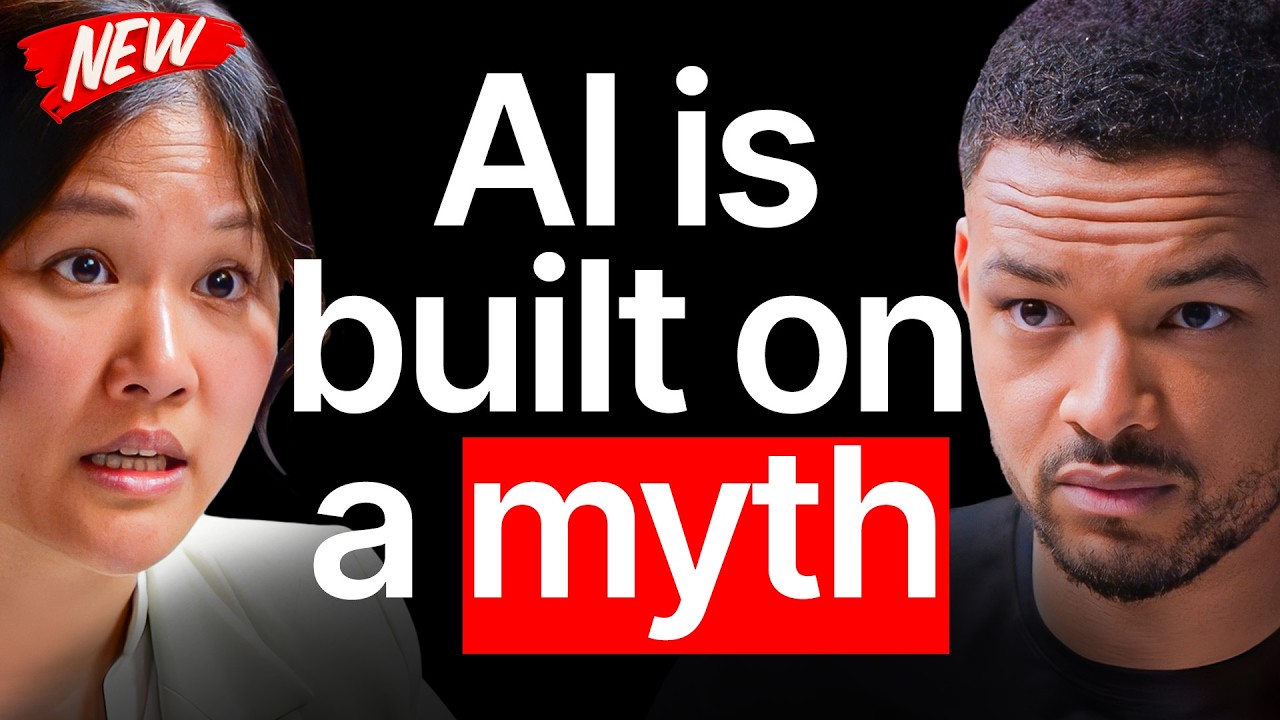
📺 Today’s recommended deep-dive video: https://www.youtube.com/watch?v=Cn8HBj8QAbk
The AI Empire: Unmasking the Power, Politics, and Human Cost of the Tech Gold Rush
Behind the polished keynotes and promises of digital abundance lies a complex web of labor exploitation, environmental strain, and imperial ambition. Journalist Karen Hao exposes how a handful of tech giants are reshaping global power dynamics by treating human knowledge and natural resources as territory to be conquered.
Core Question: Is the current trajectory of artificial intelligence an inevitable step toward progress, or is it a modern form of empire-building that thrives on extraction?
Highlights
- The “Empire” metaphor: Why AI companies mirror colonial history through land grabs, labor exploitation, and knowledge monopolies.
- The inside story of Sam Altman’s firing: How a culture of “instability” and “manipulation” led the OpenAI board to attempt a coup.
- The hidden labor class: Why award-winning directors and PhDs are now working as “data annotators” to feed the machines that replaced them.
- Bicycles vs. Rockets: The argument for specialized, efficient AI (like AlphaFold) over resource-heavy, generalized “everything machines.”
⏱️ Reading time: approx. 10 minutes · Saves you about 119 minutes vs. watching.
Want to take notes while watching? Click the image below and let AI Notebook capture the key points for you 👇

The Architect of Ambiguity
Defining AGI as a Malleable Myth
Karen Hao traces the history of AI back to the 1956 Dartmouth conference, noting that the term was a marketing choice by John McCarthy to distinguish the field. Since there remains no scientific consensus on what “human intelligence” actually is, modern tech leaders are free to redefine the goalposts of Artificial General Intelligence (AGI) to suit their immediate financial or political needs.
AGI is currently used as a malleable myth to attract billions in capital while simultaneously warding off regulatory oversight from concerned governments.
Sam Altman’s relationship with Elon Musk illustrates this perfectly; Altman mirrored Musk’s existential fears about “summoning the demon” specifically to secure funding and co-founder status for OpenAI. Once the nonprofit mission began to shift toward a for-profit empire, internal documents suggest Musk was effectively muscled out of the leadership circle. This pattern of behavior has led to a polarizing reputation where Altman is viewed either as a visionary Steve Jobs figure or a manipulative architect of chaos.

💡 Digging Deeper
Q: Why did the OpenAI board originally fire Sam Altman?
A: Internal sources suggest a “culture of instability” where Altman pitted teams against each other and failed to provide transparent documentation on critical business moves, such as his personal ownership of the startup fund.
Q: How did Ilya Sutskever view the risk of AI?
A: He hypothesized that since brains are statistical engines, building a larger digital statistical engine would naturally lead to a superior intelligence that might treat humans the way we treat animals—not with hate, but with indifference.
The Infrastructure of Inequality
Labor Exploitation and the “Human Machine”
The “Empire” metaphor fits because these companies lay claim to intellectual property, land, and labor that are not their own, often without providing a fair exchange of value. This imperial agenda involves “hoovering up” the collective data of humanity to train models that are then sold back to the public as tools for their own replacement.
We see this most clearly in the “data annotation” industry, where highly educated professionals—from doctors to award-winning directors—are reduced to “human machines” labeling data for meager pay.
This work is often frantic and dehumanizing, as workers are forced to wait at their laptops for pings on Slack, sacrificing their personal dignity and family time to feed the data flywheel. This hidden labor force is the invisible scaffolding holding up the illusion of autonomous machine intelligence. It represents a “broken career ladder” where the entry-level and mid-tier rungs are gouged out, leaving only high-level orchestrators and low-level labelers.

💡 Digging Deeper
Q: What is “data annotation”?
A: It is the manual process where humans label images, text, or code to teach AI models what is correct, such as identifying a pedestrian in self-driving footage or writing the “correct” response to a chatbot prompt.
Q: Is the labor crisis only affecting low-skilled workers?
A: No. New reports show a 40% reduction in entry-level white-collar jobs, and even award-winning creatives are secretly doing annotation work to survive as the economy restructures.
The Environmental and Social Toll
Colossal Computing and Local Crises
Beyond labor, the physical infrastructure of AI is exacting an extraordinary cost on the environment and public health. Colossal supercomputer facilities, such as the “Stargate” project, consume power equivalent to twenty percent of a major city like New York. These facilities often move into vulnerable, rural communities, competing for local freshwater resources and lowering grid reliability for residents.
In Memphis, Tennessee, Elon Musk’s “Colossus” supercomputer utilized methane gas turbines that reportedly polluted the air of a predominantly black and brown working-class neighborhood.
Residents were not consulted and only discovered the facility’s impact when they smelled gas in their living rooms, illustrating the “have vs. have-not” divide of the AI age. While the “haves” enjoy free time and “human” experiences enabled by AI, the “have-nots” live in the shadow of the cooling towers, breathing polluted air and paying higher utility bills. This is the reality of the “Dune-like” world the tech industry is building—a struggle for the “spice” of compute at the expense of the local population.

Key Takeaways
The current AI industry is operating on an imperial model that prioritizes rapid extraction over human flourishing. By framing AI development as an existential “arms race” against rivals like China, CEOs justify an anti-democratic approach that excludes the public from critical decision-making. This narrative suggests that only a few “benevolent” leaders can be trusted with the “finger on the button” of AGI.
However, we have a choice between “rockets” and “bicycles.” While rockets like GPT-4 consume vast resources for generalized tasks, specialized “bicycles” like AlphaFold provide massive scientific breakthroughs with a fraction of the data and energy. True progress involves breaking up these empires and fostering a “bicycling” ecosystem of AI that values efficiency, labor rights, and environmental sustainability.
Individuals can exercise their agency by resisting the “flawless” adoption of extractive technologies and supporting regulation. Whether through withholding data, protesting local data centers, or demanding transparency in workplace AI policies, the public has the power to shift the trajectory. The goal is not to stop technology, but to ensure that innovation serves humanity rather than enslaving it to a new class of digital monarchs.
Q&A
Q1: Is AI really going to automate all jobs?
A1: While capabilities are improving, job losses are often driven as much by executive choices to downsize as by the actual technical proficiency of the AI.
Q2: What is the “Jagged Frontier” of AI?
A2: It refers to the fact that AI is very capable at some tasks but fails unexpectedly at others, meaning it isn’t “generally” intelligent like a human, but narrowly proficient based on its training data.
Q3: Why does Karen Hao compare AI to “Dune”?
A3: Because tech leaders use religious-like myths of a “Messiah” or “AGI Heaven” to control the narrative and rally people behind their specific “house” or company.
Q4: Do self-driving cars solve the safety problem?
A4: Not universally. Statistical engines are probabilistic, not deterministic; they make errors that humans don’t, and their safety record depends heavily on whether they were trained for a specific location.
Q5: Can we develop AI without the environmental cost?
A5: Yes, by shifting focus toward smaller, curated datasets and more efficient architectures instead of the “brute force” scaling of massive LLMs.
Q6: What did the Klarna CEO say about AI layoffs?
A6: He noted that while his company shrunk from 7,400 to 3,000 people, AI now handles 70% of customer service, though he admits the value of “handcrafted” human interaction will likely increase.
Q7: What can regular people do to help?
A7: Stay informed, support regulation, and realize that the adoption of these technologies is a choice; you can influence policies in your workplace and local community.