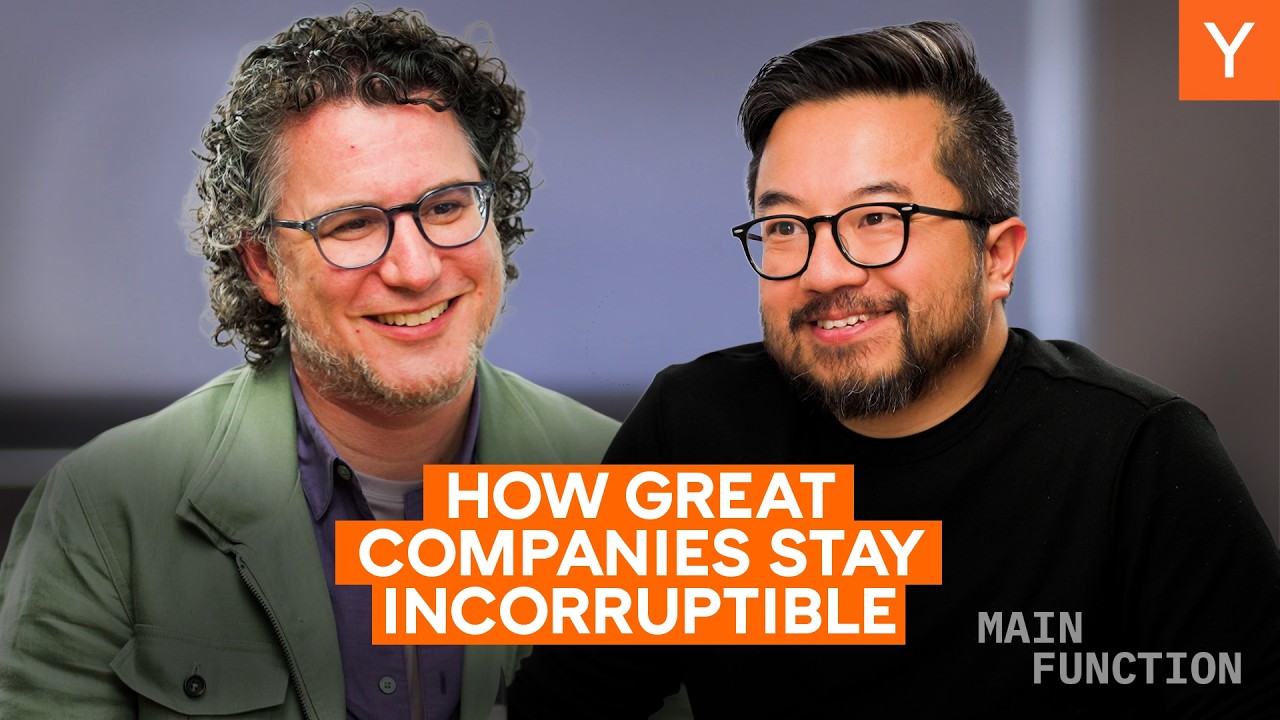
📺 Today’s recommended deep-dive video: https://www.youtube.com/watch?v=7VKliOQXQ9M
The Incorruptible Founder: Engineering a Mission That Outlasts You
Most startup founders believe that achieving product-market fit is the ultimate shield for their vision, yet success often makes a company the primary target for extraction. Eric Ries argues that the current “best practices” of corporate governance are actually value-destroying mechanisms that prioritize temporary investors over long-term innovation. To build a company that lasts a century, builders must transition from investor-led structures to “mission-controlled” governance.
Core Question: How can founders protect the integrity of their company’s mission from the “gravitational pull” of short-term shareholder primacy?
Highlights
- The “Best Practice” trap: How standard Delaware C-Corp structures can force founders out of their own companies.
- The Sol Price Legacy: Lessons from the “natural AB test” between FedMart’s collapse and Costco’s endurance.
- Industrial Foundations: Why Novo Nordisk’s non-profit ownership structure saved the development of GLP-1 drugs.
- Beyond Founder Control: Why “Emperor for Life” structures fail and how checks and balances create true stability.
⏱️ Reading time: approx. 7 minutes · Saves you about 43 minutes vs. watching.
Want to take notes while watching? Click the image below and let AI Notebook capture the key points for you 👇

The Invisible Trap of Shareholder Primacy
Why success makes your company a target
Success does not grant you freedom; it creates a target. As a company becomes more valuable, it becomes worth stealing, and the very structures designed to help you scale—like standard Delaware C-Corp bylaws—often become the tools used to strip you of control. Eric Ries notes that we have built an economy run by temporary managers for temporary investors, leading to a massive decline in corporate lifespans and executive tenures.
We have been conditioned to believe that “best practices” are natural laws of capitalism.
In reality, the doctrine of shareholder primacy only dates back to the 1980s and was never actually voted into law by any legislature. It is what Ries calls a “normative consensus,” where everyone agrees that everyone else agrees, creating a legal obligation for boards to maximize short-term returns even at the expense of the company’s soul. This system forces boards to act like auctioneers rather than guardians of a mission, leading to the “corporate death penalty” for companies that dare to prioritize public benefit over immediate stock price.
If you don’t get your governance right early, no other decision you make will matter in the long run because you won’t be the one making it.

💡 Digging Deeper
Q: Is maximizing shareholder value actually the law?
A: It is a “legal obligation” enforced by courts rather than a statute passed by a legislature; boards can be sued and removed if they fail to prioritize shareholder returns during a sale.
Q: What is the “Professor” story in the book?
A: It’s a case study of a brilliant founder building AI for bioscience who realized his standard legal documents would eventually force him to sell his technology to the highest bidder, even if they were “evil.”
Q: Why does Ries dislike “independent” directors?
A: Nominal independence often masks a pro-investor bias, as these directors rely on venture capitalists for future board recommendations, creating a hidden conflict of interest.
The Legend of Sol Price and the Costco Fortress
The fiduciary hierarchy of a builder
Sol Price, the father of modern retail and mentor to Sam Walton, operated on a simple but radical premise: he was a fiduciary to his customers. He believed that if he could get a product cheaper at a competitor, it was his duty to tell his customers to go there. This level of trust created a “gravitational pull” that brought customers back for decades, but it put him at constant odds with investors who wanted high prices and low wages.
This conflict eventually led to Sol Price being locked out of his own office at FedMart.
When the investors took over FedMart and applied “best practices,” the company went bankrupt within seven years. Meanwhile, Sol started over with Price Club, which eventually merged to become Costco. Today, Costco remains an outlier because it maintains a “governance fortress” that allows it to ignore the “Kroger-style” best practices that prioritize extraction over the customer-first ethos that made the company great in the first place.

💡 Digging Deeper
Q: What happened to Jeff Lawson at Twilio?
A: Despite growing revenue to $4 billion and the stock being up 390% since the IPO, his super-voting shares expired, and he was removed from the company in less than 200 days.
Q: Why did Polaroid fail after firing Edwin Land?
A: Land was the “mission guardian” of their R&D powerhouse; once the suit-led management took over, the company stopped innovating and became extractive, eventually fading into irrelevance.
Q: What is the “governance fortress” mentioned?
A: It is a combination of voting structures and board compositions that protect a company from outside hostile takeovers or “activist” investors who want to liquidate long-term assets for short-term gains.
The Third Way: Mission-Controlled Companies
The miracle of industrial foundations
We are often told that the only choice is between investor control or founder control, but Eric Ries advocates for a third way: mission control. The most successful version of this is the “Industrial Foundation” model, where a non-profit foundation owns a controlling stake in a for-profit subsidiary. This structure makes a company six times more likely to survive to its 50th anniversary because the board’s primary duty is to protect the mission, not the share price.
Novo Nordisk serves as the gold-standard example of this structure.
In the early 2000s, when the pharmaceutical industry was obsessed with “eat or be eaten” mergers, Novo Nordisk’s board tried to sell the company. The non-profit foundation trustees stepped in and asked if the merger was necessary for survival; since the company was profitable, they vetoed the deal. Because of that interference, a “failed” research program was allowed to continue for 13 years, eventually resulting in the invention of GLP-1 drugs (like Ozempic), which now makes the company worth more than the GDP of Denmark.
Founders have been deprived of their birthright by being told the Delaware C-Corp is the only option.
Modern founders can utilize the Public Benefit Corporation (PBC) status to restore “purposeful incorporation.” This legal shield allows directors to prioritize a specific mission—like AI safety or environmental sustainability—over pure profit maximization. While a PBC doesn’t make a founder invincible, it provides the legal “cover” necessary for a board to resist the pressure to sell out or cut corners when times get tough.

💡 Digging Deeper
Q: How does Anthropic use this model?
A: They created a “Long-Term Benefit Trust”—a perpetual purpose trust that has the power to appoint directors, ensuring the company stays aligned with AI safety even under immense market pressure.
Q: What is a “Poison Pill”?
A: A defensive tactic used by boards to prevent hostile takeovers; while often maligned, it was originally seen as a standard tool to protect a company’s authorized public benefit.
Q: Can a PBC prevent a founder from being fired?
A: Not directly, but it prevents the board from being sued for not firing a founder who chooses mission over maximum profit, acting as a shield for the board’s discretion.
Key Takeaways
Building an “uncorruptable” company requires more than just a strong-willed founder; it requires structural integrity. The “Builder’s Intuition”—the idea that the best way to make money is to create more value than you capture—is under constant assault by a financial system that views companies as mere financial instruments. By adopting structures like PBCs or Industrial Foundations, founders can ensure their companies remain “builders” rather than becoming “extractors” like Philip Morris.
The path forward involves reclaiming the identity of the builder and rejecting the “normative consensus” of shareholder primacy. We are currently living through a period of institutional collapse, partly because we have built our economy on temporary structures and “best practices” that destroy long-term value. Whether you are at the seed stage or preparing for an IPO, the time to build your governance fortress is now, before the “gravitational pull” of success makes it impossible to change course.
Q&A
Q1: Why is “Founder Control” (dual-class shares) not a perfect solution?
A1: Founder control often lacks a bridge for succession; it makes the founder a “human shield” who can never leave. Furthermore, “Emperor for Life” structures can lead to hubris syndrome, making founders less compassionate and more afraid of losing power.
Q2: What is the specific benefit of a Public Benefit Corporation (PBC)?
A2: It restores “purposeful incorporation.” It allows you to write a specific mission into your charter, legally protecting the board when they make decisions that favor that mission over immediate shareholder returns.
Q3: How did Marie Krogh influence the history of medicine?
A3: After a diabetes diagnosis, she and her husband August licensed insulin from Canada under the condition that they would never exploit patients. They formed the non-profit foundation that still controls Novo Nordisk today.
Q4: What is the “Kroger Practice” vs. the “Costco Practice”?
A4: “Kroger Practice” refers to following all standard corporate governance best practices, which Ries argues often leads to mediocre, extractive performance. “Costco Practice” involves “bad” governance ratings that actually protect a superior, mission-driven business model.
Q5: Why did the board of Twitter have to sue Elon Musk to buy the company?
A5: Because of shareholder primacy. The board felt a fiduciary duty to complete a transaction that was at a high premium for shareholders, regardless of whether they believed Musk was the right person to lead the mission of the platform.
Q6: What should a founder do if they only have SAFEs and no equity investors yet?
A6: You can convert to a PBC tomorrow with a simple two-page legal filing in Delaware. Since you have no equity investors to veto the move, it is the easiest and most impactful time to set your mission-controlled foundation.
Q7: What is an “Industrial Foundation”?
A7: A two-tiered structure where a non-profit foundation owns the majority of the voting shares of a for-profit company. This ensures that the company’s long-term R&D and mission are protected from the quarterly pressures of the public markets.