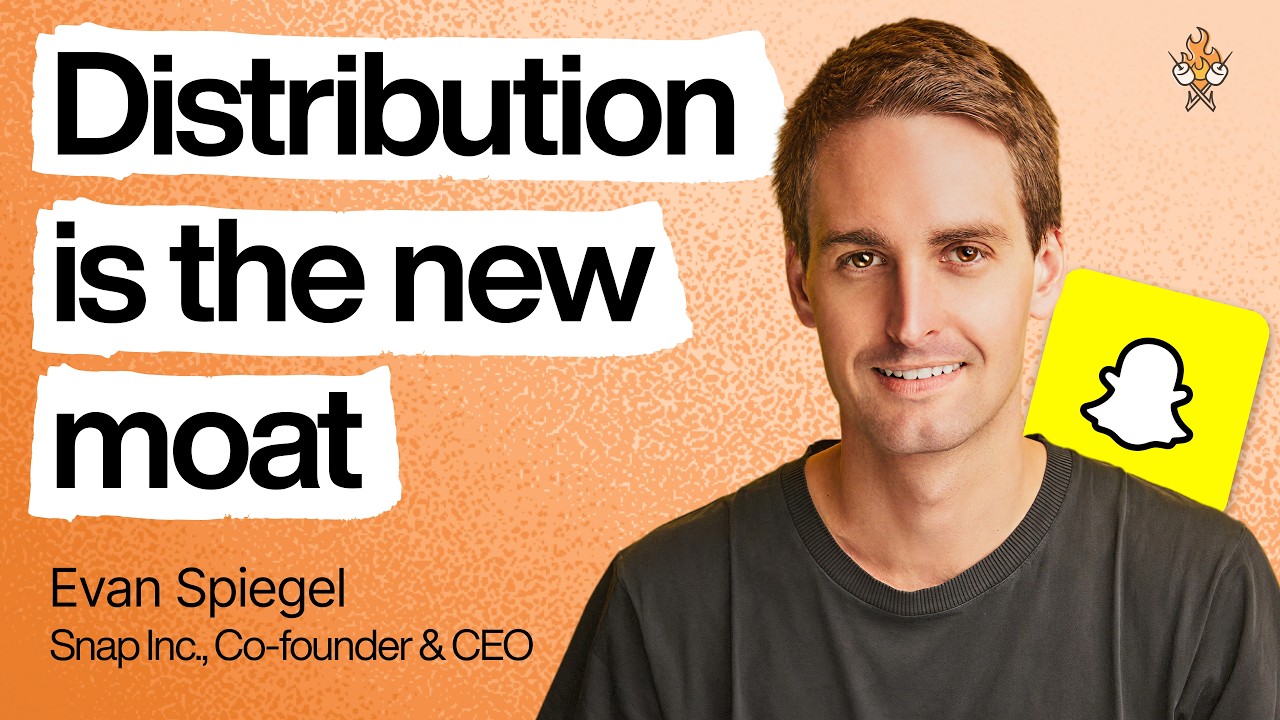
📺 Today’s recommended deep-dive video: https://www.youtube.com/watch?v=-7Yol5vX5xw
Beyond the Keyhole: How Snap Out-Innovates the Giants
Evan Spiegel, CEO of Snap, reveals the organizational secrets that allow a billion-user company to maintain the agility of a startup. From the “middle child” strategy to the brutal critique process of a tiny design team, this discussion explores why social products live or die by distribution rather than features.
Core Question: How can a consumer technology company build a durable moat in an era where software features are instantly cloned?
Highlights
- Distribution is the true differentiator in modern consumer tech, as seen with TikTok and Threads.
- Software is no longer a moat; hardware and vertically integrated ecosystems are the new defense.
- Snap operates with a flat, 12-person design team to maintain high-velocity innovation and avoid hierarchy-driven risk aversion.
- Humanity, not technology, dictates adoption rates and will cause significant societal pushback against AI.
⏱️ Reading time: approx. 8 minutes · Saves you about 62 minutes vs. watching.
Want to take notes while watching? Click the image below and let AI Notebook capture the key points for you 👇

The Distribution Moat and the Death of Software
Why Features No Longer Win the Social Game
Most founders fixate on product-market fit while ignoring the reality that the App Store’s “golden age” of organic discovery has long since ended. Successful newcomers like TikTok didn’t just have a better algorithm; they effectively bought distribution by spending billions to subsidize both sides of their video marketplace until the ecosystem reached critical mass.
Software features are no longer a defensible moat because any successful interaction can be cloned by incumbents within weeks.
To survive this reality, Snap shifted its focus toward building deep ecosystems between creators and developers and investing in a vertically integrated hardware stack. This approach acknowledges that while a “Story” format can be copied, the underlying relationships in a close-friend network and the physical complexity of AR glasses are significantly harder to replicate.

💡 Digging Deeper
Q: Why was Snapchat successful 15 years ago compared to now?
A: The mobile App Store was in its infancy, and users were eager to download everything, providing a level of organic distribution that no longer exists today.
Q: Is the “Network Effect” still a valid moat?
A: It is important but insufficient; Evan argues that connecting a user to the right person (a best friend) is more valuable than connecting them to the most people.
Q: How does Snap view Meta’s tendency to copy their features?
A: Spiegel views it as a blessing because it proves they are making things people want, but it forces them to innovate faster and build moats that software cannot touch.
The “Loonshots” Architecture of Innovation
Managing Systems One and Two Within a Billion-User Org
Snap maintains a unique organizational friction by keeping its design team tiny—oscillating between nine and twelve people—and completely flat. This structure is inspired by Safi Bahcall’s “Loonshots” philosophy, which suggests that large organizations naturally become risk-averse because employees prioritize promotions over experimentation.
The design team acts as a “Fast Thinking” system that stays in constant dialogue with the “Slow Thinking” engineering teams responsible for reliability at a billion-user scale.
This velocity is maintained through a relentless critique process where designers must present new work on their very first day. By producing hundreds of ideas weekly, the team sheds the “preciousness” of individual concepts, acknowledging that a high volume of ideas is the only guaranteed path to a single great one.

💡 Digging Deeper
Q: Why did Snap wait until it had 200 employees to hire its first Product Manager?
A: Spiegel wanted to ensure that designers were responsible for strategy and vision, preventing a culture where designers just produced visuals for PMs.
Q: What is the “Design Bottleneck”?
A: It is a deliberate checkpoint where all products must be approved by the design team to ensure a cohesive through-line across the entire user experience.
Q: How does Spiegel hire designers if he doesn’t care about their resumes?
A: He looks exclusively at portfolios for “range” (the ability to design for different needs) and the “why” behind their work to test their empathy.
The Hardware Pivot and the Crucible Year
Moving From “Keyhole Computing” to Augmented Reality
Evan Spiegel believes we are currently “hunched over like Gremlins,” interacting with the digital world through the tiny keyhole of a smartphone screen. The investment in “Specs” (AR glasses) is an attempt to move computing from an isolating, thumb-based experience to one that is anchored in the physical world.
By overlaying digital objects onto reality, Snap aims to bring people back into social interactions rather than removing them to look at a glass pane.
The current year is described as a “crucible moment” because Snap must prove it can be a profitable, mature business while simultaneously launching its next-generation computing platform. Occupying the “middle child” position—larger than Pinterest but smaller than Google—Snap must define itself as a distinct entity that is no longer overshadowed by its older “siblings.”

💡 Digging Deeper
Q: What is the “Explainer-in-Chief” role?
A: Inspired by Bill Clinton, Spiegel views his CEO job as explaining the world and the company’s role in it to employees and shareholders to align their direction.
Q: How does Spiegel handle screen time with his own four children?
A: It varies by age: zero screens for the toddler (except during haircuts), retro handhelds for the middle children, and full integration for the 15-year-old.
Q: What is the primary risk for AI adoption?
A: Societal pushback; technology leaders often assume blind adoption, but Spiegel believes humanity will dictate the pace of AI based on comfort and ethics.
Key Takeaways
The transition from a startup to a Fortune 500-scale company requires the CEO to evolve into a communicator who can manage the tension between high-risk innovation and operational rigor. Spiegel’s insistence on staying “in the weeds” of product design reflects a belief that product differentiation is the only way for a “middle child” company to survive the gravity of larger incumbents.
Innovation is not a stroke of genius but a result of high-velocity work habits and a flat organizational structure that removes the fear of failure. By forcing designers to rotate through different products and present new work weekly, Snap avoids the stagnation that typically kills large-scale consumer apps.
Finally, the future of computing lies in breaking the isolation of the smartphone. Whether through AR hardware or AI agents that handle the “jobs to be done” for advertisers and users, the goal is to make technology serve human interaction rather than replace it.
Q&A
Q1: How did Snapchat detect screenshots before Apple provided an API?
A: They realized that taking a screenshot triggered a “touch-loss” event on the screen; by requiring users to hold their finger down to view a snap, they could detect when that connection was broken.
Q2: What is the “Loonshots” philosophy?
A: It is the idea that companies need two distinct structures: one flat and creative for innovation, and one hierarchical for scale, with leadership acting as the bridge between them.
Q3: Why is Spiegel skeptical of “Heads-up Display” glasses?
A: He finds them disruptive because they put notifications in your line of sight; Snap’s Specs focus on anchoring content in the real world to facilitate “hanging out.”
Q4: How does Snap use AI internally?
A: They use Glean to create a flat leadership structure where agents comb through company data to find “hotspots” and bugs, and they use agents to automate go-to-market workflows.
Q5: What was the inspiration for Snapchat Stories?
A: Users asked for a “Send All” button to blast friends, but they also complained about the pressure of public likes; Stories solved both by providing a broadcast method that was chronological and temporary.
Q6: What is Spiegel’s advice for improving communication as a founder?
A: You must learn to love the dialogue; he initially hated all-hands meetings but realized that “Explainer-in-Chief” is a core requirement of the CEO job.
Q7: What is Spiegel’s favorite all-time Snapchat lens?
A: The “Vomiting Rainbow” because of the sheer joy it brought to the community during the early days of AR.