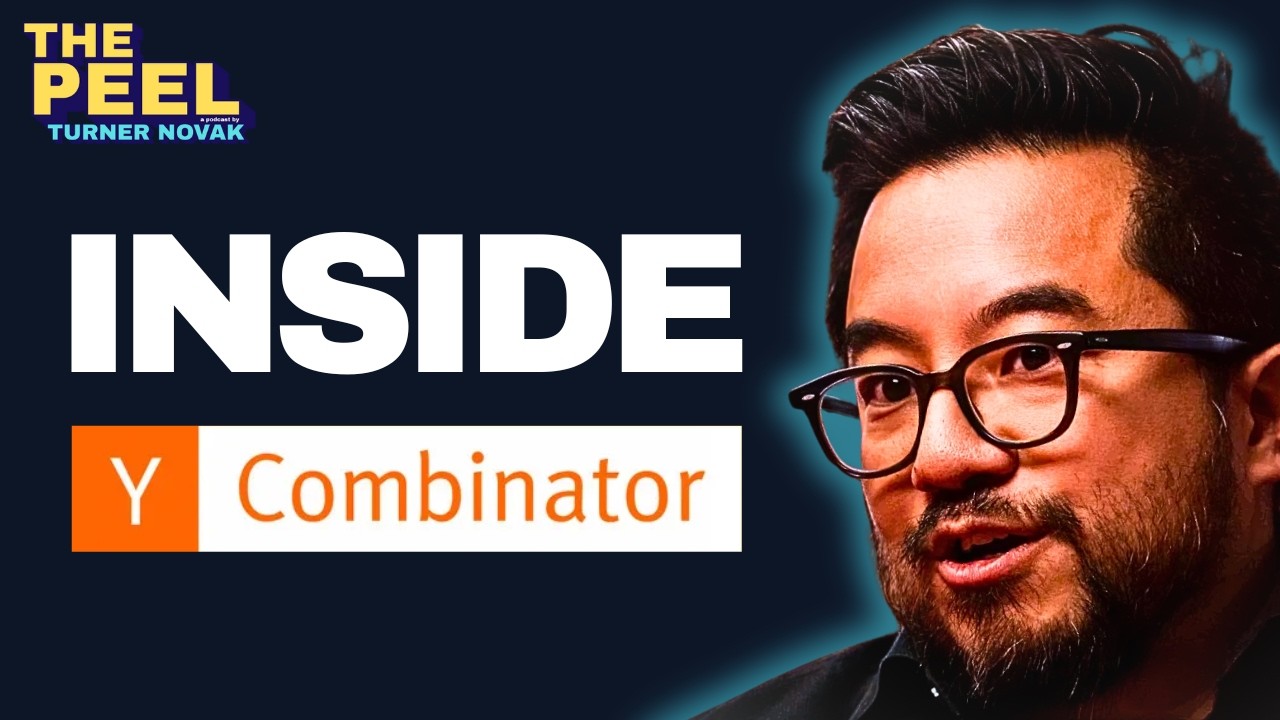
📺 Today’s recommended deep-dive video: https://www.youtube.com/watch?v=rEwK7MIQ-QA
The YC Playbook: Scaling Founders and Fighting for San Francisco
Gary Tan, President of Y Combinator, shares the inside story of the world’s most successful startup accelerator and its evolution from a “summer internship” experiment into a global guild. From navigating the “mortal ego wounds” of rejection to battling California’s controversial tax policies, Tan reveals the psychological and political hurdles facing the next generation of tech giants.
Core Question: How can founders navigate personal psychological traps while building companies in an increasingly hostile political environment?
Highlights
- The shift from “Manager Mode” back to “Founder Mode” at YC.
- Why California’s proposed “billionaire tax” is actually a threat to middle-class services.
- The “horse and rider” analogy for mastering founder psychology and conflict.
- How “metaprompting” serves as the ultimate productivity hack in the AI era.
⏱️ Reading time: approx. 8 minutes · Saves you about 76 minutes vs. watching.
Want to take notes while watching? Click the image below and let AI Notebook capture the key points for you 👇

The Evolution of the YC Machine
From Summer Internship to Managed Marketplace
Y Combinator was never supposed to be a multi-billion dollar institution.
It began as a radical experiment by Paul Graham and Jessica Livingston to see if giving small amounts of “internship-level” money to smart hackers could yield actual companies. In the early days, founders like those behind Reddit or Twitch received as little as $13,000 to survive a summer in Cambridge. That shoestring budget forced a level of scrappiness that eventually birthed unicorns like Airbnb and Dropbox, proving that the guild model—technical founders helping other technical founders—was the ultimate shortcut to product-market fit.
Today, YC has matured into what Tan describes as a “managed marketplace” for the world’s most ambitious talent. The program now provides half a million dollars in exchange for roughly 7% equity, but the capital is secondary to the network effects. By concentrating 20% of all high-value startups founded since 2012 into a single ecosystem, YC creates a high-pressure environment where “objects in motion stay in motion.”

💡 Digging Deeper
Q: Why did YC move back to a strictly in-person model in San Francisco?
A: Remote programs didn’t capture the “Disneyland Imagineering” quality of the batch; physical proximity in places like the Dogpatch creates a default trust and speed of iteration that Zoom cannot replicate.
Q: What is the significance of “Founder Mode” in YC’s current leadership?
A: It’s the rejection of “Manager Mode”—the tendency to hire smart people and walk away. Tan, influenced by Brian Chesky, believes leadership is presence, requiring radical ownership over every detail from the application process to Demo Day.
Q: How does YC handle the high volume of rejections?
A: With 80,000 applications a year, rejection is common. Tan views surviving a “mortal ego wound” from YC as a litmus test for founder resilience.
The Political War for the Golden Goose
The Threat of Asset Seizure
Silicon Valley is facing a localized existential crisis that many founders are still ignoring.
Tan warns that the proposed “billionaire tax” in California is effectively an asset seizure tailored to strip startup founders of their voting control and net worth long before they have liquidity. Because the tax is calculated based on voting power rather than just economic ownership, founders like Larry Page or Sergey Brin could face tax bills that exceed their actual cash reserves. This isn’t just a problem for the ultra-wealthy; it’s a policy that drives a trillion dollars in net worth out of the state, eventually forcing the middle class to foot the bill for public services.
The hostility isn’t limited to taxes; it extends to the very act of innovation.
In San Francisco’s Mission District—the birthplace of self-driving cars and large language models—local supervisors recently attempted to ban R&D laboratories entirely. Tan argues that tech needs to “go direct” with its message because traditional media often fails to highlight how these policies kill the “golden goose.” The result is a massive migration to the other 49 states, where founders find that life outside the California bubble is not only possible but preferable.

💡 Digging Deeper
Q: Is the “billionaire tax” actually going to pass?
A: There is a significant chance it reaches the ballot as a direct proposition, bypassing the Governor’s veto power and embedding itself into the state constitution.
Q: Why does Gary Tan focus so much on local SF politics?
A: Because San Francisco is the “root of the tree of prosperity,” and if R&D is banned in the city where GPT-1 was formulated, the entire American tech edge is at risk.
Q: What is the “Gross Receipts Tax” issue?
A: It’s a tax on transaction volume rather than profit, which has already driven companies like Stripe and Square out of the city due to the massive overhead it creates for fintechs.
The Psychology of the Successful Founder
Debugging the Internal Script
Startups take on the personality of their founders, which means a founder’s unaddressed trauma is a ticking time bomb for the company.
Tan identifies a common trap called “self-abandonment,” where a founder avoids conflict to preserve a relationship, only to have the pressure build up until they “blow up” at their team. He uses the “horse and rider” analogy: the rider (the prefrontal cortex) tries to steer, but if the horse (the emotional self) is ignored for too long, it eventually revolts. Great co-founding relationships aren’t characterized by a lack of fighting, but by the ability to have high-intensity conflict that always prioritizes the relationship over the argument.
You must learn to “freeze all motor functions.”
This Westworld-inspired technique involves hitting a metaphorical debug mode during moments of high stress. By identifying the physical triggers—like a face getting hot—a founder can insert an “if statement” into their reaction, choosing a productive path rather than a reactive one. This internal work is not “West Coast fluff”; it is a fundamental requirement for building a functioning organization that doesn’t collapse under the weight of its own leadership’s ego.

The AI Stack and the Future of Work
Mastering the Metaprompt
We are entering an era where software is no longer a luxury for the few, but a utility for the billions.
Tan’s personal productivity revolves around “metaprompting,” a process where he uses LLMs to write the very prompts that will eventually replace his repetitive tasks. By dropping inputs and outputs into a context window and asking the AI to “introspect” on the conversion process, he creates high-fidelity agents for everything from YouTube scripting to interaction design. He views the current AI landscape as a “Matrix” moment for workers: you can remain a cog in a corporate machine, or you can take the “red pill” and use these tools to build your own reality.

💡 Digging Deeper
Q: Which AI tools does Gary Tan use daily?
A: He uses Claude for coding and evaluating outputs, Perplexity for web-connected synthesis, and ChatGPT/Grok for diverse perspectives on complex prompts.
Q: What is “vibe coding”?
A: It refers to the new era of development where natural language and intent drive the creation of software, allowing founders to iterate at speeds that were impossible even three years ago.
Q: What is the “long-short fund” theory for CEOs?
A: Tan suggests that a company’s success in the next decade can be predicted by whether its CEO is a “hacker” who actively uses tools like Claude Code rather than just a manager.
Key Takeaways
Building a successful startup is as much about internal maintenance as it is about external growth. Gary Tan emphasizes that the most successful founders are those who treat their own psychology as a system to be debugged, moving past the fear of conflict to reach a state of radical truth-seeking. This personal resilience is the only defense against the “mortal ego wounds” of the early startup journey.
Simultaneously, the environment in which innovation happens is under threat. The “golden goose” of Silicon Valley—a unique mix of talent, capital, and ambition—is being squeezed by short-sighted political policies that favor asset seizure over growth. For tech to continue improving human life, founders must become politically engaged and direct in their communication, ensuring that the places where the future is built remain hospitable to those building it.
Ultimately, the future belongs to those who can harness AI to expand the reach of software. As code becomes more accessible through natural language, the percentage of global GDP touched by technology will explode. The founders who win will be the ones who stay in “Founder Mode,” obsessing over the “back of the cabinet” and refusing to let their ambition be stifled by either internal scripts or external regulations.
Q&A
Q1: How does YC help founders avoid “blowing up” their companies?
A: Partners act as “soft advisors” who have seen the same 10,000 landmines before. They help founders navigate co-founder conflict by encouraging them to stop “self-abandoning” and start voicing disagreements early and constructively.
Q2: What is the core mantra of Y Combinator?
A: “Make something people want.” It’s a simple sentence that requires a deep, meditative focus on the intersection of creation and market demand.
Q3: Why is the proposed California tax called an “asset seizure tax” by Tan?
A: Because it taxes founders based on their voting control rather than their liquid assets, potentially forcing them to hand over their entire ownership stake to the government to pay the bill.
Q4: What is the “Matrix” analogy for founders?
A: Being an employee at a giant corporation is like being jacked into the Matrix—you have no power or direct touch with reality. Starting a company is taking the “red pill,” allowing you to be directly present with the market and your users.
Q5: How does Gary Tan use multiple LLMs for a single task?
A: He gathers outputs from several models (GPT-4o, Grok, Gemini) and then asks Claude to act as a judge, rating each response’s pros and cons before synthesizing a final version.
Q6: What is the significance of “rebatching”?
A: It’s an experiment Tan is considering where YC would provide a second “batch” experience for companies after they reach Series A to help them navigate the transition from a small team to a scaled organization.
Q7: Why does Tan believe hard tech and defense tech are growing in YC?
A: Because there is a renewed focus on commercial validation within the batch. Companies like Icarus are booking million-dollar contracts with the Department of Defense during the program, proving that “objects in motion stay in motion.”