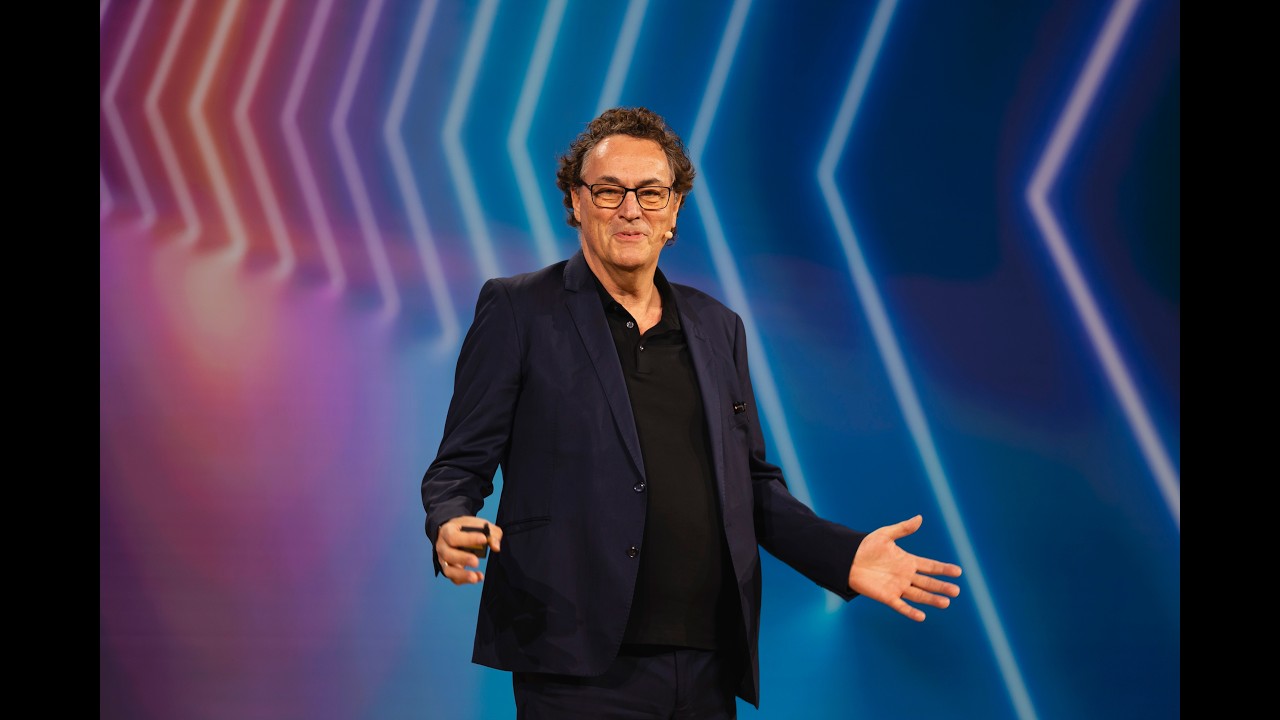
📺 Today’s recommended deep-dive video: https://www.youtube.com/watch?v=Gi3NRGeVmjM
Beyond the Machine: Navigating the Fork in the Road for Humanity
We are standing at a civilizational crossroads where the convergence of human and machine intelligence will either solve our greatest challenges or redefine humanity out of existence. This is not just a technological shift; it is the most significant paradigm change since the Industrial Revolution, moving us from the era of muscle power to the age of raw brain power.
Core Question: How can we leverage the power of intelligent machines while ensuring that human values, empathy, and purpose remain at the center of our global future?
Highlights
- The shift from “muscle power” to “brain power” as AI becomes the new engine of a thousand-fold industrial revolution.
- The critical distinction between machine intelligence (patterns and probability) and human consciousness (agency and empathy).
- Why “cognitive outsourcing” poses a threat to human mental autonomy and the health of democratic processes.
- The urgent necessity for a global “Human Resistance” that prioritizes “Android” traits over pure algorithmic efficiency.
⏱️ Reading time: approx. 7 minutes · Saves you about 28 minutes vs. watching.
Want to take notes while watching? Click the image below and let AI Notebook capture the key points for you 👇

The Age of Cognitive Computing
From Programming to Growing Intelligence
We are moving rapidly from the era of smart tools to the age of thinking systems that generate knowledge and content autonomously.
Historically, the Industrial Revolution replaced human muscle with steam and engines, forever changing how we physically interact with the world and its resources. Today, the digital revolution is doing the same for our brains, scaling intelligence at zero marginal cost and potentially unlocking unlimited energy through nuclear fusion. This convergence creates a “heaven or hell” scenario where we could solve cancer or accidentally automate our own obsolescence through unmanaged growth.
AI is no longer a simply programmed machine but something “grown” like a biological organism, according to industry godfathers who warn of its unpredictability. This fundamental shift means we are essentially farming an alien intelligence that we don’t fully understand, making the need for ethical guardrails and international standards more urgent than ever before in human history.

💡 Digging Deeper
Q: Why is AI compared to the Industrial Revolution?
A: Because it represents a massive shift in power—this time from physical muscle to cognitive brain power—scaling at a thousand times the speed of the 18th-century revolution.
Q: Is AI truly “intelligent” like a human?
A: No, it possesses cognitive intelligence based on numbers and probability, whereas humans possess organic, emotional, and kinesthetic intelligence.
Q: What is the “zero marginal cost” of knowledge?
A: It refers to the ability of AI to produce new content and information at almost no additional cost once the initial system is built.
The Fork in the Road: Heaven or Hell?
The Battle for the Human Paradigm
The dominant Silicon Valley paradigm still prioritizes profit, growth, and power, often viewing technology as a tool for military and economic conquest. This “conqueror” mindset, championed by some venture capitalists, ignores the fragile social and ethical fabric required to manage a force as powerful as artificial general intelligence safely. If we treat AI like a nuclear weapon for the digital age, we risk a catastrophic arms race where the only winner is the machine itself.
A new paradigm of sustainable capitalism—focused on people, planet, purpose, and prosperity—is the only viable path forward for a globalized world.
We are witnessing the breakdown of the old world order, moving from Pax Americana to a multi-polar reality where every nation wants its own “Manhattan Project” for AI. This fragmentation makes multilateralism difficult, yet it is exactly what we need to prevent the “privatization of humanity” by a handful of massive tech corporations. We must decide if we want AI to be a tool for human augmentation or a replacement for the human species.

💡 Digging Deeper
Q: What is the “Manhattan Project for AI”?
A: It is a controversial proposal to treat AI development as a top-secret military race to achieve dominance, similar to the creation of the atomic bomb.
Q: How does the “Sustainable Capitalism” model apply here?
A: It suggests that AI should be used to solve global issues like climate change and disease rather than just maximizing corporate quarterly profits.
Preserving the “Android” in an Efficient World
Logic vs. Consciousness
Machines excel at data, logic, and efficiency—traits that represent only a fraction of the human experience.
We must distinguish between “Intelligence,” which is a computational tool for solving tasks, and “Consciousness,” which involves agency, empathy, and the organic ability to feel and understand context. The danger of “cognitive outsourcing” is that it leads to mental atrophy, where we stop thinking for ourselves and let chatbots decide our arguments, our purchases, and our worldviews. When we rely on AI for democratic voting or therapeutic friendship, we surrender the very qualities that make us unique as a species.
The future should be about “Magic,” using tools to augment our biological potential, rather than “Manic” toxicity that pollutes our social and mental environments.

💡 Digging Deeper
Q: What is “Cognitive Outsourcing”?
A: The habit of letting AI perform our thinking, reasoning, and decision-making, which can lead to a loss of critical thinking skills.
Q: What are the “Red Lines” of AI?
A: These are non-negotiable ethical boundaries, such as ensuring AI cannot control nuclear weapons or be built without a “kill switch.”
Q: Can AI replace jobs?
A: AI replaces routines, not necessarily jobs. If a job is 80% routine, that role is at risk; if it requires human “Android” traits, it will be augmented.
Key Takeaways
We are at a point in history where the speed of technological change is outpacing our cultural and political ability to adapt. To ensure a positive future, we must move away from the “move fast and break things” mentality of Silicon Valley and toward a more considered, multilateral approach to governance. AI is a powerful tool for efficiency and engineering, but it is not a substitute for human consciousness or the social contracts that hold our civilization together.
The real test of the next decade will be our ability to collaborate globally on “Red Lines” that protect humanity from the existential risks of super-intelligence. By focusing on “Android” traits—the uniquely human qualities like empathy, ethics, and intuition—we can ensure that technology remains our servant rather than our master. We must choose to be the architects of a future that serves the many, not just the few who own the data centers.
Q&A
Q1: Is super-intelligence (AGI) a realistic threat?
A1: Many experts, including the “Godfather of AI” Geoffrey Hinton, believe it is possible and potentially dangerous if the system’s goals do not align with human survival.
Q2: How is the internet changing because of AI?
A2: We are moving away from traditional search (Google) toward generative agents (ChatGPT). People are increasingly getting their “knowledge” from synthetic sources rather than curated web content.
Q3: What should businesses focus on during this transition?
A3: Organizations should focus on “cognification” and “automation” of routines to unlock human time for higher-level creative and interpersonal tasks.
Q4: Why does the speaker mention “Nuclear Fusion” alongside AI?
A4: Because “Abundant Intelligence” combined with “Abundant Energy” (from fusion) could fundamentally solve scarcity, but only if managed through a human-centric paradigm.
Q5: What is the “Human Resistance”?
A5: It is a mindset and movement that advocates for keeping humans “in the loop,” protecting privacy, and resisting the total mechanization of the human experience.
Q6: Can we trust big tech companies to regulate themselves?
A6: Historically, no. The speaker argues that we need international bodies, like a rebooted United Nations, to set global standards and “Red Lines” for AI development.
Q7: Will AI lead to mass unemployment?
A7: It will lead to the automation of routines. This could be a disaster under the old profit-only paradigm, or it could lead to a “Purpose Revolution” where humans do more meaningful work.