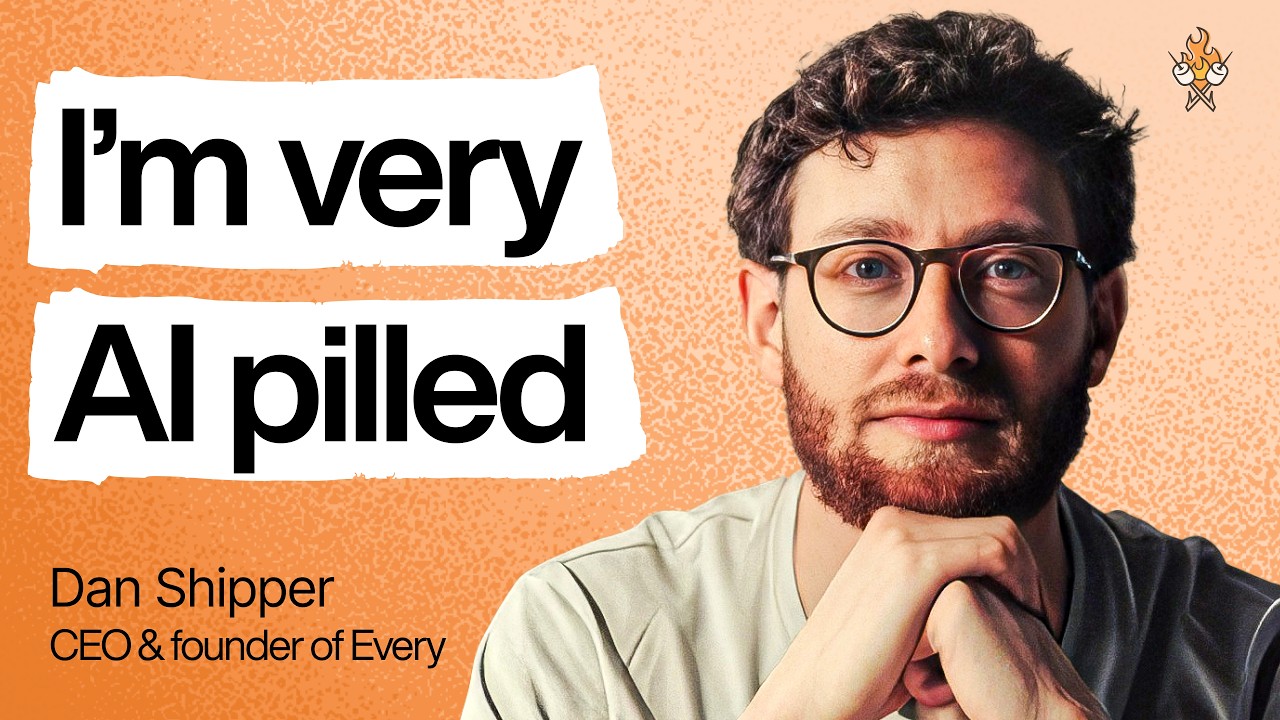
📺 Today’s recommended deep-dive video: https://www.youtube.com/watch?v=4D3hDmGhFhA
The AI Job Apocalypse is a Lie: Why Human-Led Agents are the Future of Work
Dan Shipper, CEO of Every, argues that the narrative of AI replacing humans is fundamentally flawed because every autonomous agent requires a “human gardener” to remain effective. Instead of a job apocalypse, we are entering an era where AI agents become the new desktop operating system, turning PMs and designers into super-powered individual contributors.
Core Question: How will the bifurcation of AI agents and the “ride the model” philosophy redefine professional roles over the next year?
Highlights
- The shift from CLI tools to “Co-work” environments where SaaS tools run inside the AI agent’s browser.
- Why Product Managers and Full-stack designers are the “dangerously” successful archetypes of the new economy.
- The “SaaS Apocalypse” debunked: why agents will actually increase SaaS consumption and save company margins.
- The Senior Engineer Benchmark: why GPT-5-level models still lack the “agency” to rewrite systems from first principles without human direction.
⏱️ Reading time: approx. 6 minutes · Saves you about 88 minutes vs. watching.
Want to take notes while watching? Click the image below and let AI Notebook capture the key points for you 👇

The Bifurcation of the AI Workspace
From Personal Daemons to the Company Super-Agent
Shipper predicts a massive shift in how agents are deployed within organizations. While the “personal agent” hype was high a year ago, the reality is that maintaining individual agents is “fiddly” and prone to breaking. The immediate future belongs to the “Super Agent”—a single, powerful entity (like Shopify’s River or Ramp’s internal tools) that serves the entire company, managed by a dedicated team.
This setup ensures the agent remains useful because it has a human who cares about its performance.
We are seeing a transition where work happens in two distinct modes. First, there is the asynchronous delegation in Slack, where you offload data requests or errands to the company super-agent. Second, and perhaps more profound, is the emergence of the desktop agent as your primary work surface.
In this second mode, you aren’t just chatting with a bot; you are working inside an environment like Codex or Claude Co-work. These tools now feature in-app browsers, allowing the AI to watch you work in real-time, conduct research, and even handle your “computer errands” like clearing out a decade of unread emails or drafting complex legal reports while you monologue your intentions.

💡 Digging Deeper
Q: What is the “Reach Test” for new AI tools?
A: It is the organic, subconscious habit of reaching for a specific tool the moment you wake up or start a task, proving it has moved from a novelty to a necessity.
Q: Why are CLIs considered “over” for the general workforce?
A: While the CLI era was a necessary speed-run for technical development, GUIs were invented for a reason; humans and agents collaborate more effectively in visual interfaces that provide visibility and logs.
Q: How does the “Agent-as-OS” model change SaaS?
A: Instead of AI being baked into SaaS, SaaS tools will run inside the user’s agent, allowing the user to bring their own tokens and custom context to every application they use.
The Rise of the AI-Pilled Generalist
Why PMs and Designers are Thriving
The most contrarian take in this discussion is the overwhelming bullishness on Product Managers and designers. Historically, these roles were often bottlenecked by engineering capacity, but AI has inverted that dynamic. A “lightly technical” PM who is “AI-pilled” can now ship code faster than traditional teams by using models to handle the execution while they focus on product sense.
This creates a “dangerously” effective individual contributor who can envision, build, and iterate without a massive overhead.
Full-stack designers are seeing a similar empowerment. Previously, a designer’s vision might be diluted by the “slop” of quick engineering or the limitations of a frontend developer. Now, designers are making pull requests directly, ensuring their creative interactions are preserved exactly as intended.
The “Job Apocalypse” is largely a rebranding of organizational restructuring and over-hiring.
Automation is, in many ways, a lie because it simply shifts the nature of the work. As models make “yesterday’s competence” cheap and commoditized, humans move up the stack to define new problems and manage the systems that solve the old ones.

The “Senior Engineer” Benchmark and SaaS Stocks
Why Models Still Lack Agency
Despite the exponential rise in model benchmarks, Shipper’s internal “Senior Engineer Benchmark” reveals a critical gap. Most models can patch bugs, but they lack the “confidence” to tell a user that their code is “slop” and needs a first-principles rewrite. Humans are still required to provide the “higher frame” of thinking that a benchmark cannot measure.
GPT-5-level models are hitting high scores on tasks that can be articulated and scored, but the act of knowing what to prompt remains a human monopoly.
This leads to a surprising recommendation: buy SaaS stocks. While many fear an AI-driven “SaaS Apocalypse,” the reality is that agents increase the number of “users” for these tools. Every agent needs an API or a GUI to interact with, and as agents proliferate, the volume of SaaS interactions—and therefore the value of the underlying infrastructure—will skyrocket.

💡 Digging Deeper
Q: What is a “Forward Deployed Engineer” in the AI context?
A: This is a role dedicated to managing, gardening, and building the internal systems that allow non-technical staff to use AI agents without breaking the company’s core infrastructure.
Q: How should SaaS companies prepare for an agent-led world?
A: They should optimize their HTML for agent readability and build CLIs that sync perfectly with their GUIs, allowing humans and agents to collaborate on the same piece of work simultaneously.
Q: Is AI-generated writing becoming acceptable in a professional setting?
A: Yes, provided the sender “stands behind every line.” AI-generated strategy documents and emails are becoming the standard for internal operations because the bar for human writing was already remarkably low.
Key Takeaways
The overarching philosophy for surviving the next year is to “ride the model.” This means refusing to ignore new model drops out of fear and instead treating every new release as a “new discovery” of powers. By playing with these tools and “turning over rocks” to see what they can do now that they couldn’t do last month, professionals ensure they are part of the future rather than a casualty of it.
Work is becoming less about the individual sentences we write or the specific lines of code we commit, and more about the “vibe” and “direction” we provide to the agents doing the heavy lifting.
The successful worker of 2027 will be a “Model Manager” who views AI not as a replacement, but as a daemon on their shoulder. Whether you are a CEO or a PM, your company’s progress will be limited only by your personal willingness to get your hands dirty with the latest models.
Q&A
Q1: Is the CLI making a comeback for non-technical users?
A: No. While it was a popular initial interface for tools like Claude Code, we are rapidly moving back to GUIs because they offer better visibility and collaboration for both humans and agents.
Q2: Will AI agents eventually fire all the engineers?
A: No. If anything, demand for high-level engineers will grow. We need them to manage the massive influx of “slop” and ensure that the thousands of pull requests generated by agents are architecturally sound.
Q3: What role is the “least changed” by AI so far?
A: Sales. While AI helps with sourcing and research, the core of sales remains deeply personal and human-to-human, though this may change as agents start handling more “BDR” type queries.
Q4: Should I label my AI-generated emails?
A: It’s a personal choice, but as long as the content is accurate and you stand behind it, the aversion to AI writing is fading. The value is in the thought and the “ask,” not the prose.
Q5: Why is Every (Dan’s company) hiring more people if they are so AI-forward?
A: Because AI doesn’t reduce the amount of work; it increases the capacity for it. They doubled in size because they found that more AI required more humans to manage the creative and strategic frontiers.
Q6: What is “Vibe Coding”?
A: It is the practice of building functional software by describing requirements to an agent like Codex or Cursor without manually writing or even fully understanding the underlying code.
Q7: Who has the “Mandate of Heaven” in the AI race right now?
A: After a brief period where Anthropic led with Claude 3.5, OpenAI has largely regained the lead with their latest desktop app and Codex integrations.