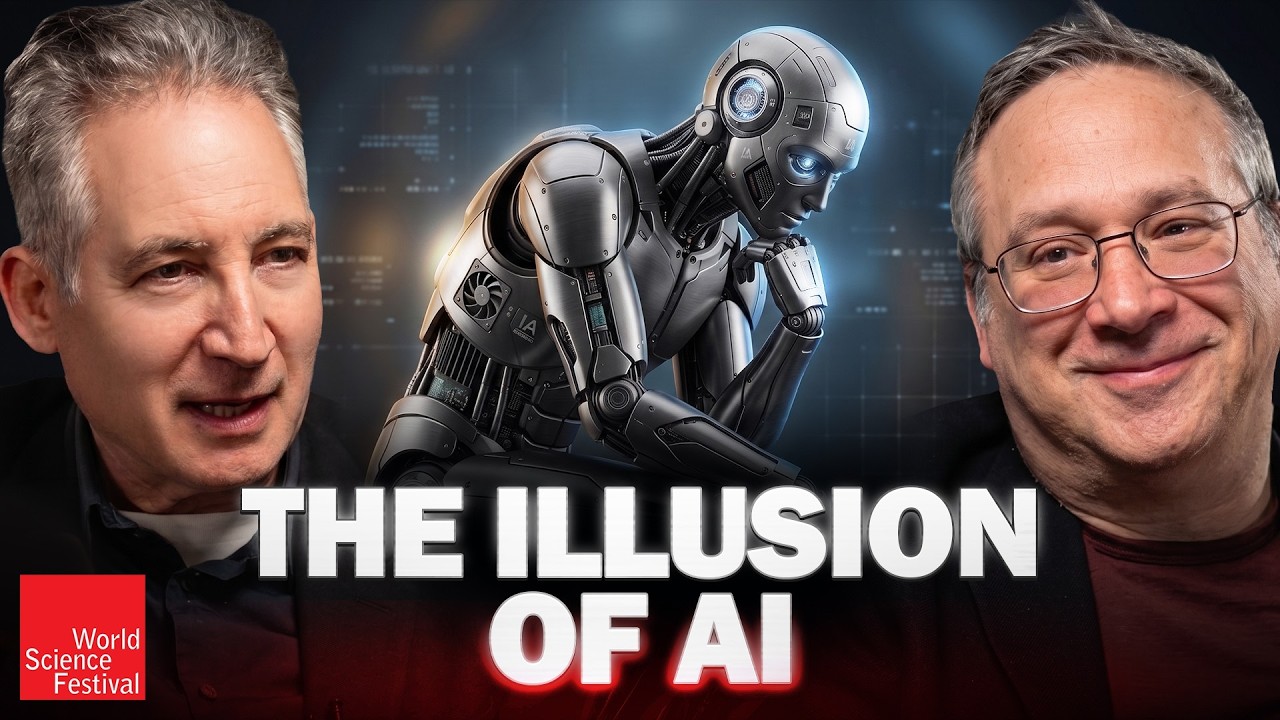
📺 Today’s recommended deep-dive video: https://www.youtube.com/watch?v=iFYF_e1GSGI
Beyond the Hype: Why Scaling Won’t Deliver AGI
As billions of dollars pour into massive data centers, AI critic Gary Marcus argues that we are rapidly hitting a wall with current technology. In this deep dive, he explains why statistical machines lack the fundamental “world models” necessary for true human-level intelligence and what we must change to move forward.
Core Question: Can pure neural networks eventually achieve human-level reasoning, or is a fundamental shift toward neurosymbolic logic required to reach Artificial General Intelligence?
Highlights
- The “ELIZA effect” causes humans to attribute agency and consciousness to machines that are merely performing sophisticated word prediction.
- Large Language Models (LLMs) excel at interpolation within their training data but fail at extrapolation and abstract reasoning.
- The most significant current AI risks are not sentient “Skynets,” but rather accidental nuclear war triggered by unreliable systems and misinformation.
- True AGI requires “world models”—the ability to induce the rules of a new environment from limited observation rather than just data scraping.
⏱️ Reading time: approx. 12 minutes · Saves you about 74 minutes vs. watching.
Want to take notes while watching? Click the image below and let AI Notebook capture the key points for you 👇

The Illusion of Scaling and the AGI Asymptote
Why More Data Isn’t a Silver Bullet
Gary Marcus argues that the field of artificial intelligence is currently hitting an asymptote where adding more compute and data no longer yields proportional breakthroughs. While the industry sells a narrative of exponential growth to maintain investor confidence, the technical reality is that progress is increasingly reliant on “harnessing” these models with classical symbolic tools.
The dirty secret of the current AI boom is that most of these companies are losing staggering amounts of money while playing a high-stakes game of double-or-nothing.
If you double the weight of a baby in its first month, it would be a mistake to extrapolate that the child will weigh a trillion pounds by the time it reaches college. This naive extrapolation defines much of the current hype, where people assume that because a model can mimic a drunken sailor’s poetry, it is on a direct path to General Intelligence. The models are building an approximation of how people use words, which is a far cry from understanding the underlying logic of the world those words describe.

💡 Digging Deeper
Q: Why did Watson win Jeopardy if it didn’t “understand” the questions?
A: 99% of Jeopardy answers are actually titles of Wikipedia pages; Watson was an incredible piece of engineering designed to find the nearest Wikipedia page rather than perform deep linguistic inference.
Q: What is the ELIZA effect?
A: It is a psychological phenomenon where humans attribute human-like intelligence and agency to a computer program based on a small sample of seemingly skilled performance, even when the underlying mechanism is simple.
The Technical Wall: Interpolation vs. Extrapolation
The Failure of Abstract Reasoning
The fundamental limitation of current neural networks lies in their inability to generalize “out of distribution.” While these systems can memorize a vast training set and generalize within that “cloud of points,” they break down the moment they are asked to perform an operation outside that specific statistical space. Marcus demonstrates this through simple identity functions; if you train a model on odd numbers, it often fails to apply the same logic to even numbers because it lacks a true abstract rule.
Human children can learn the rules of a new game or a recursive algorithm and apply it to infinity, whereas AI systems often fail when a problem increases in scale by just one step.
In a recent study by Apple researchers, they found that “reasoning” models could solve the Tower of Hanoi puzzle with seven pegs but completely collapsed when an eighth peg was added. This suggests that the model hadn’t learned the recursive logic of the puzzle, but had instead memorized specific configurations from its training data. Because these systems are driven by similarity rather than formal logic, they remain stuck in a loop of “good guesses” rather than reliable, verifiable reasoning.

💡 Digging Deeper
Q: Can LLMs play chess?
A: Only to a point; they frequently make illegal moves because they haven’t induced the rules of the game; they are merely predicting the next likely move based on a database of millions of games.
Q: Why do LLMs hallucinate?
A: They are statistical approximators designed to provide a plausible-sounding answer; they don’t have a mechanism to verify facts against a stable world model or a database like Wikipedia.
The Neurosymbolic Path Forward
Marriage of Fast and Slow Thinking
To overcome the current limitations, Marcus advocates for “Neurosymbolic AI,” an approach that combines the pattern recognition strengths of neural networks with the formal logic and rule-following of symbolic AI. This mirrors Daniel Kahneman’s “System 1 and System 2” framework, where System 1 is fast and reflexive (neural nets), and System 2 is deliberative and logical (symbols). We need machines that don’t just guess the next word but understand the causal relationships between objects.
We are currently tying one hand behind our back by refusing to build innate knowledge into our machines.
Current AI developers are essentially creating “principled nativism” in a messy way by hard-coding specific subroutines for math or coding into the model’s harness. Marcus argues we should instead follow the lead of developmental psychologists like Elizabeth Spelke, who suggests that humans are born with a “core cognition” of objects, sets, and places. By building these fundamental abstractions into AI from the start, we could create systems that learn from data much more efficiently and reliably than the current “blank slate” approach.

💡 Digging Deeper
Q: What is a “World Model”?
A: It is an internal representation of how an environment works, allowing an agent to make inferences about what is possible (e.g., in Harry Potter, you can fly on a broomstick, but in the real world, you cannot).
Q: Is AI displacement of jobs imminent?
A: In the short term, AI replaces tasks, not entire jobs; the “radiologist replacement” predicted years ago has yet to happen because human jobs require complex, multi-domain reliability that AI currently lacks.
Risks, Utopia, and the Future of Meaning
From Accidental War to Abundance
The most pressing danger of AI is not a sentient robot uprising, but rather the delegation of critical power—like military targeting or power grid management—to unreliable, statistical systems. Marcus fears that “stupid” AI could trigger an accidental nuclear conflict through misinformation or mistargeting. However, if managed wisely, the long-term potential of AI could lead to a post-scarcity “gift economy” where food and energy are essentially infinite, similar to the temporary society of Burning Man.
In a world of total abundance, humans will have to find meaning through art, music, and community rather than through paid employment.
Marcus himself practiced this philosophy by learning the guitar at age 40, a journey he documented in his book Guitar Zero. He argues that while AI may eventually replicate 99% of human creativity, the act of learning and improvising remains a deeply satisfying human pursuit that no machine can replace. The challenge for humanity will be navigating the transition from a labor-based economy to one centered on personal growth and wisdom without succumbing to the dark side of digital addiction or extreme wealth concentration.

Key Takeaways
The current AI trajectory is characterized by a “gullibility gap.” Because LLMs are so adept at style transfer—mimicking the tone of a scientist or a poet—we assume they possess the underlying cognitive depth associated with those roles. However, Marcus emphasizes that these systems lack “truth” and “agency,” acting instead as sophisticated mirrors of their training data. Until we integrate formal symbolic logic and world models, we will remain stuck with “stochastic parrots” that can write code but cannot understand the physics of a bicycle.
Looking forward, the shift to neurosymbolic AI represents the most plausible path to AGI. This requires moving away from the empiricist bias that “everything can be learned from data” and embracing the nativist reality that some degree of structure must be built-in. If we can bridge this gap, we may reach a century of unprecedented medical and material abundance.
Finally, the displacement of labor is an eventual certainty, even if it is not a 2020s reality. We must begin thinking about political and social structures that distribute AI-generated wealth fairly. Whether we land in a utopia of creative freedom or a dystopia of accidental conflict depends less on the speed of our processors and more on the wisdom of our policies.
Q&A
Q1: Do you think LLMs have any degree of consciousness?
A1: Absolutely not. Marcus views this claim as “ludicrous,” arguing that an LLM saying it is “anxious” is simply mimicking human text rather than experiencing emotional content.
Q2: Will scaling compute eventually lead to AGI?
A2: No. Marcus believes we have already reached a point of diminishing returns where pure scaling fails to produce the abstract reasoning and out-of-distribution generalization required for AGI.
Q3: What is the most impressive AI tool Marcus has seen recently?
A3: He cited “Claude Code” as impressive because it utilizes a neurosymbolic harness around the LLM, allowing it to perform more reliable, rule-based operations.
Q4: How should we view AI’s “creativity”?
A4: Most AI creativity is sophisticated recombination of existing training data. While this is useful for marketing or captions, it rarely reaches the “outside-the-box” novelty of a genius like Einstein or Dylan.
Q5: What is the biggest existential risk from AI today?
A5: Accidental nuclear war. This could be triggered by misinformation, style-transferred fake news, or the failure of an unreliable AI system used in a military context.
Q6: Is it too late for an adult to learn a new skill like an instrument?
A6: Not at all. Marcus learned guitar at 40 and notes that while you may not become a world-class virtuoso, the process of learning and improvising is highly achievable and satisfying at any age.
Q7: How does the “subroutine library” of the human genome relate to AI?
A7: The human genome acts like a library of complex subroutines (like building a hemisphere) evolved over millions of years. Current AI evolution attempts are too low-level, evolving individual “neurons” rather than high-level algorithmic structures.